What Are AI Influencers? A Guide to Virtual Creators
AI influencers abound on social media. Clutch explains what they are, why brands partner with them, and whether people can tell them apart from human...
Updated July 23, 2026

AI-driven cyberthreats are growing at breakneck speed. Unfortunately, many companies have been slow to adjust their strategies, putting their data (and their business) at risk. Learn why some are leaning on AI for threat detection and why you should too.
Cyberthreats keep growing in volume and sophistication, challenging modern IT environments. Businesses face relentless attacks that risk compromising data security.
Clutch surveyed 250 IT professionals to understand data security challenges and how they’re adjusting their strategies. These IT professionals reported that some of the most common challenges for data security include the increased volume of data (39%), the increased attack surface (25%), as well as insufficient monitoring and detection tools (25%).
Looking for a Artificial Intelligence agency?
Compare our list of top Artificial Intelligence companies near you
With these challenges in mind, many IT professionals struggle to keep up. Without the right tools in place, cybersecurity teams have to spend hours sifting through data, often missing threats.
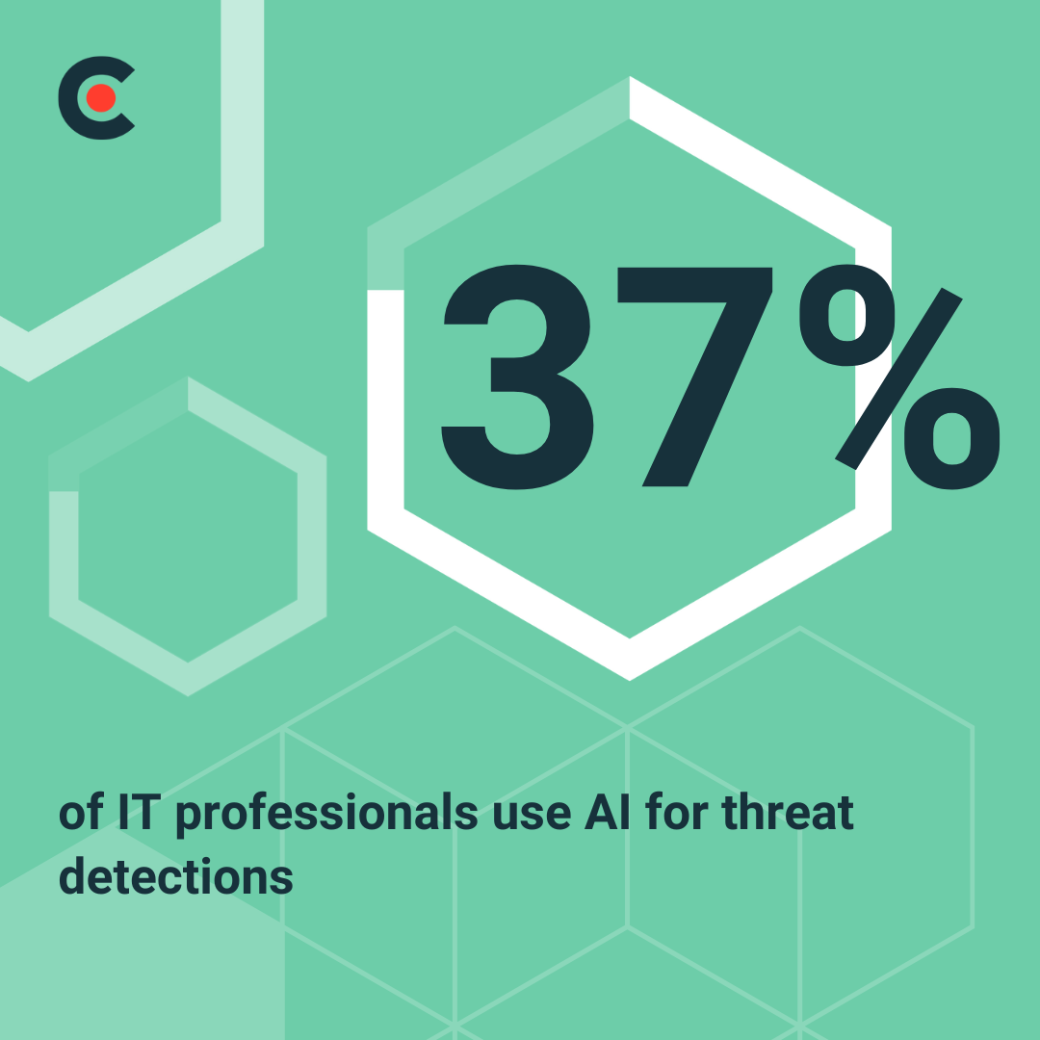
Artificial intelligence (AI) offers a potential solution — through automation, IT teams can scale their work and detect cyberthreats more effectively. However, only 37% of respondents reported using AI for threat detection.
That’s a missed opportunity.
Learn how to use AI to strengthen your data security. From behavioral analysis to real-time threat identification, AI is changing the cybersecurity sector.
Traditional cybersecurity methods don’t match up against modern threats — malware adapts quickly and bypasses predefined patterns, while phishing attacks are growing more convincing, exploiting human error, and manual analysis cannot handle the data influx. Ultimately, human analysts drown in alerts and risk missing subtle anomalies. False positives waste time. False negatives, on the other hand, leave gaps.
AI threat detection changes the game. Machine learning (ML) algorithms analyze vast datasets swiftly and identify patterns humans overlook.
In fact, AI is able to adapt to new threats (without constant updates) by processing network traffic and user behavior in real time.
Unlike rigid systems, AI learns continuously, improving accuracy. For instance, ML models detect zero-day exploits by spotting unusual activity. Deep learning improves phishing detection by analyzing email metadata. AI also reduces human workload, which frees teams to focus on strategic tasks. This approach strengthens defenses and makes AI indispensable for modern cybersecurity.
Today, companies use AI threat detection in various ways to secure their IT environments. From analyzing user behavior to automating responses, AI addresses complex threats and stands out in processing massive datasets.
Simply put, AI can identify risks that traditional tools miss. The following strategies detail how businesses can apply AI for threat detection. Each method improves security, allowing you to protect company data.
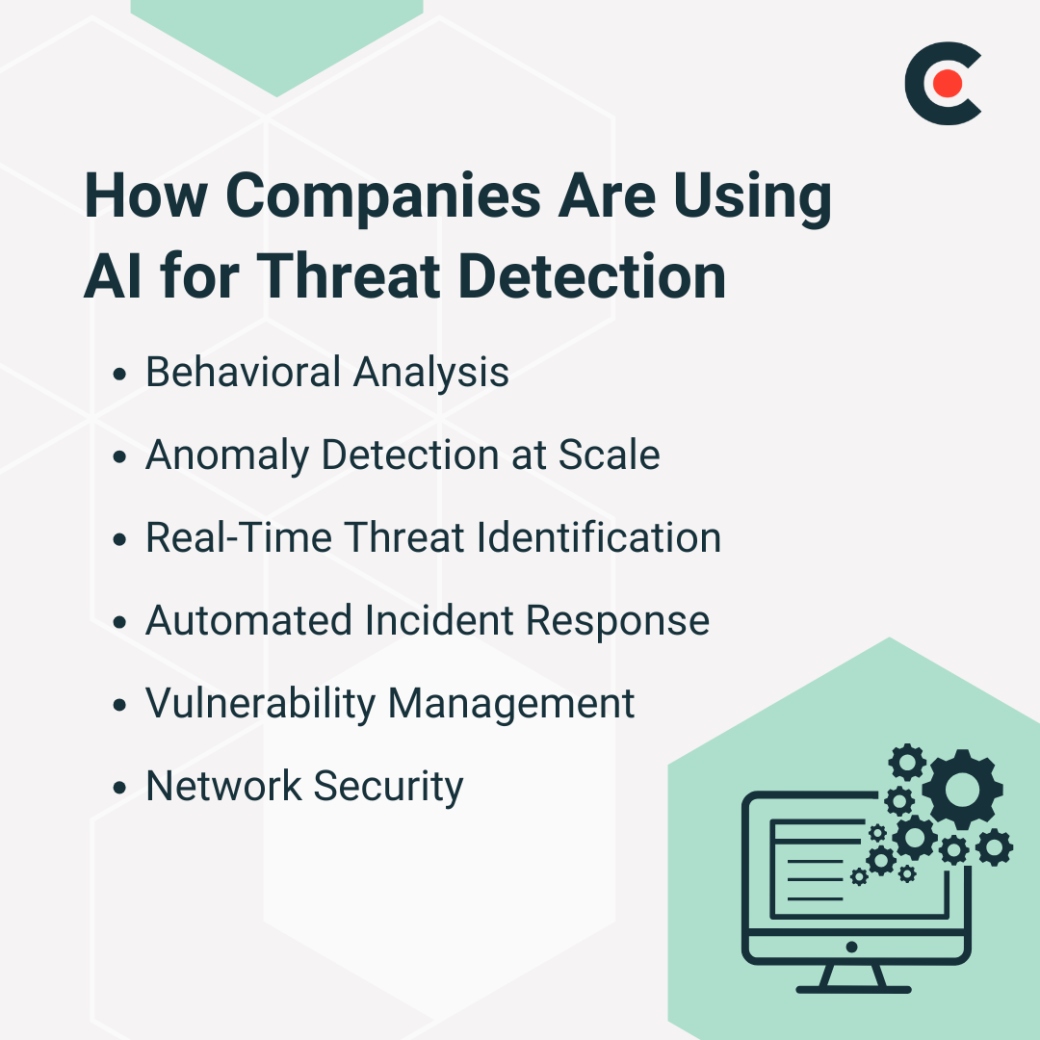
AI tools can build profiles of typical user behavior. They establish baseline behaviors for users and devices, monitor these patterns, and spot deviations signaling threats. For instance, an employee accessing sensitive files at odd hours can trigger alerts.
ML models analyze login times and file access. They can also review data transfers. These models detect insider threats and compromised accounts.
Unlike traditional systems, AI adapts to user habits. It distinguishes legitimate changes from malicious ones. This precision reduces false alarms and saves time significantly. Companies benefit from proactive monitoring — by catching threats early, they reduce the risk of hacks that could leak sensitive company data.
Anomaly detection at scale is AI’s strong suit. Cyberthreats hide in massive datasets. Manual analysis cannot process terabytes of logs daily, but AI threat detection sifts through this data effortlessly. It identifies irregularities across networks and applications.
AI tools learn what normal looks like and highlight anomalies. For instance, a sudden spike in outbound traffic may indicate data exfiltration.
AI takes note of such anomalies and flags risks before they escalate. These systems work across on-premises and cloud environments.
ML algorithms compare real-time activity to historical norms. They flag subtle anomalies, such as unusual application programming interface (API) calls. AI scales to handle growing data volumes, making sure no threat goes unnoticed. This capability allows businesses to protect complex IT environments.
Speed is everything in cybersecurity. The longer a threat goes undetected, the more damage it can cause.
Ransomware can encrypt data in minutes. Traditional systems lag, relying on periodic scans. AI threat detection operates instantly. It monitors network traffic and system events continuously.
ML models detect malicious patterns as they emerge. For instance, AI identifies phishing emails by analyzing sender details and content. It flags suspicious processes before they execute. This speed minimizes damage, stopping threats at the source.
Companies gain an edge and respond before breaches escalate. This immediate response helps reduce the time between detection and action. The sooner you act, the smaller the impact. This speed also limits how far threats can spread inside your network.
AI can do more than just flag issues. It can respond to them automatically. Automated incident response improves AI threat detection.
When threats arise, speed matters. Manual responses delay mitigation and risk damage. AI automates actions such as isolating infected devices. It adjusts firewall rules or blocks malicious devices instantly.
For instance, detecting a brute-force attack triggers automatic account lockouts. ML allows responses to match threat severity.
Automation reduces human error and response time. It can also free up security teams. They can then focus on more complex issues.
Consider solutions that offer security orchestration, automation, and response (SOAR) capabilities. These often integrate with AI-powered detection.
Identifying and addressing software vulnerabilities is necessary for any business. Attackers often exploit these weaknesses.
Traditional vulnerability scanning can be periodic. AI can improve vulnerability management. It continuously monitors systems for known vulnerabilities. It can also predict potential future weaknesses.
AI identifies risks proactively by analyzing code and system configurations. For instance, it can flag outdated software versions. It might also identify misconfigurations that create security loopholes.
AI threat detection in vulnerability management helps prioritize remediation efforts. It focuses on the most serious weaknesses first and scans devices and systems for flaws. This reduces the attack surface and strengthens overall security, helping your team prioritize patches and updates.
Regular vulnerability assessments are necessary to prevent breaches instead of just reacting to them. Companies save resources by focusing on high-risk areas.
Networks carry everything. However, they face constant threats, including distributed denial-of-service (DDoS) attacks and malware. They are often the entry point for attacks. If compromised, the damage can spread quickly.
AI assesses network traffic patterns. It detects anomalies that might indicate intrusions. AI can also identify malicious actors based on their network behavior. For instance, AI threat detection tools may flag unusual outbound connections from internal devices. They may also detect attempts to scan the network for open ports.
AI threat detection in network security provides an extra layer of defense. It complements traditional firewall and intrusion detection systems. AI's ability to learn and adapt to new threats is priceless.
Consider AI-powered network monitoring tools. They offer better visibility and threat detection.
AI threat detection offers unmatched speed and accuracy. It transforms cybersecurity and addresses the limitations of traditional methods. But implementing
AI requires a tactical approach. You must assess your environment and choose tools that integrate models effectively.
Testing with existing processes gives you a head start. The following steps guide developers and designers in implementing AI-driven security to handle threats.
Before implementing AI for threat detection, understand where you stand. Review your current setup. Identify gaps and high-risk areas that can lead to catastrophic damage. This could include unpatched software and exposed endpoints.
Review past security incidents to determine your specific security needs. For instance, outdated web servers may put your systems at risk for attacks.
Ask yourself why you are facing increasing phishing attacks. Is insider threat a major concern? Understanding your weaknesses will steer your AI implementation. Focus on areas where AI can provide the most value. This assessment is necessary for targeted implementation, making sure that AI deployment addresses your specific challenges.
Also, consider a security audit. This can reveal vulnerabilities and inform your AI strategy.
Many commercial platforms offer AI threat detection services, including CrowdStrike, Darktrace, and SentinelOne. These platforms integrate various AI and ML techniques. For instance, CrowdStrike uses ML for endpoint protection, while Darktrace is good at network anomaly detection, and SentinelOne automates threat response. For vulnerability management specifically, platforms like Aikido Security apply similar AI-assisted prioritization to code, dependencies, and containers, helping teams focus remediation on the most exploitable risks first.
Consider your specific needs and budget, keeping in mind that open-source options also exist. These may require more technical expertise to implement and maintain, but may be better for your specific needs.
You should also think about detection accuracy, scalability, ease of integration, and vendor support when looking to implement new tools.
Request demos and pilot programs from cybersecurity service providers. This allows you to test the tools in your environment. Choose vendors with a proven track record in AI threat detection. Don’t forget to check out their reviews.
You might decide to build custom AI models, which requires the support of either internal or external data science experts. Alternatively, you can integrate pre-trained models from vendors. Either way, your models need training.
Training AI models requires historical security data. Make sure the data you use for training is relevant and representative.
Explainability and auditability also matter. Security teams need to understand why an AI model makes particular decisions or triggers alerts. This helps auditing and troubleshooting false positives or negatives.
AI threat detection models should be transparent to build trust in their outputs. Consider the long-term maintenance and updating of AI models. Remember, threats evolve every day, so your models must be able to adapt.
Testing and tuning AI models prevent errors. While false positives overwhelm teams and can lead to alert fatigue, false negatives can also miss threats.
To combat this, you can use test datasets to simulate attacks. You can also mimic phishing attempts or malware injections to check how your AI tool handles threat detection. Measure model performance against known threats and adjust thresholds to balance sensitivity.
Implement continuous learning for adaptability. Feedback loops refine models to adapt to new attack patterns over time. Regular testing allows AI threat detection to remain accurate. The goal is to reduce noise and improve precision. That’s how you keep trust in AI tools.
AI threat detection generates alerts that need to be integrated with your incident response processes. Consider using SOAR (security orchestration, automation, and response) platforms to automate responses to AI-driven alerts. For instance, an alert about unauthorized access could trigger automated quarantine and notification.
Don’t cut out human input. Implement a human-in-the-loop decision-making process for serious alerts. Even though AI can provide useful insights, security analysts should validate and authorize actions. This requires clear communication channels between AI systems and security teams.
Also, make sure you define roles and responsibilities for handling AI-generated incidents. It balances automation with expert judgment.
Darktrace is a leading name in real-time threat detection. Its Enterprise Immune System uses ML to monitor networks, building a pattern of life for every user and device. When behavior changes, it responds. This could mean stopping a device from connecting to others or isolating it entirely.
Many companies use Darktrace to detect threats early. Take NKGSB Bank, for instance. After deploying Darktrace, the company reduced incident response times by 92%, containing malicious activity within seconds.
Other companies report similar wins, with faster detection and fewer disruptions. Darktrace's approach demonstrates how useful behavioral analysis and anomaly detection can be.
Cyberthreats aren’t slowing down — they’re getting smarter and harder to detect.
Traditional tools alone can’t keep up. AI threat detection gives you the speed and insight to flag odd behavior and automate responses. This means less downtime and fewer surprises.
Start with your current setup and find the gaps. Then choose tools that fit your needs and scale with your growth.
Platforms such as Darktrace, SentinelOne, and CrowdStrike help implement AI for threat detection. They give your team more time to focus on what matters.
Looking to find the top cybersecurity service providers for your needs? Browse trusted experts in cybersecurity to compare your options.