
Software Development Metrics That Matter to Business Leaders (With Examples)
Tracking and reporting key metrics is paramount to ensuring the success of your software development project. Understand these benchmarks to improve...
Updated January 2, 2025

A software development team is comprised of product managers, designers, developers, and project managers. Learn more about their roles, the team structure, and how to hire each professional.
Updated March 13, 2023
Software development teams are involved in everything from UI/UX design, to product development, testing, quality assurance, and more. With so many different skillsets needed to bring a project from a concept to launch, companies need to make sure that they find a software development team structure that can meet all of their needs.
Looking for a Software Development agency?
Compare our list of top Software Development companies near you
Whether you’re outsourcing to a development company, working with a hybrid team, or are building an internal development team, you need to build a team that complete the development lifecycle.
In order to deliver a final product that meets project requirements, software development team structure usually includes team members that can fulfill these four key roles:
This article explains what each person on the development team is responsible for, the traits to look for when hiring these development experts, and what questions to ask potential candidates.
Planning to outsource your software development needs? Search for top software development companies on Clutch. Then filter by location, price, and client ratings to find the perfect partner for your project.
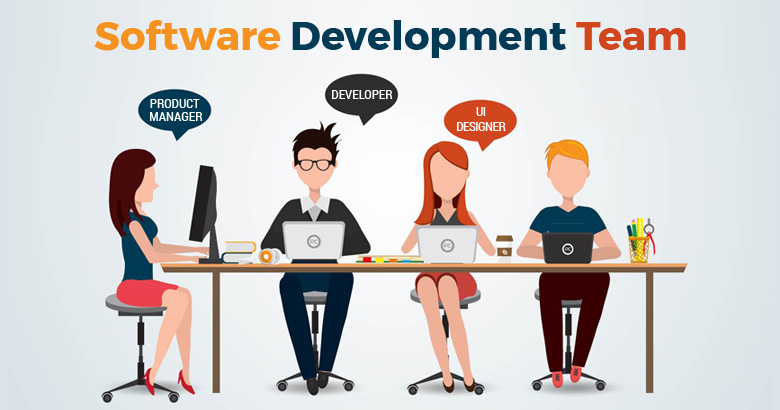
The product manager is arguably the most important role in the entire team. He or she is responsible for:
For a startup, the co-founder can play the role of a product manager in the early stages, guiding and communicating with both sales and marketing to come up with a clear vision of the product.
The right product manager is successful at the following.
The product manager spends time in the market, finding out what problems the product should solve, catching up with industry insights, and determining the best go-to-market strategy of the product.
Product managers are commonly known as the "CEOs of the product", as coined by Ben Horowitz in his book, “Good Product Manager/Bad Product Manager.”
They steer the vision, strategize, and clearly communicate to the team the value the product brings to the customer and exactly why the team should build it.
Because the product manager is constantly catching up with the industry and listening to customer feedback, he or she should always be coming up with ways to improve the product and how it can further serve customers.
Product managers constantly communicate with customers and the team about how their ideas can be implemented and which to prioritize.
Great product managers must be able to argue with or against their teams with evidence from customer feedback to back up their claims.
Once they generate ideas, product managers need to prioritize and plan the features need to be built first. This will be based on the strategic goals the product manager sets for the product and the value that they will deliver to the customer.
Product managers also define the requirements of a product's features, design their wireframes, and work with the engineering team to make sure they have all the information necessary to build the software.
It is the role of the product manager to set and execute the product’s release. Product managers, therefore, have to coordinate with all other functions within the company – sales, PR, marketing, and customer support – to ensure that they come up with a great way to take the product to market.
They also need to stay in touch with the engineering team to ensure all features are developed in time.
Since product management is a multi-faceted role, there are key traits that indicate whether someone is a great product manager.
The role of product management, as mentioned above, requires a lot of other skill sets, and with that constantly comes challenges when it comes to developing and launching a product.
Therefore, product leaders have to be able to demonstrate how they can quickly solve such problems or how they have done so in the past.
The core of the product management role is bringing different skill sets together and enabling them to work together toward a common goal.
Regardless of how much technical experience, industry expertise, or product knowledge a potential product manager has, if they lack great communication and interpersonal skills, they probably won’t be the best people for the role.
Determine the experiences product managers have encountered where they had to empathize with a customer and deliver a product/service that met a customer's needs.
A product manager has to look at the product from a user standpoint and generate ideas and plans for the product that will meet the user’s goals.
A great product manager is one who is a firm believer in what the product is intended to do and is always curious to find out how it can be further improved.
Product managers must have a deep thirst for knowledge and understanding because this will eventually translate into them generating even more ideas on how to improve the product.
A great example would be Steve Jobs or Elon Musk, both visionaries who were extremely passionate about their products, which was apparent in how they communicated about their products.
These types of leaders have a deep desire to learn more and make sure they are always innovative and ahead of the curve.
Great product managers always know that a product can fail for several reasons, and it is how they learn from failure and make changes that will ultimately determine their success in the role.
If they cannot handle the first exposure to failure, then they are not fit for the level of uncertainty the role can potentially carry.
These questions will help you find the right fit when interviewing product manager candidates:
The product manager is the most important part of the development team, but more team members are necessary.
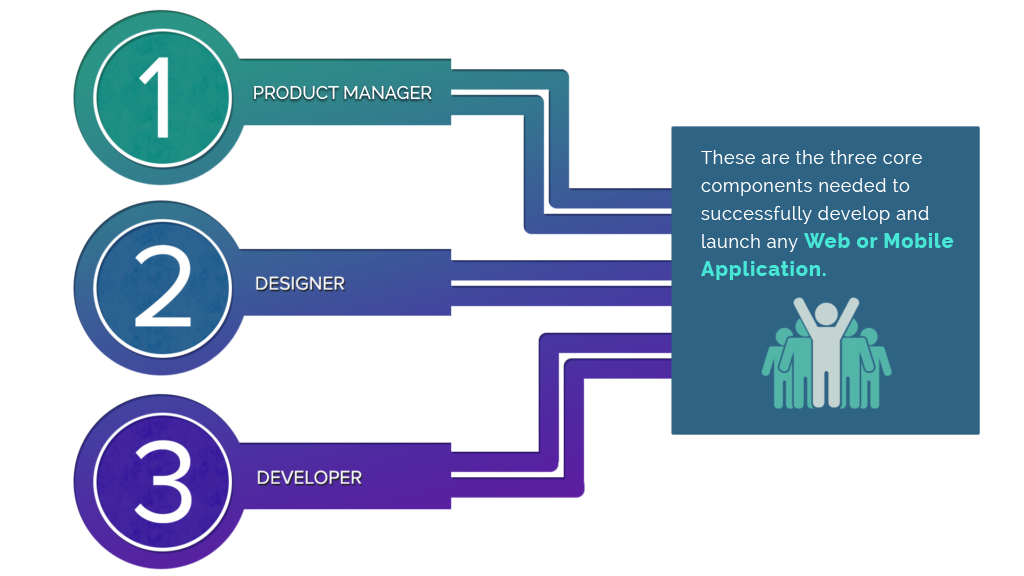
Now that you have obtained the product manager, you have developed the core of the team, and the rest of the pieces of the puzzle are easier to fill.
Developers are the ones who actually write and launch the code of the software or application. Depending on what your particular project requires, it is typically better to hire specialized resources for that particular technology.
Many development teams include both front-end developers and back-end developers, but full-stack developers are increasingly common, as they help the company save on costs since it doesn’t have to hire multiple developers. By hiring full-stack developers, the company can use the same developer no matter what platform its application is built on.
After you have identified that the developer has the technical experience you are looking for, the following features will help you identify if your candidate will be a “great” developer:
These questions will help you find the right fit when interviewing developer candidates:
A standard development team needs a UI designer to design the pages with which users interact.
UI designers:
Great UI designers must be knowledgeable of user interface trends and the best application for a particular product.
These questions will help you find the right fit when interviewing designer candidates:
The project manager is focused on bringing the product to life, the tasks involved, staying within budget, resources allocation, and deadlines.
For smaller-sized teams that can easily be managed, the team might not necessarily need a project manager, although he or she can play a crucial role in the entire project.
After you have hired these 4 employees, you have your new development team. You can later expand to bring in even more team members, such as business analysts, testers, scrum masters, and build engineers.
But this initial team should help get your product off the ground while seamlessly iterating as you get more user feedback.
To get the most out of your development team:
When you find the right development team, your product can go far.
Chris Peter Kimera is the Founder of Techtiq, a mobile and web development company in London. Techtiq is a team of talented mobile app developers, web designers and web developers in London that work together to build game-changing digital experiences.
See full profile