
What Are AI Influencers? A Guide to Virtual Creators
AI influencers abound on social media. Clutch explains what they are, why brands partner with them, and whether people can tell them apart from human...
Updated May 25, 2026

AI-powered tools offer more automation and customization options for SaaS, providing better predictive analytics and personalized user experiences. While this improves client productivity, the variable costs of these options for providers make flat SaaS pricing less feasible.
To adapt, many SaaS providers are shifting to usage-based or tiered pricing where users pay premiums for AI-enhanced features that use more computing power. “AI is pushing SaaS pricing toward usage-based models, especially for tools where compute power varies by user activity,” said Imran Salahuddin, Founder and CEO of Build Me App. “There's also a trend toward charging premiums for AI-enhanced features or offering “smart tiers” with more advanced capabilities.”
With AI's growing impact on the field, companies need to know what to consider when selecting the best SaaS pricing models for their service.
Looking for a Artificial Intelligence agency?
Compare our list of top Artificial Intelligence companies near you
Pricing not only affects revenue and profitability but also plays a major role in customer perception, market positioning, and long-term scalability.
“When determining pricing for a SaaS tool or similar product, several critical factors should be considered to ensure that the pricing strategy aligns with market expectations, business objectives, and customer needs,” explained Ivan Olin, CEO of UPline Soft.
Let’s take a closer look at these factors.
Understanding where your SaaS product fits into the competitive landscape helps determine your optimal pricing structure.
“Analyze the pricing models of direct competitors and similar products in the market. Understand their features, value propositions, and customer segments to identify where your product fits,” said Olin. With market research and competitor analysis, you can assess the pricing strategies and models your competitors use to get a benchmark for your own pricing.
Understanding user pain points lets you showcase the value of your product in a way that’s meaningful for clients.
“Quantify the tangible benefits your product offers, such as cost savings, time savings, or productivity improvements,” said Olin. “This can justify a higher price point.” As customers see how your services help them generate additional revenue or increase efficiency, they’ll be willing to pay higher prices.
You need to consider your audience's needs, how large their business is, their expectations, and budget in order to appropriately price your product. If you price your product too high, potential customers may walk away if they don’t see enough value for the price. While underpricing your product may devalue it. Customers may associate low cost with low quality or lack of seriousness.
“Understand how sensitive your target customers are to price changes,” said Olin. “This can influence whether you adopt a premium pricing strategy or a more competitive approach.”
Having a clear picture of your audience’s average budget can you help select a SaaS pricing model they can afford, making them more likely to choose you over your competitors.
How will you keep your business sustainable over the long run? Smart companies look at the total revenue an ongoing client can generate over a lifetime and focus on customer retention and upselling. They develop products tailored to solve the problems of their customers and provide value-based or tiered pricing that lets clients select the SaaS that best fits their needs.
“Align your pricing strategy with your long-term business goals, such as growth targets, market penetration objectives, and brand positioning,” said Olin.
To build a larger user base, you might offer a freemium model with a basic version of your SaaS product to attract new customers, while charging higher rates for premium features.
After determining where your SaaS product fits in the market and which customer base you should target, you’ll need to select a SaaS pricing model that suits your company and clients. Here are the pros and cons of six common pricing options.
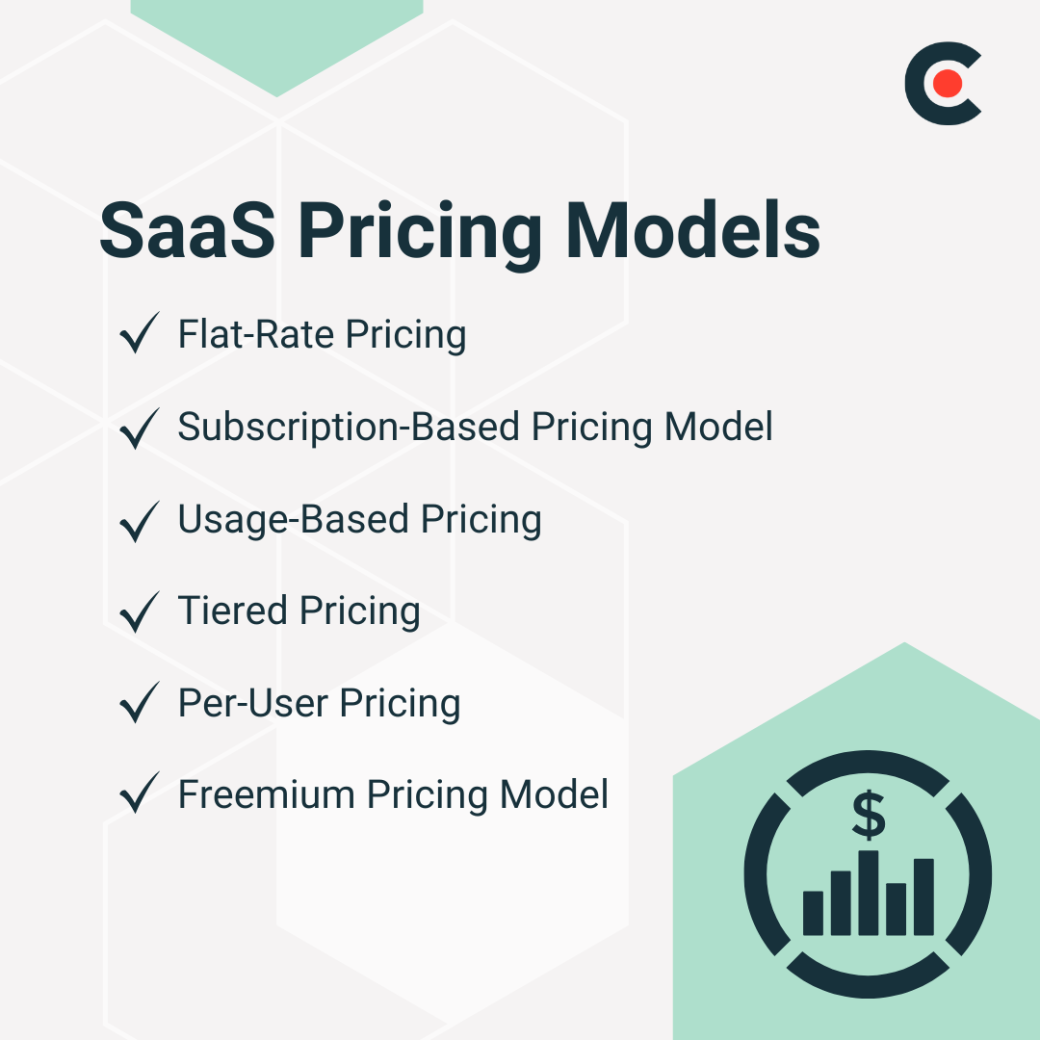
Flat-rate pricing offers users a single, fixed price for your product, regardless of usage. This appeals to customers who want a simple pricing structure. Flat-rate pricing makes it easy for businesses to manage their budgets and avoid unexpected expenses, which builds trust between companies and clients.
On the other hand, it's hard to determine an optimal flat rate for all customer segments. Small companies may find your rate too expensive. Large companies may require additional features that your business can’t afford. And clients who use your product infrequently may feel they’re overpaying for features they don’t use.
While many SaaS companies are shifting to usage-based pricing models, SaaS companies like Basecamp still offer a “Pro Unlimited” fixed-rate plan that covers unlimited projects regardless of the number of users. This is useful for growing businesses that may expand their SaaS users moving forward. Basecamp also offers fewer advanced features compared to other project management software, making fixed-rate pricing more feasible for this SaaS company.
SaaS subscription-based pricing models charge customers a recurring annual or monthly fee to use the provider’s software. A SaaS company can have multiple subscription models, including tiered, usage-based, or per-user pricing, and offer enhanced features with higher-level subscriptions.
Subscription pricing provides a steady source of income for SaaS providers. It also allows customers to upgrade, downgrade, or cancel their subscriptions as their needs change.
On the downside, offering multiple subscription tiers can get complicated for your customer support and billing departments. Providers may need to add new features to justify higher subscription fees. And customers who see their SaaS subscription fees accumulating over time may prefer buying the software outright rather than paying for a service.
Many SaaS providers use subscription-based pricing models. Microsoft365 offers multiple business subscription packages, from a Business Basic plan starting at $6 per user to a Premium plan at $22 per user.
Usage-based pricing (also called “Pay as You Go”) links the cost of a SaaS product to how much it’s used. Usage can be calculated based on the gigabytes of data used, the number of transactions processed, or some other measurement.
This pricing model is popular with businesses like cloud providers that have fluctuating usage needs. Because the price scales alongside usage, client companies don’t need to worry about paying high prices on slower months. Small startups can also benefit from usage-based pricing, as their SaaS costs will only increase as their need for the service grows.
However, the variable cost of usage-based pricing makes it harder for SaaS providers to predict their monthly revenue, creating potential cash-flow issues. Likewise, customers who pay on a usage-based pricing model can see big changes in their SaaS bill every month.
One SaaS company that uses usage-based pricing is Snowflake, a cloud-based data warehouse and analytics service. The company calculates pricing based on the average amount of data stored in an account, the cloud service features used, and computing costs (measured in credits).
A tiered pricing strategy offers customers multiple SaaS “packages” with unique combinations of features at different price points.
Tiered pricing allows a SaaS provider to tailor different packages to the needs of multiple businesses. SMBs with limited budgets can pay for a basic package that serves their needs, while large enterprise companies can pay higher rates for more advanced packages, improving a SaaS company’s revenue streams. In addition, clients can easily upgrade to a more expensive package when their needs change.
That said, having multiple packages can get confusing for providers and clients. Your billing and customer support departments will need more resources to manage multiple tiers. Plus, any modifications to a tiered pricing model will require a lot of communication and planning between departments.
Many SaaS companies incorporate AI tools in higher tiers to provide advanced functionality. “At this stage, we've noticed an emerging trend in offering premium tiers with AI-enhanced features to justify a higher price point,” said Katya Vakulenko, managing director of SOUP Agency. “However, we haven’t seen any direct price changes as a result of AI, for now.”
Per-user pricing bases its fee on how many users use the SaaS product. Each new user increases the subscription price, which can potentially make this model very lucrative for SaaS companies targeting large organizations.
For clients, per-user pricing is straightforward and easy to calculate, as costs are based on how many team members need access to the software. Companies can also scale up with this pricing model, which then rewards providers with additional revenue. And because per-user pricing can also incorporate a subscription pricing model, SaaS providers enjoy recurring revenue.
At the same time, per-user pricing may not reflect the actual value of your product. The price only goes up based on the number of users — not on the number of features you offer.
There’s also a chance that customers may cheat this system by sharing one login with multiple employees to give them all access. Even if clients don't try to get around the user count, they may decide to cancel their subscription once their teams grow too big and the price of using the software gets too expensive.
SaaS companies that use per-user pricing include Asana, which provides access to its work management platform with a combination of per-user and tiered pricing. For instance, clients can get access to Asana’s Starter package at a rate of $10.99 per user. Companies that need additional features like Asana AI and time tracking can purchase the Advanced package at $24.99 per user.
Looking to build a base of loyal customers? Freemium pricing lets companies offer an entry-level product that’s free for everyone. The free option provides basic software tools but is usually limited by its number of features or capacity.
Freemium pricing is usually part of a tiered pricing strategy where clients can pay for higher-tier paid packages with additional enhanced features.
This is a great way to introduce customers to your product and familiarize them with your tools. Once clients realize the benefits of your product, they’re more likely to upgrade to a paid option — and recommend your company to other businesses.
Of course, offering your SaaS product for free means your paying customers need to supply enough revenue to support all your clients, including the non-paying ones. People also tend to view free products as disposable, so they may not appreciate the full value of your product.
Slack offers a free forever plan for its messaging and collaboration platform. Users get 90 days of message history and 10 app integrations. However, to get unlimited message history and app integrations, users need to upgrade to a paid plan.
Advances in AI now allow SaaS companies to provide enhanced services for their clients that can improve efficiency, save time, and increase revenue. However, offering such services can be expensive, and businesses need to consider what SaaS pricing models work best for them.
When selecting a pricing model, consider the number of benefits and features your SaaS product provides to your target audience. While basic SaaS packages can still sell well at fixed rates, more companies are shifting to usage-based models, premium tiered packages, and per-user pricing.
Each option has its pros and cons, and you can also combine multiple pricing models to offer different SaaS packages at different price points. By tailoring your services to different client needs, you can expand your customer base and your profits.