
Why Searching for a Specialized Dev Agency Takes Longer Than It Should — And What to Do About It
Looking for a niche software development agency? Learn how to define your requirements, find specialized providers, and vet their experience.
Updated September 4, 2025

Not long ago, you checked off QA at the very end. These days, it’s woven into the work from the start. In some teams, tests are written before the first line of code, especially when they use test-driven development. The whole point is to move faster without losing quality and keep the entire development team aligned.
Calling QA nothing more than “bug hunting” really undersells the role. Yes, finding problems is part of it, but modern QA is just as much about ensuring the right requirements and that new releases work in real-world use.
Of course, QA will sit next to developers asking about risks, sketching out test cases, and keeping CI/CD pipelines tight so issues are caught before they reach production. That kind of teamwork means most bugs never leave the sprint, and feedback gets back to the team while it still matters.
Looking for a Software Development agency?
Compare our list of top Software Development companies near you
QA’s job isn’t to wait for something to break. It’s building the team's confidence to move fast, knowing quality is being monitored from day one.
QA isn’t stuck on the sidelines anymore. Instead of testing only at the very end, they now work shoulder to shoulder with the rest of the team: developers, designers, ops, and product. They’re not an add-on; they’re in the mix, helping shape how the product gets built.
These days, QA specialists act more like guides. They help refine acceptance criteria, ensure test stories are testable, and set automated checks that run in CI pipelines. You'll see them in backlog grooming, sprint planning, etc., asking the necessary questions to determine risk and optimize the development process.
QA and developers work much closer now than they used to. Pair testing, Test-driven development (TDD), and sharing test ownership have blurred the line between the two roles. The point isn’t to play “gotcha” with developers, it’s to head off problems early by working side by side and keeping quality focused from the start.
Releases move faster now, especially with CI/CD, and QA has had to adapt. They don’t slow the team down anymore. Instead, they jump in when a build looks shaky or when an extra set of tests might save a headache later. QA’s job isn’t to be a roadblock; it’s to give the team confidence that what’s shipping is solid.
So what does QA do today? It’s more than just testing buttons or filing bug reports. Their work usually falls into a few core areas:
This starts with digging into requirements and asking, “Where could this break?” or “What’s the riskiest part of this feature?” From there, QA maps out how testing should be approached, what counts as success, and how much effort it’ll take.
Automation covers a lot, but nothing beats directly testing the app. Exploratory sessions, checking user experience, and testing different scenarios often uncover the surprises automation misses.
To keep up with fast releases, QA builds and maintains automated suites. Tools like Cypress, Playwright, and Selenium run flows across browsers and devices, giving teams quick feedback.
Every new feature risks breaking something old. Regression checks prevent this. QA teams maintain repeatable test suites to validate product stability across versions and upcoming releases.
Sometimes, QA uses testing tools like JMeter or Lighthouse to verify how systems behave under stress. They also work alongside specialized teams to conduct security scans and ensure data protection.
When something breaks, QA logs it in JIRA or the team's tracking system. A good bug report includes reproducing steps, maybe a link to the test case, and enough context so developers don’t waste time guessing. QA also helps sort and prioritize issues, deciding what’s critical and can wait.
Before a release goes live, QA makes sure the basics are covered: they verify that versioning, documentation, changelogs, smoke testing, and rollback procedures plans are in place.
In short, QA keeps projects steady. Their work ensures that new features move quickly, from strategy to regression, without breaking what’s already working.
The Testing Pyramid, first described by Mike Cohn, has become a go-to model for thinking about test strategy. The idea is simple: not all tests are created equal. You want many small, fast checks at the bottom, and only a few big, slow ones at the top. That balance keeps the suite reliable, quick to run, and easier to maintain.
Unit tests sit at the base. They check tiny pieces of code, a single function, a component, or a class. They’re cheap to run, run in seconds, and give developers confidence to change code without fear.
Integration tests make up the middle. These look at how different parts of the system work together, whether a service talks correctly to a database, or two components pass data as expected. They take longer, but they catch issues that unit tests never could.
UI (end-to-end) tests sit right at the top. These mimic a user logging in, filling out a form, and making a payment. They’re slower and flakier, but still necessary to prove the system works.
If a team leans too heavily on the UI layer, tests get slow and painful. If they only write unit tests, gaps slip through. The strength of the pyramid is balance, matching test effort to risk so delivery stays quick and safe.
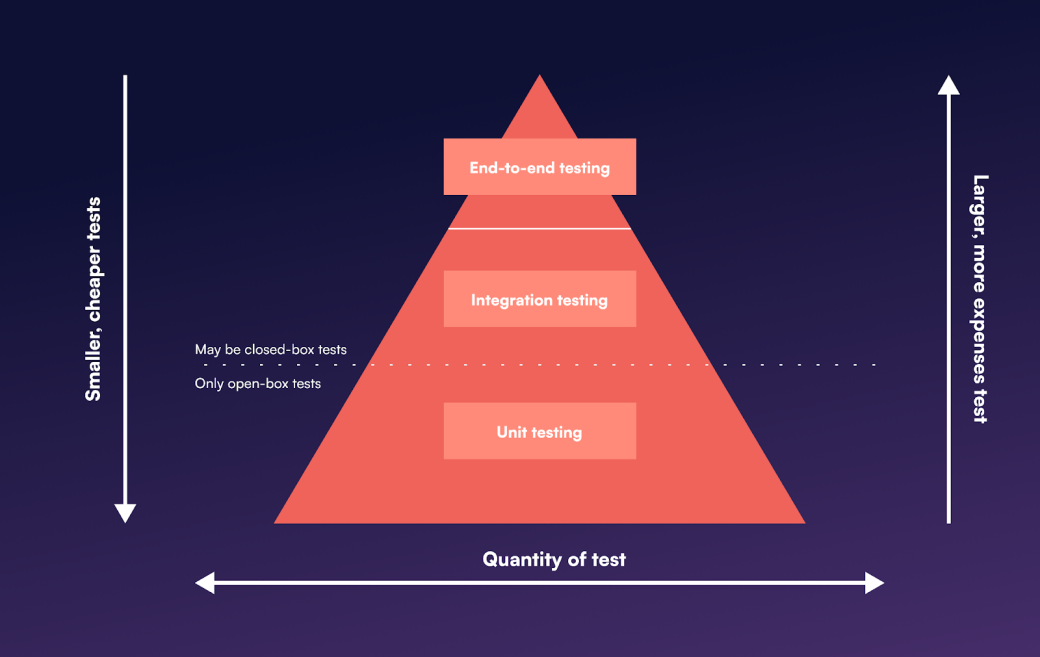
Ultimately, the pyramid keeps testing practical. Lean on lots of fast unit checks, add integration for confidence, and save the heavier UI tests for what matters most.
TDD flips the usual way of working. Developers start with the test instead of writing code and testing it.
That cycle repeats many times, each loop adding more functionality while maintaining safety nets.
Even though TDD is mainly a developer practice, it shapes how QA fits in. Smaller, testable chunks of code mean fewer hidden surprises and an easier-to-validate system. Teams that use TDD often move faster and release more confidently because bugs get squeezed out earlier in the cycle.
TDD is mainly seen as a developer practice, but it also shapes quality in ways that matter to QA. Writing the test first forces developers to spell out what the code should do before they even touch the keyboard.
QA fits right alongside that. They help sharpen user stories, asking, “What does ‘done’ really look like?” and making sure acceptance criteria are realistic. While developers focus on unit tests, QA looks wider, creating scenarios that mimic how an actual user will interact with the system.
Put together, the two approaches reinforce each other. Teams that blend TDD with strong QA usually catch issues early, ship more smoothly, and spend less time chasing down surprises after release.
QA adds a lot of value to TDD when it’s involved early. Instead of waiting until tests are written, QA professionals participate in planning and story refinement, shaping the test cases alongside developers.
Developers often check that things work when everything goes right, while QA looks at what happens when they don’t. They’re the ones asking, “What if the server times out? What if the input is invalid? Can someone with a screen reader use this?” That perspective pulls in edge cases, performance angles, and accessibility issues that might otherwise slip through.
Within QA, testers design negative test checks that ensure the system fails gracefully when something goes wrong. Meanwhile, QA engineers often write scenarios using plain Gherkin syntax in BDD setups so developers can hook them into automation.
For managers, encouraging this early QA-developer pairing isn’t just about catching more bugs. It’s about building shared responsibility for quality and reducing late rework. Teams that do this move faster and usually launch a more reliable product.
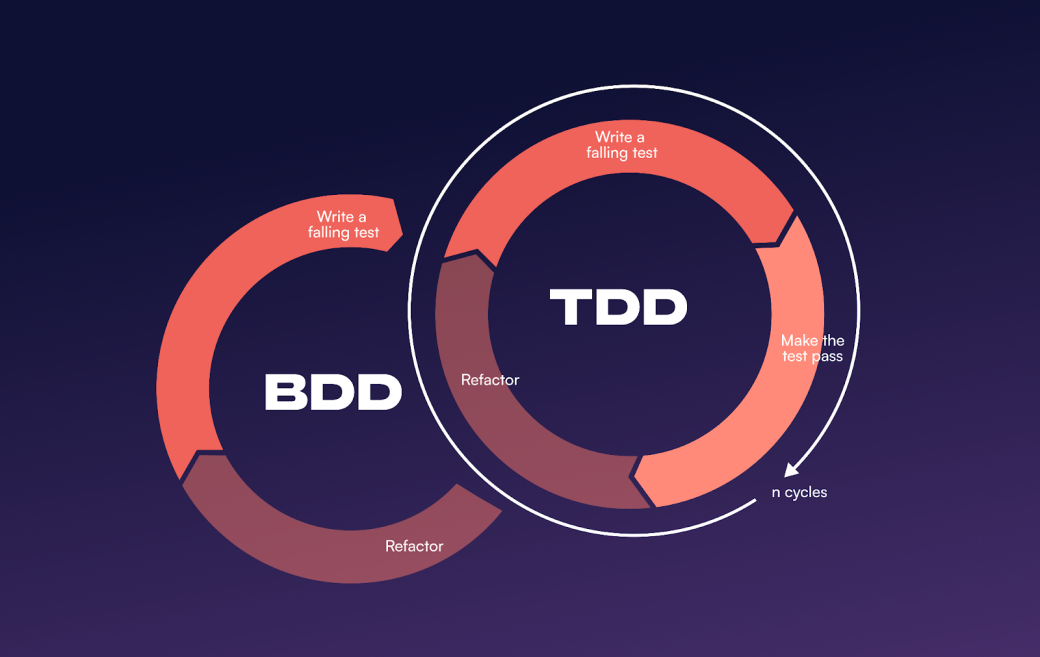
Test-driven development (TDD) is a developer practice that focuses on writing unit tests before any code is written. Behavior-driven development (BDD) takes that idea further by involving the whole team and emphasizing business value and behavior.
BDD uses structured language, often the “Given, When, Then” format from Gherkin, to describe features in plain terms that everyone can read. These scenarios double as test cases and lightweight documentation, connecting business requirements directly to technical work.
QA plays a key role here. QA professionals work with product owners and developers to shape behavioral scenarios that reflect user expectations and real workflows. Testers may design the negative cases, while QA engineers focus on keeping scenarios maintainable and aligned with acceptance criteria. Together, this reduces misunderstandings and helps keep requirements precise.
When QA is entirely part of BDD, the output isn’t just automated tests; it creates living documentation of how the system is supposed to behave. In this setup, QA shifts from being seen as gatekeepers to genuine partners in building quality into the product.
Modern QA requires a shift-left approach. Instead of waiting until the final stages, QA joins early during story refinement, backlog discussions, and sprint planning. This early presence ensures quality is considered when features are still ideas, not just when code is ready to test.
Automation is another cornerstone. QA engineers should tie their automated checks directly into the CI/CD pipeline so every deployment gets quick feedback. The mix matters: unit tests to catch minor errors fast, integration tests to confirm systems work together, and end-to-end tests to validate real user flows.
Coverage itself should be purposeful. Testing everything equally is unnecessary; the aim is to test the most critical paths with the correct depth. Teams often watch metrics like code coverage, defect density, time to resolve bugs, and pass rates to keep a pulse on effectiveness. The point is spotting trends that reveal where quality or speed is slipping.
No QA process is perfect. Teams often face recurring headaches, but the right approach can solve most problems. Here are common challenges you can encounter as a QA:
Today, QA isn’t just about testing; it’s about shaping how software gets built and shipped. From planning and automation to collaboration in TDD and BDD, QA keeps quality front and center while helping teams move faster. The real win is confidence: knowing what goes out the door works as expected for users. In that sense, QA isn’t a side role; it’s the backbone of modern software delivery.