
No-Code AI Agent Platforms For Every Team
No-code AI agent platforms make building AI agents simple and accessible. Clutch breaks down the best tools by team, including marketing, sales, and support.
Updated January 26, 2026

This article outlines a strategic four-pillar framework designed to bridge the gap between AI prototypes and production-ready systems that deliver measurable ROI. It provides a practical roadmap for prioritizing high-value use cases and aligning organizational readiness to ensure long-term success with AI.
Why do 95% of AI pilots never reach production deployment even when the early results look promising? As MIT's State of AI in Business Report states, it has nothing to do with model complexity or regulation, but an approach.
While everyone is discussing AI's high potential, very few address the risks that lie between a working prototype and an operational system. The pilot-to-production gap is the most expensive failure mode in AI implementation. Organizations invest months in building proofs of concept that demonstrate technical feasibility, yet are unable to generate returns or deliver measurable impact.
Looking for a Artificial Intelligence agency?
Compare our list of top Artificial Intelligence companies near you
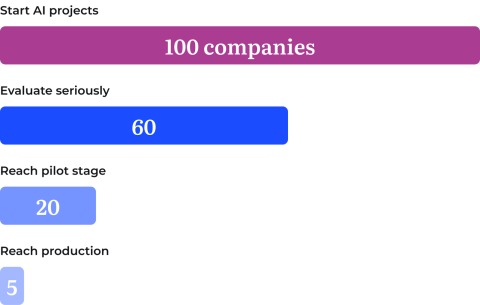
Source: MIT's State of AI in Business Report
AI strategy consulting services help companies close this gap in 100% of cases, enabling them to successfully plan for production requirements. I want to share a practical roadmap that you can apply to your current or upcoming AI initiatives to secure predictable execution and long-term value.
Businesses often start AI implementation with enthusiasm, but too frequently lack the systemic framework or governance discipline that enables steady progress. According to McKinsey's 2025 State of AI report, only 6% of companies qualify as "AI high performers," capturing at least 5% of EBIT from AI initiatives. The quality of strategic planning is the main differentiator when it comes to quantifying ROI.
Over the years of consulting with businesses on AI adoption, I've formed and refined an approach for validating readiness across strategy, infrastructure, organizational capability, and governance dimensions. Let's review in more detail how to build a winning AI implementation framework.
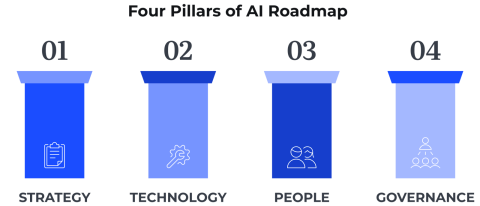
Each of these pillars represents a critical domain of readiness that must be evaluated and optimized to ensure sustainable ROI. Let's take a closer look at what each category involves and how they work together to create a strong foundation for growth.
Mapping AI projects to core business priorities is the first step in the process. Although you can verify AI's technical feasibility without it, it's simply impossible to justify investment since you'll have no idea what, or to what extent, the adopted technology has improved.
Another failure point is the inability to determine where AI use will show the highest return on a specific business model. The excitement around AI can produce dozens of potential applications. However, pursuing too many initiatives simultaneously stretches your resources and effort too thin.
You need to narrow the list to the most promising use cases that can be realistically delivered with your existing capabilities:
Here's a sample table you can use to estimate the most promising use cases:
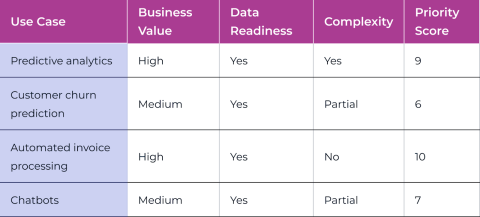
Notes: The Priority Score is calculated using a formula: Business Value × Data Readiness × Complexity Factor, or a weighted scoring system.
The point is to move from "we should do something with AI" to concrete outcomes and a strategic plan for implementing AI. It requires in-depth analysis and collaboration among various departments, as well as optimization for different objectives. In this context, AI strategy consulting can remove this burden by specifying what to build, in what order, and why.
Even the most perfect AI algorithms can't produce the expected outputs without quality data.
Even worse, 85% of AI models fail primarily due to the use of insufficient or poor-quality data.
If you don't want to become another statistic, assessing your data AI readiness and verifying whether your infrastructure can handle production-grade workloads is your best move.
Here's a list of what needs to be done:
Detecting weaknesses in infrastructure or data early gives you space to course-correct while the cost of change is still manageable. Skip this step, and as statistics show, the likelihood of failure or project abandonment skyrockets.
Around 70% of organizations identify people and process challenges as the primary obstacle to scaling AI. The key aspects to evaluate and plan for successful AI business integration:
With these responsibilities clearly defined, your chances of achieving high-level AI maturity and realizing pervasive value from investment increase dramatically.
You can check this AI readiness scorecard template to understand how prepared your business is:
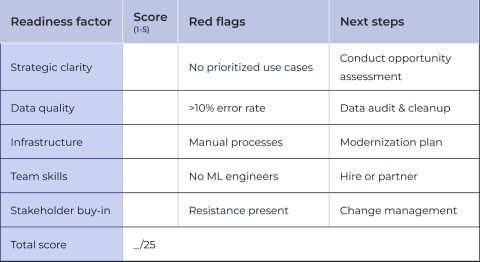
Once you have a clear picture of your current readiness, the next phase is to prioritize these 'next steps' into a phased plan. This ensures that your infrastructure and team capabilities develop alongside your AI ambitions.
Outline quantifiable KPIs tied to business objectives so you can certainly say whether the AI initiative succeeded or not. Three KPI categories I recommend tracking:
Now, let's discuss the concern of all leadership executives: AI ROI.
Calculating ROI for AI projects is more complex than for traditional software investments due to longer benefit realization timelines, significant indirect benefits, and challenges in isolating the impact of AI. To measure the project's profitability, consider all gains that add to the final result:
The most challenging part is converting these benefits into measurable numbers. But once done, you can apply a simple formula:
ROI = (Total quantified benefits – Total investment) ÷ Total investment
There have been approaches to AI consulting services for many years, and we continue to refine them as the market and technological landscape change fast. Let's see how exactly the framework works.
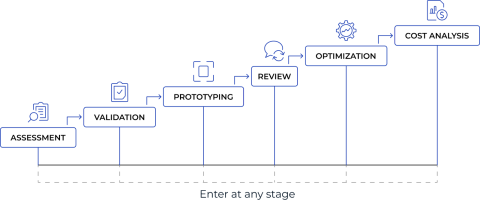
This approach allows you to participate in an AI consulting initiative regardless of where you are in your project. You can receive high-impact interventions at the most critical stages. By engaging in the process at any phase, you ensure that every action taken aligns directly with your current level of technical maturity.
Start every engagement with the question: "Will AI help you to reach your goal?" It immediately gives an understanding of whether AI is the right solution for your needs.
Then, proceed with analyzing your business processes and operational bottlenecks to identify the highest-impact opportunities for AI application. Evaluate potential use cases from business, technical, and organizational perspectives to pinpoint those with the strongest ROI opportunities.
You have an idea of using AI to automate a certain process, but have no clue what to do next. This is when an AI consulting company can help you test the idea in terms of feasibility, regulatory constraints, data needs, and commercial outcomes.
Never initiate full-scale AI development until testing core hypotheses and validating technical feasibility through a proof-of-concept (PoC) to mitigate assumptions critical to the project's success. A functional PoC enables you to demonstrate that the data algorithms can achieve the necessary accuracy with minimal investment.
Review the model's behavior in action and assess how well it matches your performance expectations, including accuracy, drift resistance, fairness, explainability, and robustness. In addition to standard metrics, you should also examine downstream risks, such as hallucinations and model degradation over time.
When companies plan to move AI prototypes into real-world environments or certify them for industry standards, architecture and code review are highly welcome. Assess your pipeline architecture, ML engineering workflows, and code quality to recognize issues while they're inexpensive to fix.
If your AI product underperforms or can't scale, identifying the root cause will require a thorough inspection. Investigate every possible pressure point in inference paths, data flows, model choice, and design a path to stable and efficient performance.
With the rising cloud and API expenses, AI cost reduction tactics become invaluable. Given that, we help organizations optimize their spending on infrastructure, AI model APIs, supporting tools, and operational overhead, preserving the same quality of outputs at a lower cost.
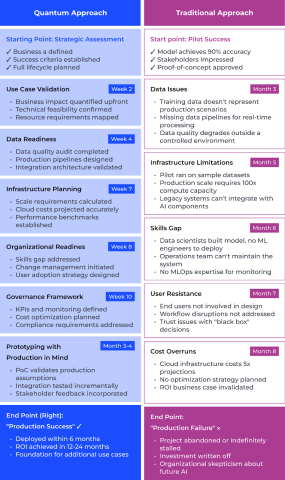
A successful AI business integration is not a matter of chance; it is the result of a well-thought-out strategic plan. The cornerstone is to define as specifically as possible the value that the AI system must generate. Then, all you need to do is design everything else around that target: use case scope, data pipeline, model choice, and success metrics. That's a sure way to build an AI product capable of delivering business value.
Yet, as is often the case, it's easier said than done. Implementing AI is a long and thorny journey with many decision points, where the wrong choice can create technical debt or hinder the expected value. You can try experimenting with AI and risk burning time and budget, or solidify your technology investment by engaging AI experts to take full responsibility for project deliverables, minimizing the risks of failure, and offering predictability and transparency in your AI progress.