
Task Automation: How to Cut Repetitive Work
Task automation saves time, gets work done faster, and reduces errors. Learn how to automate repetitive tasks step-by-step and how to decide what to automate.
Updated March 31, 2026

AI is fundamentally reshaping how B2B mobile apps deliver value. No longer just digital tools, today’s AI-powered apps automate operations, personalize user experiences, predict market shifts, and enhance security, all in real-time.
Unlike consumer apps built around engagement, B2B mobile apps exist to solve operational challenges, increase efficiency, and drive measurable ROI. AI technologies are perfectly suited for these goals.
Looking for a Artificial Intelligence agency?
Compare our list of top Artificial Intelligence companies near you
This article breaks down five high-impact AI applications, offers real-world results, and helps business leaders choose the right development partner to ensure a successful and strategic AI implementation.
AI technologies can automate tasks, and by integrating them into B2B mobile apps, it is possible to free up employees' valuable time to focus on high-value strategic work.
The Challenge: Manual tasks like invoice processing, scheduling, and data entry slow operations and increase error rates.
The AI Solution: Robotic Process Automation (RPA) and Large Language Models (LLMs) automate these repetitive tasks within B2B mobile apps.
Real-World Result: A leading retail company witnessed a decrease in order handling time from 15 days to 2 days as a result of introducing automated invoice processing using RPA systems.
What to Look for in a Partner:
Integrating Robotic Process Automation into B2B mobile apps therefore plays a significant role in enhancing efficiency, accuracy, and the overall user experience.
With advances in Machine Learning algorithms, AI technology can analyze usage patterns in real-time and dynamically adapt dashboards, content, and workflows. This ensures that users see only hyper-personalized metrics and role-specific insights that are relevant and matter the most to them.
The Challenge: Most apps use a one-size-fits-all design, even though executives, sales teams, and operations managers all have different needs.
The AI Solution: Machine Learning tailors app content and dashboards based on user behaviors, roles, and preferences all in real-time.
Real-World Result: A global logistics firm saved up to $300 million annually by using an AI-based routing system that analyzes live traffic, weather, and delivery patterns to show its drivers the most optimal route in real-time on their dashboards.
What to Look for in a Partner:
By embedding ML models within B2B-focused mobile apps, businesses can enhance decision-making, optimize workflows, and deliver smarter, data-driven solutions through any specific insights raised.
Real-time predictive analytics make it possible to anticipate trends, forecast demand shifts, identify smart pricing opportunities, and flag potential risks before they escalate. This means that companies can react faster and smarter through proactive and informed decision-making.
The Challenge: Traditional reports are backward-looking. Leaders need to anticipate disruptions and spot trends early.
The AI Solution: ML models forecast demand, identify supply chain risks, and suggest proactive actions directly within mobile apps.
Real-World Result: A B2B services company aimed to better manage its pricing model. Using an AI tool, it created a pricing structure based on hundreds of customer and deal parameters. As a result of using AI for smart pricing, the company saw a 10% uplift in earnings.
What to Look for in a Partner:
By amalgamating predictive analytics technology, B2B mobile apps can deliver actionable intelligence and give companies a competitive edge in dynamic markets.
Unlike consumer-facing apps, B2B apps are designed to facilitate operations and collaboration between business entities. These apps help companies streamline processes, enhance productivity, and improve communication.
AI-powered Chatbots, Virtual Assistants, and Natural Language Processing (NLP) technology now make it possible to resolve common queries instantly while escalating complex issues to human agents. This results in faster response times, lower operational costs, and higher customer satisfaction.
The Challenge: Scaling B2B support is expensive. Delays frustrate clients and hurt retention.
The AI Solution: NLP-enabled chatbots handle routine questions instantly and escalate complex issues intelligently to human representatives.
Real-World Result: A global software company reported a 40% drop in operational costs within six months of deploying AI chatbots.
What to Look for in a Partner:
To ensure optimal performance, integration of elements such as AI-powered chatbots, virtual assistants, and natural language processing should be proactively supported by continuous model training with industry-specific datasets.
Mobile app-based AI-powered security systems can direct anomaly detection algorithms to monitor unusual transaction patterns, flag suspicious activities, and prevent unauthorized access.
The Challenge: Large B2B transactions attract fraud. Traditional security reacts after the damage is done.
The AI Solution: AI algorithms detect anomalies in real-time, flagging suspicious behavior before harm occurs.
Real-World Result: A global banking chain was able to improve fraud detection by 6% following its adoption of fraud detection-trained AI models.
What to Look for in a Partner:
By combining AI-powered fraud detection into B2B mobile apps business users are provided with a robust defense against financial risks and malicious activities. This not only safeguards financial transactions and sensitive data but also contributes to building trust with app users as well.
In the fast-paced world of B2B technology, mobile apps have become essential tools for businesses. But what is really reshaping the capabilities of these apps today? The answer is clear: Artificial Intelligence.
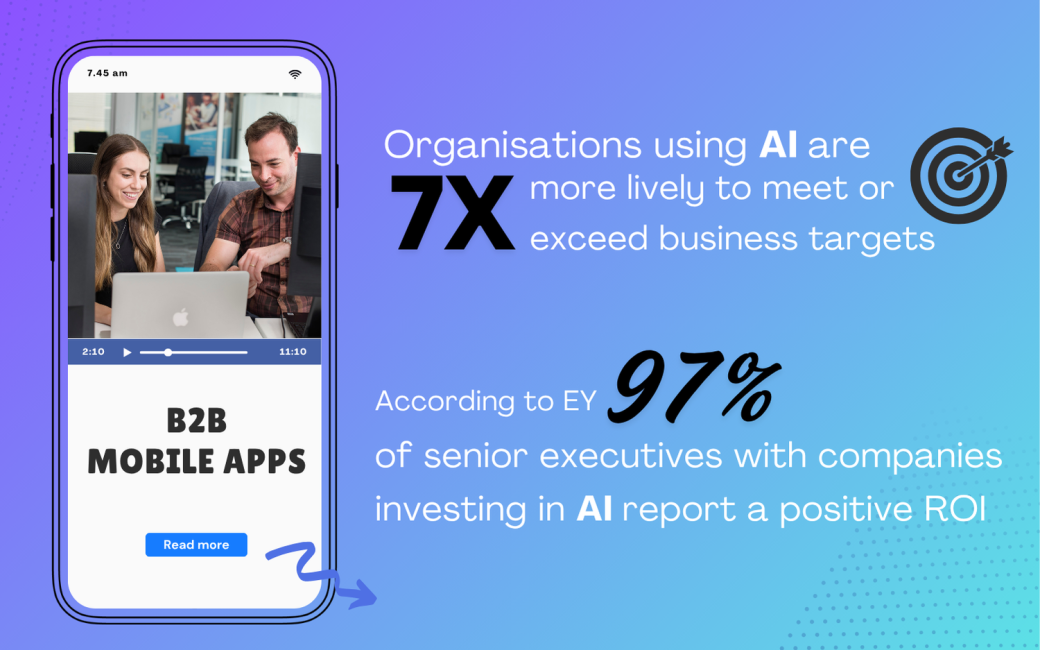
AI is no longer a futuristic add-on - it’s now the core engine that’s fundamentally reimagining how B2B mobile apps function and deliver value. In fact, organizations that already leverage AI are 7X more likely to meet or exceed their business targets, while those that have yet to adopt it are 3X more likely to miss their targets.
According to EY, 97% of senior business leaders in the USA whose organizations are investing in AI report a positive ROI from their AI investments. Companies that embrace and integrate AI technologies into their B2B mobile apps today will outperform competitors tomorrow, through intelligent automation, delivering hyper-personalized user experiences and unlocking new revenue streams via data-driven insights.
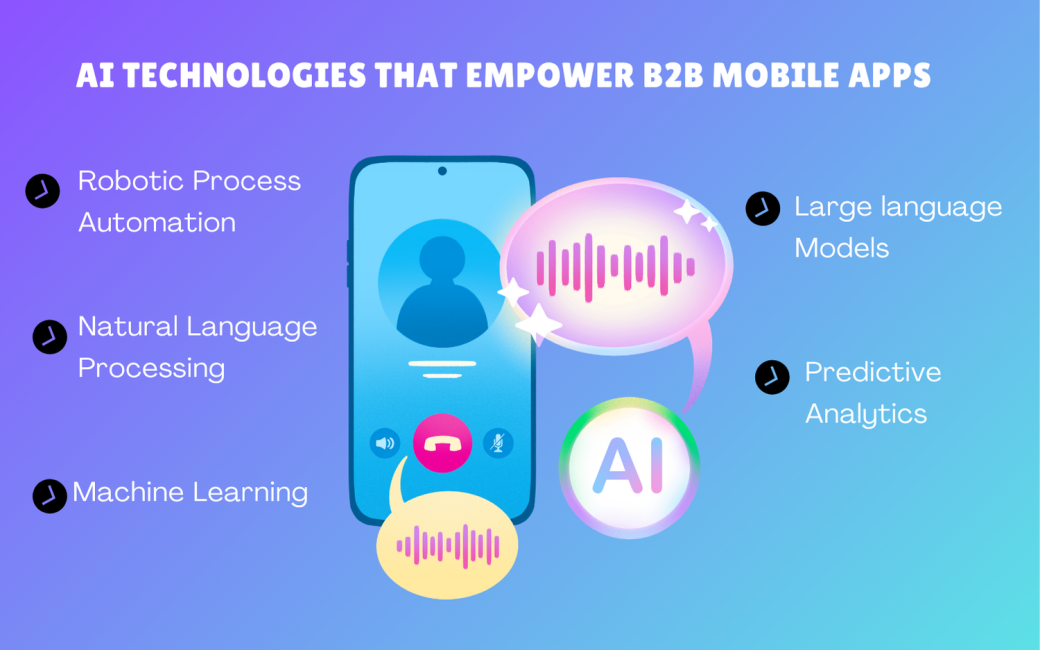
Robotic process automation uses intelligent automation to automate repetitive office tasks.
Large Language Models are AI systems trained on massive datasets capable of understanding and generating natural language inputs for a variety of tasks.
Machine Learning is a branch of artificial intelligence (AI) focused on helping computers learn from data and improve on their own. The more data it is exposed to, the better its performance.
Natural Language Processing uses Machine Learning to enable computers to understand and talk like humans.
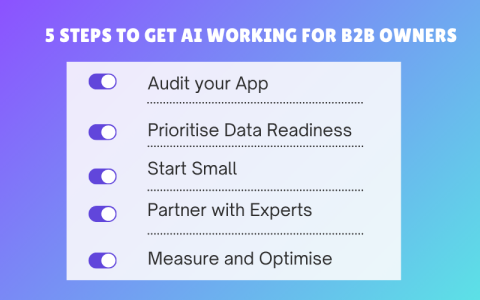
Here are 5 Steps to get started and take the AI leap:
In today’s digital-first business environment, by investing in AI, you're not just upgrading functionality, you're reshaping how your business operates, competes, and seamlessly integrates its processes and workflows. If you're building or evolving a B2B app, now’s the time to think bigger.
By embracing Artificial Intelligence solutions early, B2B app owners stand a superior chance to gain a competitive edge in the digital marketplace. B2B apps that offer AI integrations are more likely to engage and satisfy users in the long term underscoring user retention as well.
The question isn’t whether to adopt AI, it's how soon can you start. The Bottom Line: AI isn’t the future - it’s the present. Is your B2B app ready?