
Task Automation: How to Cut Repetitive Work
Task automation saves time, gets work done faster, and reduces errors. Learn how to automate repetitive tasks step-by-step and how to decide what to automate.
Updated May 28, 2026

Nowadays, it’s hard to find a business leader who hasn’t considered integrating artificial intelligence into their operations. 78% of companies are now using AI models in at least one business function. Our team also hears it almost daily: “We want to use AI, but we’re not sure what to start with.”
In this guide, we’ll help you understand whether your business really needs AI or if it’s just the effect of hype. Based on our experience in artificial intelligence integration for our clients, we’ll explain how to move from an idea to a real, well-working solution that can become an integral part of your product.
Before we move to the development part, it’s important to ask a simple but important question: Does your business truly need AI?
Looking for a Artificial Intelligence agency?
Compare our list of top Artificial Intelligence companies near you
There’s no doubt AI is powerful. But not every problem or business task needs a machine learning model. Besides, we are more than sure that not every product becomes better with artificial intelligence. We see that companies often consider AI to be the next step because competitors do so.
Instead, it’s better to focus on the problem you need to solve. Here are a few cases when your business may benefit from AI:
And here are some signs you don’t need AI, at least now:
AI is not a panacea. It’s just a practical tool. It can increase the effectiveness of your business, fasten operational processes, or improve customer experience when you use it correctly.
To help you understand how artificial intelligence can help grow your business, let’s view several examples of how global companies integrated artificial intelligence into different processes.
Spotify has launched graph neural networks to model user preferences for music, podcasts, and audiobooks. As a result, it improved new audiobook start rates by 46% and increased streaming by 23%. That’s why we can assume that AI-based recommendation engines strengthen user engagement and can make content recommendations very relevant.
Unilever launched AI recruitment tools that allowed it to screen more than 250,000 applications automatically. It decreased the average hiring cycle from 4 months to just 4 weeks.
How Unilever Is Using Artificial Intelligence And Machine Learning In Their Recruitment (VIDEO LINK)
On the contrary, the employed had to spend more than 70,000 hours to make it work. Consequently, you can delegate repetitive, high-volume administrative tasks to AI, which saves money and time.
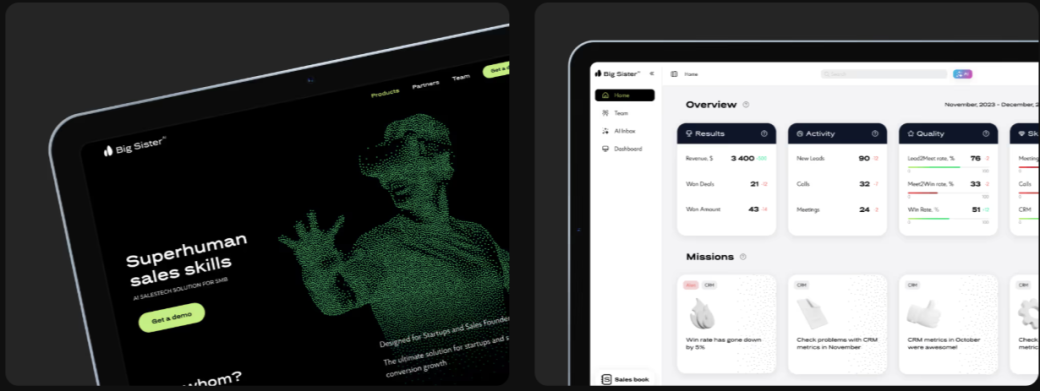
Empat developed BigSister.AI, an AI-powered system that monitors companies’ sales processes in real time, provides predictive insights, and helps managers identify areas that need improvement. It’s like a sales operations assistant that never sleeps or makes mistakes. It analyzes patterns, outlines inefficiencies, and helps teams read settled sales goals. As a result, such a tool allows sales managers to save time on manual analysis and get insights for actionable decisions.
Unlike previous cases, when businesses integrate AI into some of their business processes or tasks, your choice may be to add an AI-based product to your portfolio. That’s exactly what we did with PixShare.
Empat AI engineers developed PixShare, a mobile app that uses AI to recognize faces in photos and automatically share them with the right people. It saves time and efforts for customers when people need to send photos to friends and family after any event or vacation. In such a way, our AI development allowed us to create a new product on the market and solve the pain point of millions of people.

Assume that you really need AI to become part of your business, if you still keep reading.
So, let’s discuss your next steps to turning an AI idea into a working solution for your company.
First, analyse your business and identify real gaps, problems, or opportunities where AI can create value. Find spheres where you can automate repetitive processes, improve customer experience, or optimize internal workflows.
Remember that not every problem can be solved with AI. You need to focus on spheres where machine learning can perform better than traditional solutions. It can be pattern recognition, prediction, or intelligent automation.
We recommend starting small and integrating AI into only one process at a time.
Such projects are rather complex and require hiring a skilled AI development team. Probably, you’ll need:
You can build an AI team inside your company or outsource development to a partner.
To develop an AI solution, you need clean, relevant, and well-structured data. This data is the basis for training accurate models.
If you feel that it’s a bottleneck in your operational processes, consider investing in data infrastructure, cleaning pipelines, or even data collection strategies. It’s an important stage before moving to building AI.
Thinking of AI implementation as a one-time project may lead to failure. We recommend approaching it like a product. Try using Agile methods to build, test, and improve your AI solution in short cycles.
During this phase:
It’s better not to aim for perfection upfront but for something useful, usable, and improvable.
Once your AI model performs well, integrate it into your existing systems or products. This includes:
A successful deployment doesn’t refer only to AI working. It’s about it working well inside your business environment.
Even if you follow all the steps precisely, your AI project may still fail. The reasons can relate to technical, organizational, or human factors. Take into account further recommendations based on our experience, which we've learned while helping companies launch AI solutions.
Don’t try to launch AI everywhere at once. It’s better to choose one clear problem where AI can create a considerable impact. It will be easier to see whether the improvement is really working.
Just trust — your data will never be perfectly clean and complete. When you try to reach it, you are just wasting your time. Try to work with what you have and improve it continuously. The key to success is to start small, validate fast, and improve your model and your data pipeline iteratively.
Remember that your business works for people. Make AI an invisible helper that improves your efficiency. Avoid situations when you complicate your user experience or customer journey with AI.
Don’t let AI be just an additional project for the tech team. Try to involve decision-makers from the beginning. Their input will help the project meet business goals, which is one of the main success points of any activity.
We know that the launching process is complicated. Bad news - it’s just the beginning. After implementation, don’t forget to track performance metrics, gather user feedback, and make improvements often. AI models may degrade rather quickly without updates. That’s why continuous improvement is important to remain effective.
AI is no longer a privilege for tech giants. It’s an effective tool that helps even small businesses grow. But success doesn’t come from a single idea. It is based on understanding your business needs, starting with clear goals, and building with simplicity and purpose.
No matter whether you’re integrating AI into your business operations or developing a new AI product, focus on:
Remember, AI doesn’t have to be complex. It just has to be useful and help your business reach settled goals.