
Task Automation: How to Cut Repetitive Work
Task automation saves time, gets work done faster, and reduces errors. Learn how to automate repetitive tasks step-by-step and how to decide what to automate.
Updated May 28, 2026

Implementing AI-powered patient discharge solutions in hospitals can significantly reduce costs and improve patient care. This article will give an overview of AI capabilities and how to implement them.
Longer than necessary patient discharge procedures are worsening across hospitals, resulting in extra costs, high bed occupancy, and poorer quality of healthcare services. AI-powered solutions have an opportunity to automate processes that are involved in patient discharge procedures, resulting in more efficient resource allocation.
This article explores the specifics of AI-powered solutions for patient discharge and how CTOs and CIOs can implement them in their healthcare organizations.
Looking for a Artificial Intelligence agency?
Compare our list of top Artificial Intelligence companies near you
When you think about patient discharge, you might think that the procedure is straightforward- if the person is no longer sick, then they can go home. However, in practice, this is not a smooth process.
Hospitals are complex organizations with various departments, requiring coordination between medical, nursing, and admin staff. Add to this process the insurance company, billing procedures, or relatives of the person that has to be taken care of during the discharge process. As a result, there are major delays contributing to avoidable costs for the medical institution, lack of available hospital beds, and staff burnout.
The UK’s NHS, for example, estimates that delayed discharges cost the system approximately $2.15 billion (or £1.7 billion) annually, with hospital bed occupancy reaching critical levels of 95.7% in late 2023. Moreover, a single patient's daily stay in the hospital costs the NHS around $610.
Given that in 2023, around 14,000 beds will be taken by patients who no longer need to stay in the hospital, the problem becomes apparent, and the question of how technology can resolve this crisis is more relevant than ever.
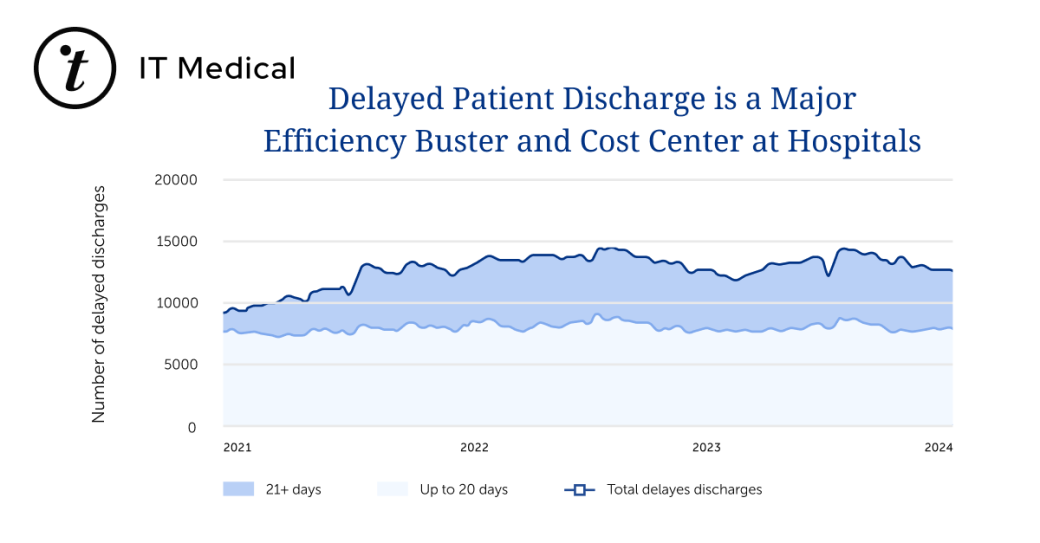
Readmission rates further compound these challenges. Many hospital readmissions are avoidable and often linked to poor discharge planning and inadequate patient education. Poor patient education on recovery and medicine follow-up post-discharge are significantly contributing to this mounting problem.
AI-powered solutions have been in the spotlight for being a solution that can address these inefficiencies.
AI-powered discharge systems are emerging as a game-changing tool to address these inefficiencies, enabling predictive analytics, automated workflows, and personalized patient communication.
Bed blocking is not the only bottleneck that arises from an inefficient patient discharge process. A group of patients is at risk of readmission. These readmissions are avoidable; if they were given proper instructions for aftercare, they would recover better. AI has the capability to identify such patients and prepare clear instructions and intervention strategies to follow after their discharge.
Patients receive personalized education, ensuring they fully understand their conditions and medication adherence plan. The research shows that AI can predict patients with high readmission risk. After taking this into account and tailoring the post-discharge treatment plan, the readmission rate fell by 30%.
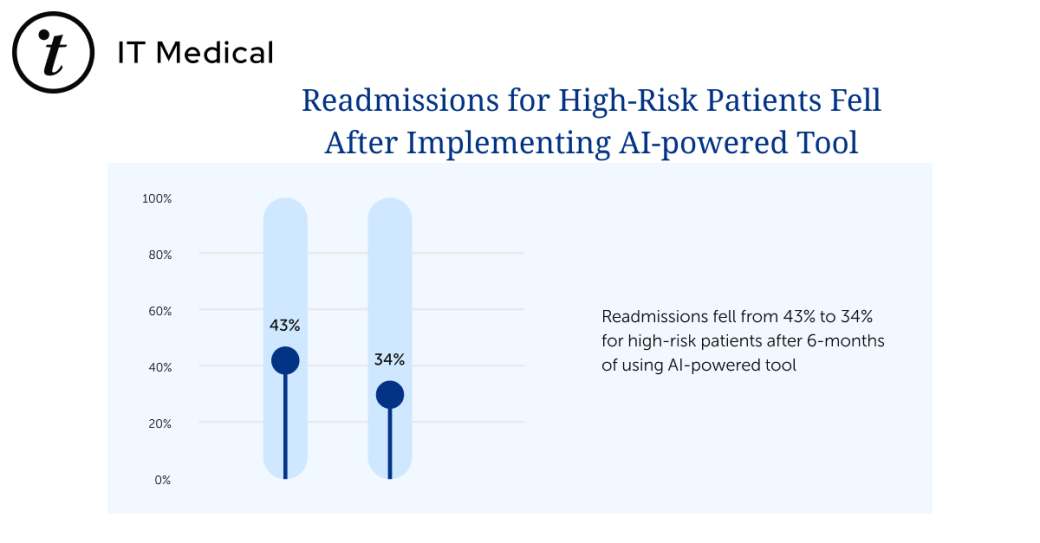
The expedited patient discharge process does not affect the number of readmissions. However, clear instructions and more careful after-discharge monitoring can significantly reduce such risk.
Administrative bottlenecks are a significant source of delayed discharges. AI-powered automation tools can generate discharge summaries in seconds, reducing the burden on healthcare providers.
Additionally, the AI tool can automatically plan and schedule post-discharge follow-ups based on each patient's individual treatment plan. Finally, all of it will be integrated with electronic health records (EHRs) to ensure seamless coordination between departments.
There are clear benefits in reducing the time patients spend in hospital and increasing bed turnover.
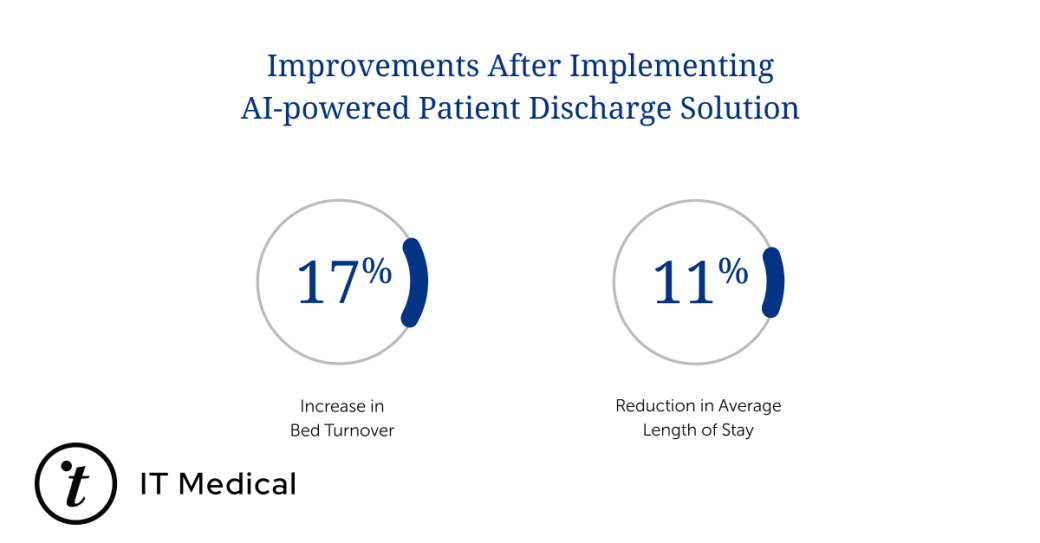
IT Medical’s in-house developed AI-powered patient discharge management system has helped our client hospital to reduce the average length of stay by 11% and increase bed turnover by 17%.
AI can transform complex discharge summaries into simplified, patient-friendly instructions, improving comprehension and adherence. Studies indicate that improving the readability of discharge documents reduces hospital readmissions.
AI-powered tools ensure that every patient is given customized discharge instructions that match patient literacy levels. Moreover, the language barriers have been removed, thanks to multi-language support, which addresses diverse patient populations.
Finally, conversational AI chatbots for post-discharge queries reduce the load on healthcare providers. These chatbots are available 24/7, cater to patients who live in remote areas, are free of judgment, and never rush. Such a comfortable setting allows patients to answer all their questions regarding their health concerns and helps evaluate whether an urgent hospital visit is necessary or if assistance from a physician is recommended.
The inefficient patient discharge procedures mean patients stay in hospitals longer than they originally needed. On the other hand, patients who urgently need hospitalization might wait until the hospital beds become available, or if they are available, the staff’s valuable time might be diverted.
This issue can easily be solved thanks to AI solutions implemented by the hospital. The patients fit for discharge are swiftly identified, their documentation is prepared, and departments automatically communicate with each other, making the bed turnover faster.
While the excitement surrounding the use of AI-powered technology is rising, mistakes or data breaches are unforgivable in healthcare. Hence, CTOs have to plan ahead for the smooth and safe implementation of technologies.
AI functions well and eliminates data biases when it has access to large and diverse data sets and vast amounts of personal data. However, there are risks of security breaches. Take, for example, the security hack on the United Health tech unit, leaking data for 100 million people. To ensure data privacy and cybersecurity are not threatened, the tech executives have to look for vendors that have obtained all necessary and recommended certifications, such as the Health Insurance Portability and Accountability Act of 1996 or HIPAA. Developers with vast experience in the healthcare sector can consult medical organizations on how they will handle patients’ data, how it will be standardized, and what security will be put in place to protect the data from leaks and cyber attacks.
Another important step is to prepare how the integration of AI solutions will complement the existing IT infrastructure. The adoption of new AI technologies will have to be performed in such a way that the existing EHR and other hospital systems are not affected.
Moreover, the IT staff resources have to be planned accordingly so a team will oversee the smooth adoption and ongoing maintenance of new AI technology.
AI in patient discharge is evolving rapidly. There are four main emerging trends:
AI will enable even more precise forecasting of patient outcomes, allowing hospitals to predict complications preemptively and enabling proactive interventions. Additionally, more sophisticated decision support tools will be developed for discharge planning.
Wearable devices and AI-driven health monitoring tools are already booming and have already received FDA approval. However, post-discharge patient tracking will allow the monitoring of patients at risk of readmission. Studies indicate that AI-powered remote monitoring significantly reduces 30-day readmissions.
AI will enable hyper-personalized patient discharge plans, considering factors such as genetic predisposition to specific conditions accompanied by real-time health monitoring data. On the other hand, AI will analyze non-health-related data, such as socioeconomic factors influencing recovery.
AI-driven home healthcare solutions, including AI-powered virtual assistants, will become integral in reducing readmission rates. AI-powered telehealth platforms will ensure that post-discharge patients receive personalized follow-ups without requiring in-person visits.
Inefficient patient discharge drains the hospital’s resources, contributes to staff burnout, and results in poor patient outcomes. The cutting-edge technology can sense the communication gaps between different departments, eliminate data silos, and use advanced predictive analytics to help identify patients fit for discharge and those who need to follow the post-discharge recovery plan.
Forward-looking CIOs and CTOs have to stay ahead of the game and identify technological solutions that will improve the efficiency of the healthcare organization they work for. After all, AI implementation will result in great savings and better resource allocation. However, the chase after efficiency should not compromise cybersecurity; thus, the AI developer with a strong track record in healthcare should be chosen.