
Evaluating an Marketing Agency in the AI Search Era
AI search has completely changed how people interact with online content. When an AI summary appears at the top of search results, Google users only click a...
Updated May 27, 2026
It may sound paradoxical, but many marketing agencies struggle because they don’t, well, market themselves. Learn why you should put just as much effort into promoting your own business as you do for your clients with expert insights from Carole Mahoney, founder of Unbound Growth.
When it comes to promoting clients, the best marketing agencies go all out. A/B testing, the latest social media trends, creative content — they’ll do whatever it takes to spread the word. But all too often, they don’t put the same energy into their own agency marketing.
“One of the biggest mistakes I see with marketing agencies specifically is the classic ‘the potter has no shoes’ scenario,” says Carole Mahoney, founder of Unbound Growth. “The work they do for clients, they don’t do for themselves. They don’t write content or try to attract clients for their own business. These are two common pitfalls I see agency owners fall into.”
Set yourself up for long-term success by taking your agency marketing just as seriously as your clients’. Here’s what’s at stake and how to get started with insights from Carole Mahoney, founder of Unbound Growth.
It’s easy to put your own marketing on the back burner, especially when you already have plenty of clients. But that neglect can have serious consequences, including:
So, what do marketers need to do to remedy this?
Effective agency marketing isn’t just about creating the right content or buying the occasional ad. It’s a complete mindset shift.
“The biggest pitfall I see is that agencies don’t do for themselves what they do for their clients,” Mahoney explains. “They don’t treat their own business as a client.”
That means putting real effort into promoting your business all the time — not just when you’re between projects or need a side quest for your intern. After all, you wouldn't give any other client a half-developed strategy or months of downtime.
Here are three strategies to help you build your agency’s presence:
You would never start marketing a client’s business without a clear end goal in mind. And the same principle applies to your own agency. Goals drive action, not the other way around.
Start by setting realistic and specific objectives for your campaign, such as:
Use key performance indicators (KPIs) to see if you’re making progress toward your goals. For example, you might monitor engagement on TikTok to measure growing brand awareness. Or you could track web traffic to see if your SEO tactics are paying off.
Internal tracking dashboards can help you gather this data and see the big picture. Google Analytics, for instance, tracks the behavior and demographics of website visitors. Similarly, Ahrefs monitors backlinks, keyword ranking, and other SEO data.
Of course, setting your goals shouldn’t be a set-it-and-forget-it task. Be sure to review your goals regularly and make adjustments as needed. Check in monthly for short-term objectives, such as gaining 100 Instagram followers. For more ambitious goals, measure your performance at least quarterly or yearly.
As a marketing agency, you have a unique advantage: you’ve already built your own A-team of promotional whizzes. Put their talents to good use with regular strategy meetings for your agency.
These sessions are a great time to discuss:
Resist the urge to chat about client projects during these meetings. This is dedicated time to strategize for your own business’s growth, so take it seriously.
Marketing your agency isn’t a one-person job — at least, not if you’re prioritizing it. You need a dedicated team with different specialities, such as:
Use a task management tool like Asana or Trello to assign projects and set deadlines. That way, everyone knows exactly what they’re responsible for. It also means you’ll never have to wonder if your social media specialist has finished this week’s Instagram posts — you can just check the software.
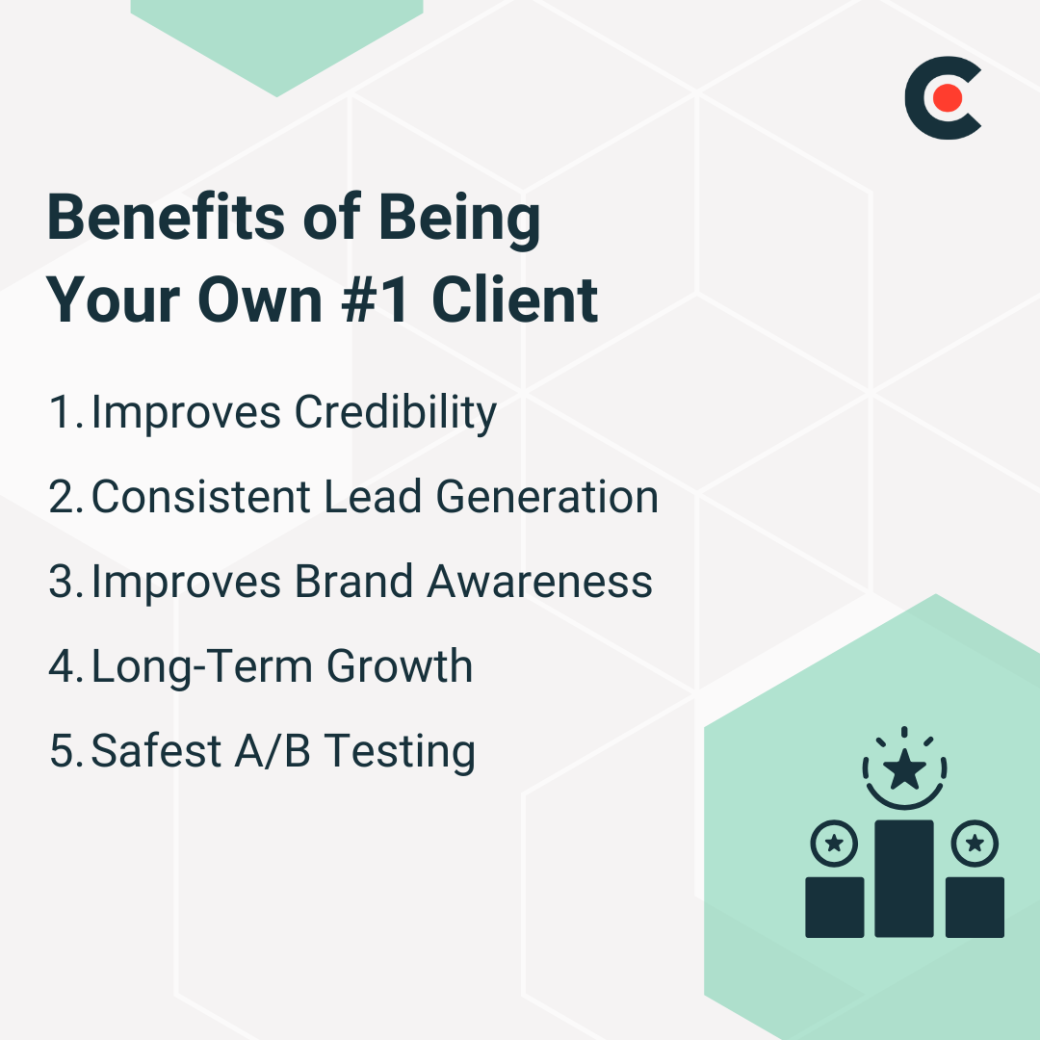
Focusing on marketing your agency has many advantages, including a few that you might not expect. Here are a few reasons to invest in yourself:
Clients feel more comfortable when they can see your expertise at work. And there’s no better way to prove your effectiveness than by getting results for yourself.
Just think about it — would you rather hire an agency with successful social media channels and an awesome blog, or one that barely has an online presence? The choice is obvious.
Even the most loyal clients can vanish overnight, especially during economic downturns. Agency marketing will help you attract a steady stream of leads, so you always have new clients and projects in the hopper.
Savvy marketing builds brand recognition, which can eventually attract new customers. Plus, people are more likely to trust your agency when they know they can count on you for quality content.
Internal marketing and strategic planning are investments in your agency’s future. They allow you to create focused long-term objectives and improve your brand positioning. These activities can also reveal weaknesses in your business, such as unclear branding.
For example, you might realize that some of your social media posts are sarcastic and filled with slang (“no cap”), while others sound like they’re written by a friendly grandmother. A more consistent brand voice will help you reach the right audience for you.
Along with promoting your business, agency marketing gives your team a sandbox for experimenting with new approaches and tools. For example, you could test out new software without risking your client’s business. If it works out, great! You can add it to your clients’ toolkits. If not, no worries — only your agency is affected.
Internal campaigns also allow your team to truly unleash their creativity. They can innovate to their heart’s content and use what they’ve learned to make your clients’ projects even better.
Agency marketing should always be a top priority, not an afterthought. By investing your time and talents in your own business, you can boost your reputation and continue to grow.
Get started by setting goals and focusing on one or two channels at a time, and encourage your team to be bold and creative. After all, if there’s ever a time to experiment and show off your talents, it’s with your own marketing.

Carole Mahoney, the Founder of Unbound Growth, is a sales coach for the Entrepreneurial MBA program at Harvard Business School, where she’s been called “the Sales Therapist.” She draws on cutting-edge science, statistics, and data from 2.2 million sales professionals to inform her sales coaching work with clients.