The AR/VR Advantage: How Brands Are Leveraging Immersive Technology
In 2026, AR and VR technology is creating new opportunities for businesses to connect with buyers and drive conversions. Clutch surveyed 400 consumers to...
Updated January 3, 2025

As a major player in the digital world, artificial intelligence is taking over in 2020. While AI is one of the more complex technical features for businesses, the use of it can be found in different areas that impact our daily lives.
It is 2020. We have all heard about artificial intelligence (AI). The question that may be harder to ask is what is artificial intelligence?
Quite simply, artificial intelligence mimics a human brain inside a machine. In other words, the machine has the ability to do tasks that are usually done by us humans.
Looking for a Software Development agency?
Compare our list of top Software Development companies near you
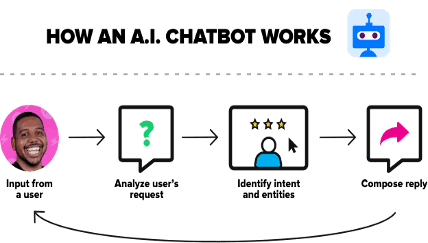
Chatbots are a component largely used in the world of artificial intelligence. They mimic human experience through several clues left by users and respondents.
Source: Drift
After receiving input from a user, the chatbot will analyze the request and will compose a reply once the intent is discovered.
With its advanced technologies and programs, AI can save our lives or simply make them more comfortable. It is used in a private capacity and across most, if not all, industries. This article will dive into what’s possible in the world of AI.
Whether we realize it or not, artificial intelligence has become part of our daily lives. Whether it’s to get in touch with friends and family or starting a new business. AI is there to make our lives easier.
Assistance with social media, email communications, web searching, stores, and online services is now a breeze with AI applications.
A majority of the world owns smartphones. Each of the apps on your smartphone has a layer of artificial intelligence. Imagine not having the convenience of all of the above. AI most definitely adds value to our lives.
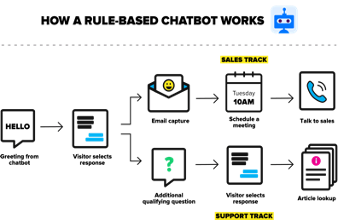
Another aspect of daily life is work. Worried about scheduling meetings and finding time to talk to a sales representative? Use a chatbot.
Source: Drift
A rule-based chatbot can provide support through looking up information and corresponding with visitor questions. It can also assist with scheduling and finding emails.
As we rely more and more on AI in our daily lives, it has now become an extension of our education system.
For students, AI applications can be tailored to the students’ needs. The quality of education for children with learning difficulties has improved greatly with the use of AI computing tools.
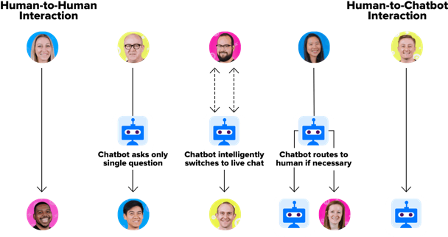
Chatbots easily mimic human interaction. So even outside of the classroom, students can receive direct communication.
Source: Drift
Chatbots have the ability to ask questions. They can talk back and forth with respondents, and if a question is too difficult, it can direct the user to the next best thing.
AI will not be able to replace teachers. However, it can streamline administrative and other repetitive tasks and give teachers the freedom to have more quality time with students.
Since AI is the future, it is important that teachers together with students are exposed to AI technology.
AI is making a difference in many ways and is widely used in the healthcare industry. With AI techniques, various diseases such as heart, lung, and cancer illnesses can be quickly diagnosed in patients.
AI can also be used to identify skin lesions in skin images and find indicators of diabetic retinopathy in eye images.
AI applications in the health industry solve problems and/or diagnose patients in half the time an expert, doctors or specialist would. Medicinal drugs are developed and produced faster, which improves the prevention and recovery time of patients. Early detection of diseases is a lifesaver for the patient and a cost-saver for medical aids.
As technology advances, it’s been asked how scientists use it to prepare the world for natural disasters such as earthquakes, hurricanes, and tsunamis. The solution that we can rely on is AI technology. These applications can predict natural disasters, which means the difference between life or death.
By predicting early warning signs of natural disasters, many lives are saved through timeous evacuations of people in natural disaster-stricken areas. With the aid of AI and refined planning, relief workers and professionals can assist and help victims in the aftermath of a disaster.
It is the responsibility of the government to keep its citizens safe. Various organizations, including the government, use advanced technologies such as intelligent automation to analyze data that allows them to be a step ahead of any threat.
AI reduces human errors to make defense personnel more effective, creating a safer environment for its citizens and personnel.
Home security is taken to a whole new level with the help of applications layered with AI. Efficiency has increased considerably in the event of break-ins, notifications of intruders, and false alarms.
Self-driving cars are also known as autonomous, robotic, or driverless cars. These self-driving cars are created by technology companies. Automation of cars improves the quality of life for handicapped individuals and seniors. Giving them the independence to move from place to place freely.
Robotic cars are programmed to sense the environment and safely drives with minimal or no human input. Automation of cars increases road safety and reduces accident rates by eliminating or minimizing human errors.
Artificial intelligent applications for data security can be used to detect threats and identify hackers who want to gain access to personal information on your laptop and smartphone.
With cybersecurity, you can be assured and feel confident that your personal information is protected from hackers or cyber malware attacks.
AI can identify and respond to cyberattacks faster than humans. Another advantage, AI is always available whereas people are not because of holidays and other commitments.
Business automation can be a cost-saver by automating a specific production line or process, reducing intensive human labor and tedious tasks.
By reducing the human element, errors are reduced drastically. The quality of work and product is consistent with a good standard.
Companies now have opportunities to fight disaster with algorithms. This, in turn, will have a snowball effect on sales and marketing which will equate to higher profit.
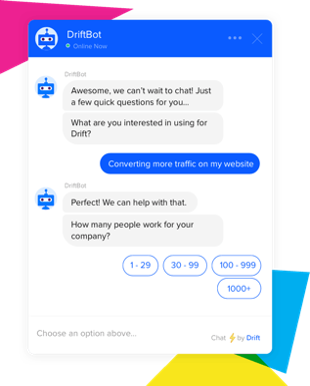
Intuitive chatbots are a great solution to save time.
Source: Drift
As seen in this graphic above, a chatbot can provide multiple-choice responses geared to questions they have in their system.
There is also a convenience factor with AI technology. Expanding AI applications can save us lots of money in the workplace as well as in our homes.
Smart electronic devices can be controlled by apps that can be switched on or off even when we are not at home.
Experts say that artificial intelligence is the future, but the future has arrived.
With the use of AI, different industries can automate their processes, save time and money, and find creative business solutions.
AI technology can predict natural disasters, find explanations for illness, and facilitate educational improvements.
Who knows what lies in store for other industries as AI becomes more prevalent within society?