
When AI Determines Strategy: Turning Algorithms Into Real Decisions
How teams actually use AI in strategy, moving from dashboards to decisions, spotting early signals, and turning models into measurable outcomes without...
Updated April 10, 2025

Statistics show that AI projects have a high failure rate. Our experience of working with multiple clients shows that AI projects require a completely different approach than regular mobile/web apps. The goal of this article is to outline the high-level process for developing successful AI-powered applications effectively.
According to the International Data Corporation (IDC), 50% of all AI projects fail. The IDC is not the only one making this claim.
The findings of their data research and advisory company seem conservative when compared to the numbers put forth by Pactera Technologies.
Looking for a Artificial Intelligence agency?
Compare our list of top Artificial Intelligence companies near you
According to them, more than 80% of AI projects fail to deliver the desired results that they were expected to produce upon initiation.
What’s most concerning is that AI projects fail despite the best efforts of the businesses initiating them. So, why do most AI projects fail? A report by Dimensional Research has some answers.
According to the findings of the report, the problems that lead to the failure of AI projects include lack of quality data, inappropriate labeling of the data needed to train AI, and low confidence in the AI model.
However, the problems do not end there. The IDC survey finds two other reasons for the high failure rate of AI projects: unrealistic expectations and skill shortages.
Despite the high failure rate, the implementation of AI projects is growing. While many AI projects will fail in the future, many others will be implemented successfully.
Businesses can ensure their success by following the high-level process designed to develop AI applications effectively.
Achievion has used this process to deliver successful AI solutions to businesses across a range of industries.
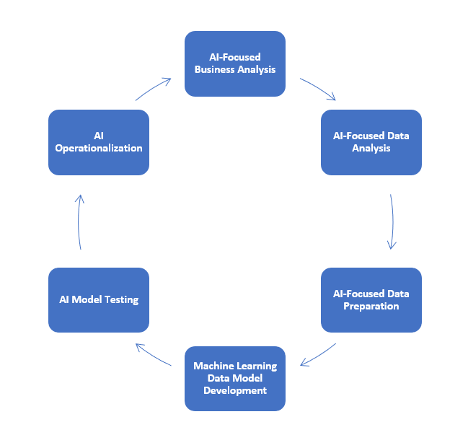
The following section describes each phase in detail.
This is an analysis of the business that centers around AI.
The key elements of AI-focused business analysis comprise the following set of questions that need to be answered:
The AI-focused business analysis needs to begin with a focus on the core requirements and objectives of the business.
Although your business will have many needs and objectives, your focus needs to be on only those that make AI essential. This is the ‘success criteria’ defined for the project.
To arrive at the ‘success criteria’ for the AI project, you need to assess the current situation of your business and understand the cognitive requirement.
Once you’ve established the success criteria, the next step will be determining how AI can help you meet it.
At this point, the AI Go/No-Go Assessment needs to take place. This is a quality control measure that will help you determine whether to proceed with the project or abandon it.
In case there are enough factors to proceed with AI implementation, it is critical to pick the proper AI pattern which will drive the execution technology stack, approach, and machine learning models selection.
The industry recognizes 7 distinct patterns:
Ultimately, all these activities help perform an analysis of the business centered around the AI project as well as determine its success chances.
The second phase of the AI application development process is all about analyzing data in relevance to the AI application being developed.
The key questions that need to be answered as part of this phase are:
This analysis needs to begin with an understanding of the core objectives and requirements for data. Once these requirements are understood, the next step would be to filter out the data sources that are relevant to the AI project.
Additionally, you need to find out the type and quality of data available to meet the business objectives that were established during the AI-focused business analysis.
The AI relevant data is the data that will be used for AI training purposes. Before you start using this data for AI training, establish a few important things, such as:
You also need to consider pre-trained models and whether they can be used for the AI project to speed up the project delivery.
By performing this analysis, you will know if you have the quality data needed — in the required quantity — to build a successful AI solution.
The purpose of this phase is to prepare data in accordance with the requirements and scope of the AI project. The key elements are:
The data used for the AI project must be able to address the needs of the business. Therefore, data not only needs to be prepared, cleaned, and labeled, but it also needs to be properly formatted and augmented.
The latter is especially important and can be achieved with engineering and enhancement of data. However, before you do this, make sure that pruning and optimizing data will make modeling more effective and accurate.
Once the initial data set is prepared, the process for future data set iterations needs to be established.
By ensuring the above, you will have enough data to move to the next phase.
This phase looks to establish the important processes that help create the ML data model for the project.
The key elements of this phase are:
Some important considerations for ML data model development include:
Taking all these things into consideration will allow you to create an appropriate ML data model for your AI project.
As the name suggests, this phase involves the testing of the AI model that has been developed.
The key questions that need to be answered as part of this phase are:
In AI model testing, the first thing to know is if the learning takes place for the trained model. A tool that can be used for diagnosis is learning curves.
Once testing results are available, the model should be reviewed for accuracy and performance as well as for matching the business KPIs.
If the model does not meet the criteria it needs to go through another iteration to achieve an improved outcome.
Ultimately, this phase will produce an ML/AI model that is ready for operationalization.
Now that your ML model has been tested and fine-tuned, it’s time to integrate it with other web or mobile application components and roll out to the production environment.
The process typically begins with a comparison of model operationalization requirements. You need to select the target deployment approach for your ML model:
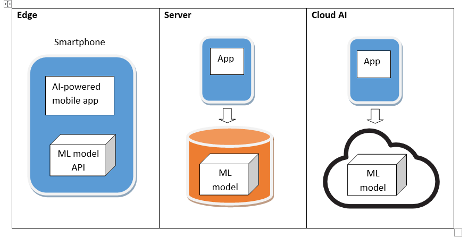
Based on the selected approach, the target environment needs to be configured and end-to-end integration with the rest of the application must be properly verified.
The last step of this phase is the development of the monitoring plan as well as a strategy for model governance.
The AI-focused software development process outlined in this article addresses a majority of the issues that lead to AI project failures.
This process has been battle-tested on multiple projects that Achievion has successfully delivered for its clients of various sizes and industries.