The Emerging Relationship Between Social Media and AI
As more customers rely on AI for recommendations, discover how AI-driven social discovery can make your content more visible.
Updated January 2, 2025

Even the most powerful technology can’t replace graphic designers and web developers – but Artificial Intelligence (AI) can certainly empower them to excel in their professions by streamlining manual processes. AI-enabled web development and design tools can automate routine, mundane, and lengthy procedures.
When applied to work that requires in-depth customization and intricate detailing, AI-enabled design tools are useful but far from perfect.
I’ve never felt a stronger tectonic shift in the web design and development sphere before now, and I predict that a next-level disruption of the industry is yet to come as artificial intelligence continues to advance and develop.
Looking for a Artificial Intelligence agency?
Compare our list of top Artificial Intelligence companies near you
This image represents the symbiotic relationship between AI assistive technology and the human technology specialists it supports. Rather than dictating or controlling the work people produce, AI serves as a helping hand in the background.
Everyone knows that AI is powerful – But how so, and to what extent? This article will seek to answer these questions through:
Together, these examinations will illustrate how AI-enabled tools can be valuable assistants to designers and developers at the workplace, but they can’t replace human specialists just yet.
Artificial Intelligence is an area of computer science that emphasizes the creation of intelligent machines to perform tasks independently.
These tools mimic aspects of human intelligence such as:
AI is commonly referred to as ADI (Artificial Design Intelligence) in the graphic design and web development industry. Nuancing the broader acronym gives it a more applicable and personalized feel.
In design and development, ADI refers to machines that exhibit human-like intelligence to complete tasks such as website development or image optimization without any human intervention.
People and businesses alike, tech-savvy or not, have a uniform desire for automation tools.
In the current market, this wish has turned into a necessity for organizations worldwide who want to stay ahead of the times. AI is a critical aspect of automation and holds exciting potential for technology companies.
Graphic design agencies and their identity depend on the nature of the work they perform. Regardless of your company’s expected volume of output, quality should never be a factor to compromise.
As time becomes an increasingly premium resource, consider implementing AI as at intervention at critical junctures. After all, everyone appreciates the power of automation to take care of their manual tasks.
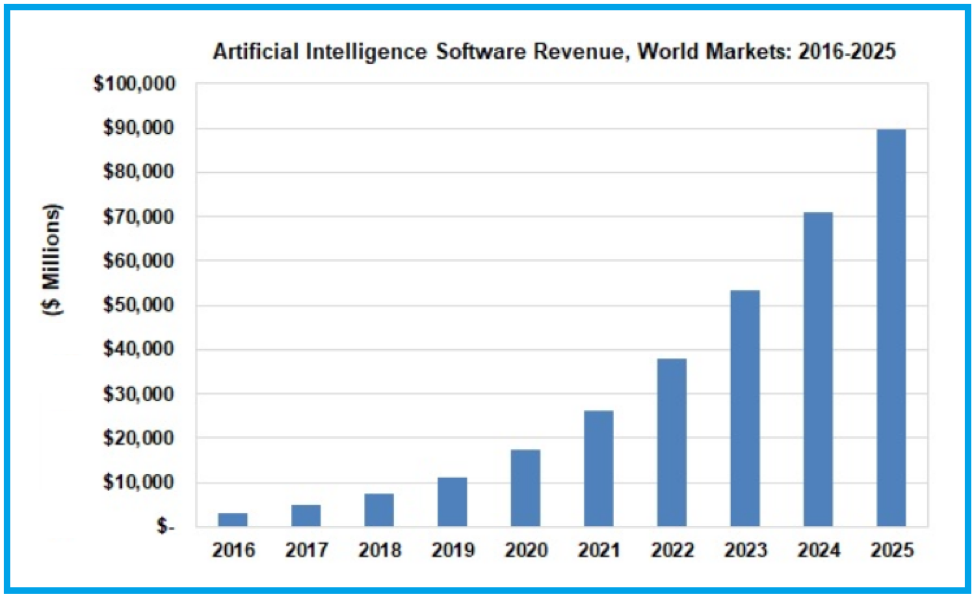
The numbers in the chart below tell a compelling story. Since 2016, the AI market has been growing at an incredibly fast pace and is expected to be worth $89.8 billion by 2025.
The design and web development industry has seen exponential growth over the years, but there’s no indication that the recurring, operational complexities have completely been curtailed.
AI has come far in assisting people at work, but it still has a long way to go before it’s 100% reliable and foolproof — especially for carrying out complicated tasks.
Many companies have sensed the boundless opportunity AI offers to power solutions. Leveraging this technology provides scalability and increased effectiveness.
The crux of ADI’s utility lies in helping automate the process of designing and developing websites and images.
The following list gives four examples of tools targeting automation and explains what they can do in greater detail:
Before you decide to leverage AI-enabled tools for your company, take a closer look at the benefits and drawbacks.
PROS:
Here are some of the most favorable aspects of AI-enabled tools:
Ask yourself an important question: Do these automated websites and design adjustments meet the quality mark you expect for your business? In many cases, these tools perform can perform sufficiently but still leave much to be desired.
CONS:
Lately, these areas have surfaced as weaknesses for AI-powered tools:
As a specific example, The Grid has come under fire recently. Experts have claimed that the use case of the tool is restricted to image auto-cropping and generating color palettes.
The websites these tools churn out have even been criticized as looking like overly similar copies of each other since they allow very little space for further customization.
Can AI Assist humans? Certainly. Can it outperform them? No, or at least not yet.
All the tools we’ve mentioned so far have created an immense buzz in this industry sphere, but not one of them has come even close to replacing human abilities.
After all, AI is still in the infancy stage. While capable of building websites and adjusting image designs, the tools’ shortcomings prevent them from doing so completely independently.
While it’s still too early to expect miraculous returns from AI, the scope of future opportunities holds unlimited potential for it to leave a mark.
Looking at the present, AI serves as a worthy catalyst for human designers and developers by saving time and physical labor.
AI-Powered Tools: The Perfect Assistant for Designers and Developers of Today
AI tools can’t measure up to human capabilities, but they can certainly empower people to improve. Together, technology and human advancement can get closer and closer to perfection.
AI Reduces Daily Legwork: Designers and developers are often stepped in mundane and basic and time-consuming tasks. AI can save time by automatically adding numbers, updating database records, simple image editing, and generating predictive coding to solve software glitch with distinction.
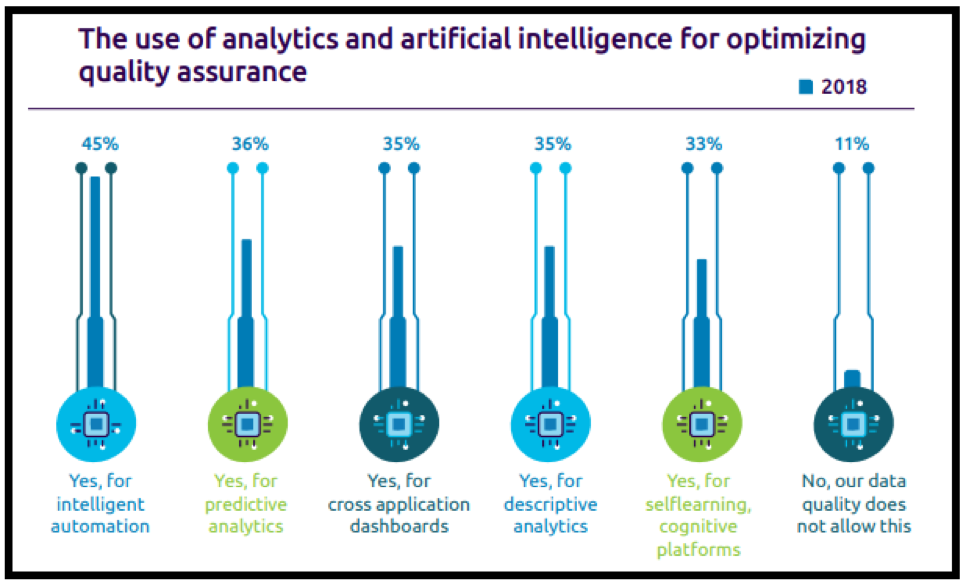
The World Quality Report by tech giant Capgemini offer the following statistics:
Quality Assurance: Another primary area of human empowerment AI has brought about lies in QA testing for applications. Deep learning algorithms can test an app without any human intervention by analyzing huge amounts of data and predicting any errors or inefficiencies. While improving the standards of software quality checks, they concurrently save time for dedicated testers.
Chatbots: AI-powered chatbots mimic human interaction and enhancing customer experience for website visitors. As these bots become more intelligent every day, their use cases become more varied and widespread.
A specific value they provide is automating the process of accumulating customer experience data based on user input and passing it on to the team. Developers and designers can use this insight to modify and enhance a website’s design, browsing experience, and UI/UX.
Human experts will always be a necessary aspect of design and development. The following factors differentiate AI from human intelligence. AI-powered tools won’t function autonomously until they can:
Designers and developers have no reason to feel insecure about their jobs. However, if the above statistic is any indication, it will be exciting to watch the future unfold.
Aditya is the founder of Digital Polo a unique design company that provides unlimited design work for a paltry fixed fee. Branding is simple if you know your way around the design bit of it. Through Digital Polo, Aditya has provided ample reasons to brands across the globe to buy into this claim.
See full profile