
Why Searching for a Specialized Dev Agency Takes Longer Than It Should — And What to Do About It
Looking for a niche software development agency? Learn how to define your requirements, find specialized providers, and vet their experience.
Updated February 19, 2026

The product owner plays a unique, collaborative role in a project and can often be the deciding factor in a project’s success. This article goes over a product owner’s core responsibilities as well as some of their top skills.
Updated 06/15/2023
For modern software development companies, the management method is crucial to the project’s success.
Looking for a Software Development agency?
Compare our list of top Software Development companies near you
Agile is an iterative and flexible methodology that’s become commonplace over the years. It’s based on the principle of creating a working software through comprehensive documentation. And it can accommodate the need for a dynamic solution in an ever-changing industry.
In my experience working for an angular development company, a functional Agile team requires a competent product owner who can structure the team for success.
Dividing your project into separate teams led by a product owner can help avoid unnecessary chaos in the work process. Each functional team can focus maximum effort on their specific responsibilities, allowing them to perform the best quality control.
First, we need to clarify what the role of the product owner is. This is a key position in any IT team that has become common, with the rise of Scrum- and Agile-based methodologies.
As reported in “Achieving Greater Agility” from Forbes Insights 2017, out of 500 international senior executives in July 2017, 92% stated that Agile methods are important to business success.
In an effort to understand the efficiency of Agile methods, in the 2017–2018 State of Scrum survey, data was collected to compare and evaluate the success rate in various industries using multiple different metrics:
Under the category “Leaders of Agile transformation,” senior executives ranked the product owner as the fourth-most important, leading the Agile transformation charge with a score of 22% contribution rate.
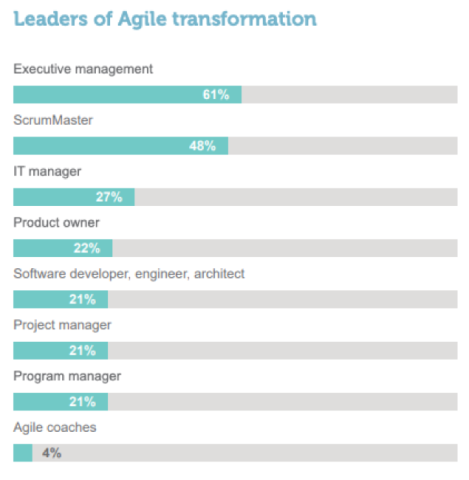
This score on its own shows how necessary product owners are when supporting other team leads, including the executive management (61%), ScrumMaster (48%), and IT manager (27%).
Product owners are able to apply and utilize new and effective management methods to push the project further.
Still not convinced?
For “Challenges with implementing Scrum,” the rate of failed Agile projects due to “Product owners/teams not willing/enthusiastic” has been ranked at a whopping 35%.
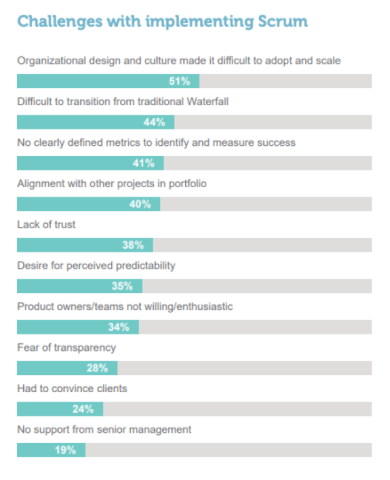
Having a good product owner can be a deciding factor for an Agile project’s success.
Now that we have covered the importance of a good product owner for any Agile project, we need to answer the next big question: what does a product owner do?
While the listed duties are common for the position, they would naturally vary depending on the project’s needs.
Product owners carry out meetings that serve to communicate the details of the project, as well as obtaining information regarding deadlines and the importance of different tasks.
As the direct link between the client and the development team, it falls on the product owner to make decisions that heavily affect both the work process and the end product. They should always have the best interest of the product in mind.
They need to communicate with the team to decide how many tasks can be completed realistically per Sprint. Delegating the Sprint timeframe (usually between 2 and 3 weeks) while allowing for flexibility during the task's planning period is important.
Keeping a “healthy” backlog is crucial, so weekly 1-hour meetings have to be structured and organized to push the project forward.
In those meetings, the items of the backlog are prioritized and assigned to specific resources to work on until the next meeting.
The product owner is the one who lays out the guidelines of each Sprint and the one who implements any further changes that may be needed in the meantime. This allows for a good objective view of where each team is and can help with the overview of the project’s workflow.
A product owner should always be prepared for meetings by doing some or all of the following:
Product owners play a very active role in Sprint planning, emphasizing important tasks so that they are taken care of first. They need to keep an eye on when a task should be updated as the situation changes.
What has been done? What could have been done better? What needs to be adjusted for the next Sprint? These are all questions that the product owner covers after a thorough analysis.
They’ll then implement these changes in the next Sprint planning process, discussing with team members to keep everyone aligned.
A software development company often has a research and development (R&D) period for processes. This involves testing new technical approaches that don’t always pan out but can still be time-consuming. Regardless, the data is always kept as it may prove helpful in new projects.
Communicating with stakeholders outside the project team can help clarify any questions. The product owner is responsible for gathering input and incorporating the received feedback into the project.
Both Agile and Scrum offer flexibility, which allows for a customized work process that achieves optimal results. As such, there’s no one plan that lays out all of the perfect steps for a project, so it’s up to the product owner to figure it out.
They must remain available and open-minded towards any suggestions from anyone on the development team as it may shift the development process for the best.
The best product owners are effective product owners. To fully understand what’s expected from a product owner role, examine these top skills of every great product owner:
As you have probably gathered by now, a good product owner has to demonstrate various qualities to be able to handle the different aspects of the job.

There are 6 main traits that a good product owner has:
These traits help project managers execute tasks effectively.
Product owners must be able to focus on specific tasks while also keeping tabs on what the other teams in the project are doing and why.
Seeing the big picture is the only way to manage the project as a whole. This allows the product owner to ensure that a team isn’t falling behind while other tasks being finished first aren’t becoming overly complicated. At the end of the day, a chain is only as strong as its weakest link.
This is the ability to scrap an idea or a plan if it doesn’t seem to work out, rather than pushing it until it does.
When it comes to the software development industry, it is key to understand the dynamic nature of building new software that has not existed before. R&D teams provide new ideas that often work wonders in the project. But sometimes, the attempted path does not fit in the final product.
This is a product manager that is focused on developing high-quality products. The core belief is, if a product is efficient, easily usable, and well-structured, it can be marketed after the fact to the target group that would benefit the most from it.
While overseeing a product’s development process, the product owner must know what the project will benefit from the most and adjust the work process to match the requirements.
They must also have a vision of the product’s potential functionality and application.
Approach the project focused on the potential end customer so that you can best tailor the solution. A product owner must also research competitors who provide similar services and work to develop a product that offers higher quality and/or better solutions.
While some argue that customer-focused and product-driven approaches are opposites, a good product owner must be able to operate with and understand both methods.
The product owner should have a strong understanding of the business principles of the market, such as customer needs, the biggest competitors, and current digital trends. Developing a business and marketing strategy to best serve the project and being able to implement it are a must.
More often than not, it’s easier to make a software engineer, development team lead, or a CTO the product owner rather than finding someone with all the qualities needed from a business background.
Along with knowing how to manage the project in terms of a business strategy, the product owner should ideally understand the key concepts of the software development process. That would allow for smoother communication with the technical team and optimized efficiency.
Additionally, being able to explain these concepts to stakeholders personally would remove the need for a software engineer to be involved in negotiations and business meetings when planning the project, which saves valuable time.
Keeping the end user’s intended experience in mind from the start is critical if you want to avoid additional UX work. A good product owner will strive for an intuitive and usable product.
Product owners are an absolute necessity for Agile management, and their performance will directly affect the entire development chain. It’s a collaborative leadership role that helps guides the project’s direction, though product owners will often pass the credit to the developers who carried out the legwork.
Regardless, product owners are key decision-makers who are responsible for understanding the product and business needs, addressing UX concerns, and prioritizing tasks efficiently. They must also communicate those goals to all relevant stakeholders and keep on their toes as situations change.
That interplay between well-thought-out guidance and consistent, focused effort can advance the software development industry by great leaps and bounds.
Marketing Specialist at Dreamix nurturing audience engagement through content, with a passion for technology, new software, and gadgets that revolutionize the working experience.
See full profile