
Podcast SEO in 2027: How to Make Business Episodes Findable
Learn how transcripts, question-led titles, structured data, and guest links help business podcasts get found on YouTube, Apple Podcasts, and Google.
Updated August 17, 2026

Content moderation services in 2026 range from about $49–$99/month for self-serve AI tools to $5,000–$50,000+/month for enterprise hybrid programs with dedicated human review teams, tooling, and compliance reporting. A workable content moderation budget covers four categories: moderation service costs, technology and infrastructure, quality assurance and training, and legal and compliance. This guide walks through building each of those line items step by step — with a free budgeting template — and covers the two regulatory shifts (the EU Digital Services Act and the UK Online Safety Act) that changed the compliance line materially since 2024.
User-generated content (UGC) is now the default surface of most online products, and moderating it well protects both users and brand reputation. Content moderation companies exist to make that manageable at scale. What follows is a practical framework for budgeting the service — including price anchors, category-by-category cost drivers, and the compliance implications you can't skip in 2026.
Content moderation pricing varies widely based on volume, content type, coverage hours, and the balance between AI and human review. As a rough 2026 anchor:
Looking for a Content Marketing agency?
Compare our list of top Content Marketing companies near you
| Program Size | Typical monthly cost | What you get |
| Self-serve AI tools | $49 – $199/month | Automated spam and toxicity filtering for a small brand's social channels or comment sections. Fast setup, no human review. |
| Mid-market AI + light human review | $200 – 2,000/month | Automated filtering plus part-time human reviewer for edge cases. Suitable for growing platforms and higher-volume ecommerce brands. |
| Outsourced human moderation team | $200 – 10,000/month | Dedicated moderator seats via a BPO or specialist agency. Coverage hours, escalation SLAs, and volume tiers drive cost. |
| Enterprise hybrid programs | $10,000 – $50,000+/month | Large moderation team, custom AI tooling, multinational coverage, formal QA program, and regulatory reporting infrastructure. |
For detailed pricing by service model — retainer, per-hour, per-item, and per-seat — see Clutch's content moderation services pricing guide. The rest of this article covers the framework for building the budget once you have a rough band.
Content moderation companies offer a range of services to ensure that both in-house content and user-generated content meet brand guidelines. A workable budget breaks down into four categories:
Grouping your budget across these four categories keeps forecasting comprehensive from the start and surfaces potential costs before the project commences. A well-planned system helps all parties manage expectations around spending, avoiding scope creep and downstream miscommunication.
The largest cost driver within any moderation budget is the balance between AI and human review. LLM-based moderation (built on top of general-purpose language models fine-tuned for classification) has changed the economics substantially since 2023 — accuracy is higher, multilingual coverage is easier, and per-item cost has dropped. But AI can't handle everything, and the failure modes differ from human failure modes.
A rough guide to how the mix affects your budget:
The right mix depends on your content volume, risk profile, and how much regulatory documentation you need to produce (regulators generally want to see human involvement in high-stakes decisions).
If your platform has users in the EU or UK, two regulations changed the compliance side of your content moderation budget between 2024 and 2026:
The EU Digital Services Act has been fully applicable to all in-scope services since early 2024. Key budget implications:
Even for non-VLOPs, plan for legal review of your terms of service, statement-of-reasons infrastructure, transparency reporting tooling, and appeals process design. Practical range: $10,000–$50,000 in initial legal and infrastructure work for a mid-size platform, plus ongoing reporting overhead.
The UK Online Safety Act, in effect since 2024–2025, imposes duty-of-care obligations on services that host user-generated content, with additional requirements for services accessed by children. Budget implications parallel the DSA in structure — illegal content duties, risk assessments, content-reporting mechanisms, and enforcement penalties — but the specific compliance obligations differ. If you have UK users, add a line item for UK-specific legal counsel and any reporting infrastructure the DSA setup doesn't already cover.
Beyond the EU and UK, several US states have passed platform-liability and children-online-safety laws with content-moderation implications (varying by state, subject to ongoing litigation). If your user base is US-focused, budget for tracking these — most of the compliance work is legal-review time rather than infrastructure, but the legal-review time is real.
Effective content moderation is crucial for maintaining the integrity and safety of online platforms. When outsourcing content moderation services, creating a well-thought-out budget is key to ensuring a secure and efficient moderation process.
Coming to your content moderation partner with a strong set of goals and objectives is the first step to a successful project. Some of the moderation metrics and KPIs to center your efforts around:
With those goals outlined, you have a solid foundation for working with a service provider. The budget falls into place much more easily when you know what you're aiming at.
Once you know what you need, you can begin evaluating candidates. There will be pros and cons to each. To narrow down the options, evaluate providers against:
Once you receive proposals, narrow down to the provider that best aligns with your priorities. From that point on, collaborate closely with your provider to break down exact costs and go into depth on your budget expectations.
Compare vetted providers in Clutch's directory of top content moderation companies.
Now, it’s time to break down your costs based on the categories of a content moderation budget. Let’s first address content moderation costs.
With your service provider, estimate service fees, scalability costs, content-volume tiers, and pricing differences by content type. Text is generally cheapest to moderate; images sit in the middle; video is most expensive per unit because it requires either frame sampling or full playback review.
Be candid with your provider about must-haves versus nice-to-haves. Providers are usually flexible on the mix when they understand your priorities.
Technology and tools may often be forgotten about within the scope of content moderation. However, these solutions are the infrastructure and foundation. Reserve space on your budget for tech because these costs can add up, particularly if you don’t expect them.
Include costs for:
At this point, it’s time to allocate funds for quality assurance and training aspects of content moderation.
Budget for initial training and onboarding of moderation teams, ongoing training programs, and quality assurance measures to maintain high moderation standards. A well-trained team is critical for accurate and consistent moderation.
The legal and compliance line varies by industry and by where your users are. Given how central compliance has become in 2026 — especially with DSA and UK OSA in effect — it's worth building this into the plan from the start rather than bolting it on later.
Cover:
Legal considerations are essential to navigating potential challenges in content moderation — and to keeping your platform out of regulatory trouble. Review and update your budget regularly to reflect changes in scope, volume, and regulatory obligations.
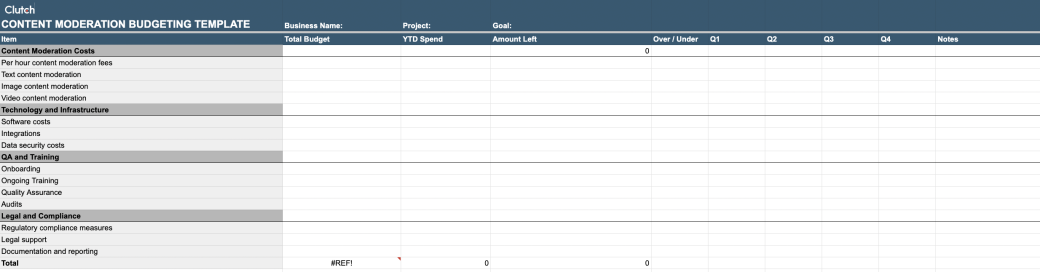
Download Clutch’s content moderation budget template.
Four factors move the needle most on content moderation cost. Use this as a checklist when you're pricing a new project or comparing providers:
| Factor | How it affects cost | Practical impact |
| Content volume and complexity | Cost scales with volume; video costs more per item than images, which cost more than text | A platform with 1M text posts/month costs meaningfully less to moderate than one with 100k videos/month. |
| Stringency of moderation criteria | Higher-precision guidelines require more review time per item and more calibration | Platforms serving minors or handling sensitive categories pay a premium for careful review. |
| AI and tooling mix | Upfront investment in AI reduces per-item human cost but increases infrastructure spend | Hybrid AI + human is the 2026 default for anything above small-brand scale. AI-only fails on edge cases; human-only doesn't scale. |
| Legal and regulatory scope | EU (DSA) and UK (OSA) exposure adds compliance infrastructure and reporting overhead | A US-only platform has lighter compliance costs than one with EU/UK users. Track this by user geography, not company HQ. |
The most successful content moderation projects share a solid budget in common. A thoughtful approach ensures your budget aligns with your moderation goals, regulatory obligations, and the specific characteristics of your platform's content. Budgeting effectively is the foundation for protecting your community through moderation — and for keeping the project defensible as it scales.
Content moderation costs range from roughly $49–$199/month for self-serve AI tools to $10,000–$50,000+/month for enterprise hybrid programs with dedicated human review teams. Mid-market brands typically spend $200–$2,000/month on AI-plus-light-human-review; growing platforms using outsourced human moderation teams typically spend $2,000–$10,000/month. Actual cost depends on content volume, content type (text is cheapest, video is most expensive per unit), coverage hours, and regulatory scope. For detailed pricing by service model, see Clutch's content moderation services pricing guide.
AI moderation is substantially cheaper per item — often 10x to 100x less than human moderation — but AI-only isn't sufficient for platforms of any real scale. The 2026 default is hybrid: AI handles high-volume, low-nuance filtering (spam, clear violations); humans handle edge cases, appeals, and context-sensitive decisions. Human moderation is still appropriate for very small platforms, specialized communities, or any decision where accountability matters more than speed. The right mix depends on your content volume, risk profile, and how much regulatory documentation you need to produce.
Regulatory compliance infrastructure — specifically the tooling and processes required by the EU Digital Services Act and the UK Online Safety Act. If your platform has EU users, you need statement-of-reasons documentation (Article 17), transparency reporting infrastructure (Article 15), and, for large platforms, systemic risk assessments and independent audits. Most 2023-vintage moderation stacks didn't account for these obligations, and the retrofit is often the single largest surprise line item in a 2026 content moderation budget. Plan $10,000–$50,000 in initial legal and infrastructure work for a mid-size platform with EU exposure, plus ongoing reporting overhead.