
How App Companies Can Build Trust with Customers
Learn how app companies can build customer trust through better privacy practices, transparent communication, and stronger security to improve retention and...
Updated September 8, 2026

Achieving success with a marketplace application requires your business to understand its target niche, customer preferences, and a smart scaling strategy.
Scaling a marketplace app means expanding your users, offerings, and infrastructure while keeping supply and demand in balance.
The core steps: validate traction in a niche, respond to real demand signals before expanding, build trust systems that hold at volume, invest in growth channels that compound, and build community.
Looking for a Mobile App Development agency?
Compare our list of top Mobile App Development companies near you
Most marketplaces that fail don't lack demand — they scale before they're ready, or they grow one side of the platform without the other. This guide walks through each stage, from early traction to multi-market expansion.
Before pushing growth, confirm you've earned it. Scaling an unvalidated marketplace amplifies problems, not revenue.
Look for these signals before shifting into scaling mode:
When all four are trending positive, you're ready to shift into scaling mode.
Traction is the rate at which a business model captures monetizable value from its users.
In the world of marketplaces, traction is when you have achieved a “network effect,” which is when your platform attracts both service providers and people who need these services.
To create this effect and grow your business, you need to find the activities your users do now and that can bring you revenue in the future.
To determine these sorts of activities, study your client’s behavior, talk to your potential customers, and analyze the way they interact with your marketplace. For example, ask them to test your product and tell you what prevents them from making a purchase or what functionality will improve their user experience.
Tips for gaining traction for your marketplace startup include:
Once demand exists, respond to what users are already asking for — don't guess.
For example, the owners of Rover, a marketplace that connects dog owners with dog sitters, discovered that their users ask sitters for other services, such as dog boarding, drop-in visits, grooming, or doggy daycare.
In response, they added these services and gained traction by creating not just a marketplace, but an entire community for pet lovers.
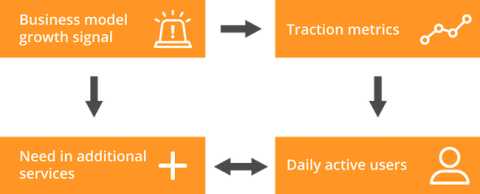
In business terms, the founders of this marketplace identified the business model growth signal – a need of additional services – which resulted in an increase in traction metrics, the number of daily users.
Yuggler, a kids' activities marketplace, had a solid product but stalled on downloads. The problem was thin inventory — users wanted more activities to browse, and faster. Yuggler added content-rich listings with photos and detailed descriptions. In one year, they reached 10,000 registered users.
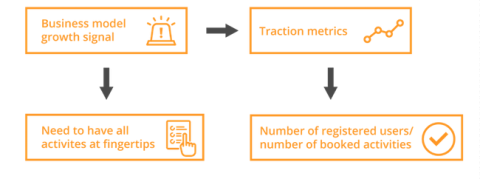
The pattern: identify what's already driving traction metrics, then double down on it. Business model growth signals show up in your data before your instincts catch them. Look for behaviors users are already doing, not features you think they might want.
After you have proved your value proposition, shift your focus to scaling.
There are various approaches to scaling which differ according to your market. These include:
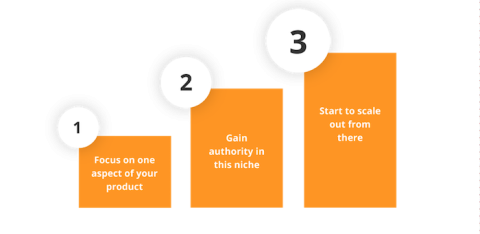
The picture above describes the steps you should take to grow your marketplace.
Here are the main tips on how you can do this.
As your user base grows, you need stricter controls on quality. More users means more risk — and your platform's reputation is only as strong as its weakest participant.
Here is how you can build the trust among them:
Create standards for your marketplace members and follow them as your platform grows. For example, Rover approves only 20% of applicants. If you carefully verify the requests you receive, you will build a reliable and proven community around your product. Here are the main things you need to check:
Ask both buyers and sellers to rate every transaction. Reviews are the trust infrastructure of a marketplace — they let users self-select partners and give the platform accountability without manual moderation at scale.
According to a UPS report, inconvenient returns policy deters 80% of shoppers. A good refund and return policy in the product marketplace gives your users more confidence in the legitimacy of your platform.
There are many of effective ways to promote your marketplace:
Word of mouth is an extremely effective technique for spreading knowledge about your product. It's not too costly, as mostly all it requires is your creativity. A great example of the effectiveness of word-of-mouth marketing is the food delivery marketplace Deliveroo. Every Friday, Deliveroo staff in Singapore put on kangaroo onesies to hand out different Deliveroo merchandise. This approach helped them create awareness for their brand.
Referral programs are widely used in popular online marketplaces such as Uber or Airbnb. Uber’s referrals program helped them grow and expand into 50+ countries in 3 years. Uber offers referral programs for drivers and riders. If the riders sign up for the first time, they get cash credits. If they refer a friend, both of them will get a referral reward.
Affiliate marketing is a way to get commission by promoting a product or service of another company on your website. For example, Preply, an online marketplace that connects tutors and students, uses an affiliate program in which anyone who places its link on their website can get 20% of the revenue on students and 2% of the revenue on teachers. One advantage of affiliate marketing is that you don’t pay for it until it provides results. If this strategy is suitable for your business, it is definitely worth trying.
Organic search is one of the most scalable channels for marketplaces because the content compounds. Build location-specific landing pages ("find a dog sitter in [city]"), category pages, and guides targeting the searches your users are already running. Thumbtack credits up to 90% of its growth to local SEO — a strategy that gets more effective as the marketplace expands into more markets.
The hardest scaling problem in any two-sided marketplace is the chicken-and-egg problem: buyers won't come without enough supply, and sellers won't list without enough buyers. This tension doesn't disappear as you grow — it moves up a level.
How to manage it:
Growing and maintaining a dedicated community is one of the best ways to scale your online marketplace.
Here is how you can do it:
To make your online marketplace more effective and valuable, include useful features. This will help you to improve your user experience and provide users with the necessary tools to interact with your platform.
To make your marketplace more advanced, you can add various third-party integrations. Here are some of the examples:
Custom quotes allow service providers set their own prices. You can also give your users an opportunity to get custom quotes instantly.
For example, ServiceWhale allows users to get a quote for home improvement online without the need for onsite visits from contractors.
Such an approach promotes transparency and promptness.
Custom admin panels for providers and buyers give your users more control over the buying and selling process. Admin panels also store key customer information, such as their activity, revenue, and orders, in one place.
The most important thing here is to listen to your users. User feedback helps you better provide your value proposition and grow your online marketplace.
Use these approaches to help you do it:
Helen is a content writer at Apiko, a marketplace development company. Her passion is writing useful tips for startups and established online marketplaces.
See full profile