
How to Define Brand Values That Guide Every Business Decision
Brand values are the principles that guide company decisions, define what a brand stands for, and shape how it treats customers, employees, and partners.
Updated August 26, 2026

Make sure your business name stands the test of time with evergreen branding.
Startup companies, much like flowers, sprout up fast and grow quickly.
In a rush to capture market share, the company naming process often centers on the initial product offering. The name focuses on the what vs. the how or why.
Looking for a Public Relations agency?
Compare our list of top Public Relations companies near you
Worse yet, the business moniker results from a late-night brainstorming session based on trending fads, awkward mashups, or knee-jerk word associations.
The results are scattered, outmoded brand names that require clarification, explanation, and expensive marketing.
To brand right, you have to dig deep.
For a brand to really take root, you must first do the hard work of shoveling and creating space for the idea to grow.
This means uncovering the taproot of the business model, which is the central theme or core attribute powering the brand. We call it your “pivot point,” the prime motivator that inspires both your current and future product and service offerings.
Evergreen branding is the discipline of building a brand — from the name outward — that adapts to industry changes without needing to rebrand. It's the opposite of trend-chasing branding: instead of tying your identity to a specific product, technology, or moment, you tie it to attributes and values that stay relevant as your business evolves. Done well, evergreen branding lets a company pivot from PC networking to cloud services without a name change, from mail-order books to global commerce without a rename, from a single meditation app to a wellness ecosystem without repositioning from scratch. Done badly, you end up as Books-A-Million rebranding to "BAM!" because the original name pigeonholes you into an obsolete niche.
This article covers what makes a brand evergreen beyond just the name, how to choose an evergreen company name that lasts, the AI-era naming considerations that didn't exist a decade ago, and how to navigate the 2026 domain and trademark landscape. First, a note on scope: "evergreen branding" and "evergreen content marketing" are different concepts. Evergreen content marketing is about publishing content that stays relevant over time (a how-to guide that still ranks in three years). Evergreen branding is about the brand itself — name, positioning, and messaging — being durable across industry cycles.
Evergreen brands share four durable qualities. A name that doesn't tie the company to a specific product or moment is the most visible one, but it's one of four:
The rest of this article focuses on the naming dimension, because that's where the most consequential — and hardest to reverse — evergreen branding decisions get made. But name selection only pays off when the other three dimensions are in place.
Literal brand names such as Toys “R” Us, CompUSA, RadioShack, and Linens & Things all proved problematic once they grew and evolved beyond their names.
To create a transcendent brand, an “evergreen,” the name should align with attributes or values that never go out of style.
Books-A-Million made sense when shipping hard copy books was in style. The name, however, pigeon-holed the company into the narrow and growingly obsolete niche of paper and hardcover books.
In desperation, product-identified brands will resort to tag lines such as “We’re more than just books!” In the case of Books-A-Million, the marketing department reduced it to BAM!, as if getting books by mail were some heart-palpitating event.
Amazon took another route, aligning itself with a metaphoric river, one that flows with an abundant assortment of products. Aligning in this way allowed this brand to expand without having to rebrand or overbrand its existing name.
One client of ours came with the name of PCnet-inc.com (both a hyphen and “inc” in the website name). The PC in the name was no longer PC.
This IT startup had its origins in networking PCs via ethernet cables. It eventually evolved to hosting, data management, cloud services, and data security.
We rebranded PCnet-inc.com as Corserva, based on the word morphemes of core, services, and servers, with a Latin-esque “a” ending, giving it a corporate feel.
The marketing lexicon now revolves around these attributes of vital or mission-critical, core services. Clients will always need core services, but they won’t always need PCs.
To avoid choking the life out of your brand, avoid literal, descriptive, or geographic references.
Avoid literal, descriptive, or geographic references.
Don’t use “wholesale” in the name if you ever plan to sell retail. Don’t use “USA” if you want to attract a global audience. Same applies to “host,” “hosting,” “site,” “sites,” etc. if you plan to expand beyond hosting and web design.
If you ever find yourself saying “We’re more than _______,“ then you have too literal of a name.
Great brands stay green no matter how long they've been in business. They don't follow trends and popular naming schemes such as mindlessly adding an "-ly" or "-ify" to the product name itself (e.g. Optiqly, Spacily, Sevenly, Flightly, Boxly, Bonusly, Optimizely). Just because the .ly is available, it shouldn't be the deciding factor in choosing a company name.
Instead, base the name on key attributes and/or positive connotations. The modern crop of technology brands illustrates this well: Notion, Linear, Vercel, Anthropic, Perplexity, Loom, Figma, Stripe. Each is either abstract (Notion, Vercel, Stripe), evocative of a durable positive quality (Linear, Loom), or drawn from a classical root that stays relevant across categories (Anthropic, Perplexity). None ties the company to a specific product, technology, geography, or moment. Each has room to expand — Stripe went from a payments API to a full financial-services platform without needing to rebrand.
So, just how do you create an evergreen brand name? Start by making a list of short words that capture your company’s key characteristics and attributes, words such as "true," "tru," "new," "nu," "bright," "smart," "star," "key," "first," "spring," "stream," "ever," "on," "all," etc.
These word parts imbue the company with pre-existing positive equity that can jumpstart the first impression. Make sure these words match up with what you do best, qualities you naturally exhibit.
Combine these words with more generic “tofu”-type words, such as "mark," "point," "line," and "time" – words that absorb the feel of the stronger, positive-connotation words.
You can also add some industry descriptor words but only if you know for certain they are broad enough and that you will remain in that sector for the life of your business.
So, tread lightly when adding these types of words. As a tool, we find it helpful to create an 8x8 or 10x10 grid and populate it with all these words as in the example below for an imaginary IT service company.
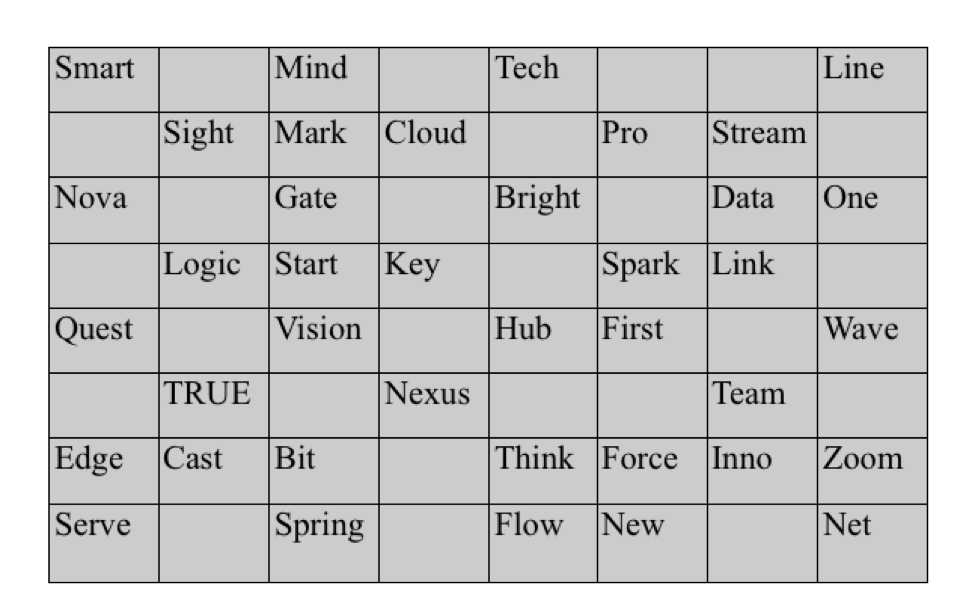
With this simple naming technique, you can mix and match thousands of possibilities such as:
Most of these names’ exact domain match will be taken or already in business, so be persistent and look up the current owner through a WhoIs.sc search and do a preliminary TM search on USPTO.gov.
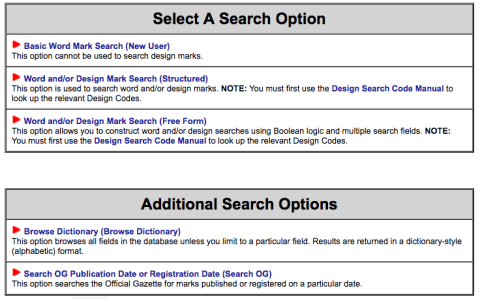
You will eventually find some winners that are available (as in deleted and available to register) or ones listed for sale on sites such as Afternic, GoDaddy, Sedo, or HugeDomains.
A couple thousand dollars is a reasonable investment for a good two-word domain name.
You will want to vet the short list as much as possible by running it by a TM attorney and Googling the name to see what’s similar to it.
Try out each name by practicing it as an introduction.
Develop a matching tag line that complements and clarifies the brand message and mission. Complete it with your own brand story that tells the “why” behind the brand.
Creating an evergreen brand name is one of the top naming strategies we employ, so fully explore the possibilities this type of company name can offer.
Once you have a shortlist of candidate names, you'll need to check domain availability and trademark clearance. Both landscapes have changed significantly.
.com scarcity. Most short, two-word .com combinations are already taken. Aftermarket domains (available on Afternic, GoDaddy, Sedo, HugeDomains) run from a few thousand dollars for available two-word combinations to six or seven figures for one-word premium domains. A couple thousand dollars remains a reasonable investment for a good two-word .com; budget more if you want something distinctive.
Alternative TLDs. New TLDs have moved from experimental to mainstream. .ai has become the default for AI-native companies and commanded a domain-registration land grab starting in 2023 — many premium .ai domains now cost five or six figures on the aftermarket. .co and .io remain established alternatives for tech companies. .studio, .design, .agency, and category-specific TLDs are viable for niche brands, though .com still carries the most trust signal for consumer-facing businesses.
International trademark considerations. If you plan to operate internationally — and most digital-native businesses do from day one — a US-only trademark search isn't enough. Check the EUIPO (European Union), UKIPO (United Kingdom), and any major target market's trademark database. A short list of candidate names should also be checked for meaning across major languages (a name that works in English may translate awkwardly or offensively in Mandarin, Arabic, Spanish, or German). AI translation tools make this initial screening much easier than it was a decade ago.
Domain verification workflow. Search the name on WhoIs for current ownership, do a preliminary trademark search on USPTO.gov, then run each finalist past a trademark attorney before committing. Google each candidate to see what's semantically similar — including in AI answer engines like ChatGPT, Perplexity, and Google's AI mode. A name that gets confused with an existing brand in AI responses starts life at a disadvantage.
AI answer engines have added a new consideration to evergreen naming: how easily an AI model can distinguish your brand from generic terms and adjacent brands. Three shifts worth designing for:
The naming principles outlined — evocative, positive-connotation, attribute-aligned, distinct from category descriptors — hold up well in the AI era. If anything, they've become more important: distinctive brand names are easier for AI models to remember, cite, and disambiguate. Generic names lose twice: they don't resonate with humans, and they don't stand out to the machines humans increasingly ask.
Aligning your company name with what you currently sell can spell trouble. Aligning with the "how" or "why" behind your company can clarify your true purpose and empower future growth and expansion. By choosing attribute-based naming strategies, you can grow a brand that adapts with changes in the industry — and, in 2026, one that AI answer engines can accurately represent to buyers researching your category.
The naming decision is one of the highest-leverage decisions a company makes in its early years. It's the one branding choice that scales into every future decision: every website, every product, every hire, every marketing dollar carries the name forward. Make it evergreen from the start, and you save yourself the cost — often measured in years — of a rebrand later.
Evergreen branding is the discipline of building a brand — from the name outward — that adapts to industry changes without needing to rebrand. It has four dimensions: an evergreen name that aligns with attributes rather than specific products; consistent positioning that stays fundamentally the same as the business grows; durable messaging that holds up across cultural shifts; and operational consistency where the brand's behavior matches its promise over time. Well-known evergreen brands include Amazon (a metaphoric river that flows with any product), Anthropic, Notion, Linear, and Stripe. Poorly named counter-examples include Toys "R" Us, CompUSA, RadioShack, Linens & Things, and Books-A-Million — all names that pigeonholed the businesses into obsolete categories.
Start with your company's core attributes and values, not your current product. Combine short evocative words that carry positive equity ("true," "smart," "star," "spring," "ever," "first") with more generic "tofu" words that absorb the meaning ("mark," "point," "line," "time"). Avoid literal, descriptive, or geographic references — no "wholesale" if you'll sell retail, no "USA" if you'll go global, no "host" if you'll expand beyond hosting. Test candidates by checking .com and alternate TLD availability, running preliminary trademark searches on USPTO.gov and international registries (EUIPO, UKIPO), verifying meaning across major languages, and checking how AI answer engines represent the name. A good two-word .com typically costs a few thousand dollars on the aftermarket; premium single-word or .ai domains cost substantially more.
Evergreen branding and evergreen content marketing are different concepts that share the "evergreen" metaphor. Evergreen branding is about the brand itself — the name, positioning, messaging, and operational consistency — being durable across industry cycles. It's a strategy for the identity that carries every future product, campaign, and hire. Evergreen content marketing is about publishing content (blog posts, guides, videos) that stays relevant over time and continues to attract traffic and leads for years after publication. A company can have strong evergreen content marketing on top of a poorly-named brand (or vice versa). Both benefit from the same underlying principle: build for the long term, not just the current moment.