
Why Searching for a Specialized Dev Agency Takes Longer Than It Should — And What to Do About It
Looking for a niche software development agency? Learn how to define your requirements, find specialized providers, and vet their experience.
Updated May 28, 2026

Building a website can cost anywhere from a few hundred to tens of thousands of dollars, depending on design, features, and functionality. Learn how to create a smart web development budget that prevents overspending, breaks down costs, and ensures your site supports long-term growth.
Web development projects can easily spiral out of control thanks to scope creep, unclear requirements, and poor communication. That’s why business leaders need a clear website budget—not just to control costs, but to invest wisely in design, functionality, and ongoing maintenance that deliver measurable returns.
A well-planned budget ensures companies allocate resources effectively, build a site that supports growth goals, and avoid costly surprises that can undermine performance or credibility down the line.
Looking for a Software Development agency?
Compare our list of top Software Development companies near you
Here’s what you need to know to create a website budget before you start building your website.
It usually costs less than $10,000 to build a website from scratch, but the price can vary widely depending on the complexity and functionality of the website.
It also largely depends how much of the work you handle yourself, the size and scale of your website, and the additional expenses for things like payment processing, plugins, and design assets.
Based on data collected through Clutch reviews, here’s a general breakdown of what it would cost to build a website, whether you build it yourself or hire a third-party developer.
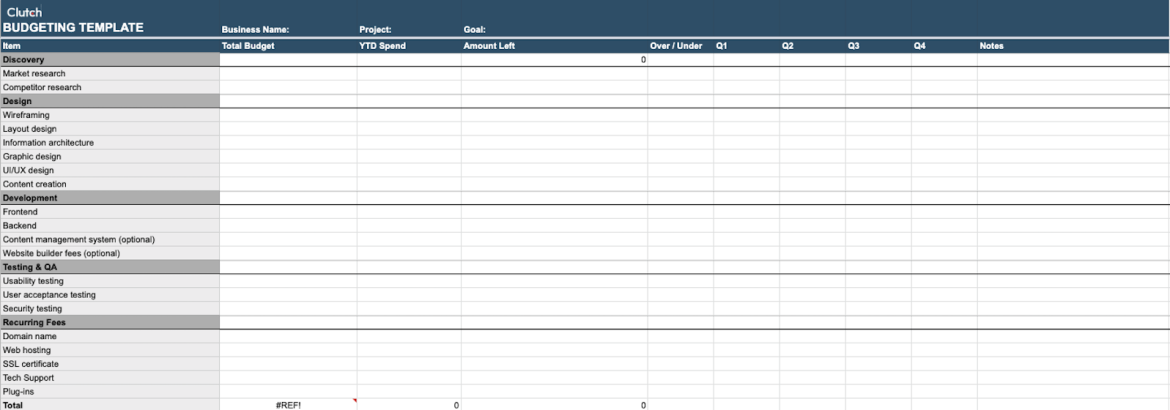
Download the template for your web development budget.
The cost of building a website varies widely, due to many factors including:
To create an accurate budget when building a website, companies must be aware of the costs surrounding web development. Know what each part of your project will cost in order to keep your budget under control.
The purpose of your site may also impact the size of the platform — an informational site may require just a few pages, while a database or an e-commerce site may need a few hundred or a few thousand.
Of course, a larger website means that it will take longer to develop it. Generally, web developers charge an hourly rate for their services. Thanks to these labor costs, the price of the project will inherently increase based on the size of the platform.
Having a general idea of how big the site will be will not only help developers create a timeline to keep the project on track, but it will also help you calculate how many hours they will spend on the project, and therefore, how much you will need to budget for labor costs.
What may affect the budget of the project more than anything are the features and functionality of the website. More complex websites are labor-intensive and expensive. Even though certain features can impact the project’s budget, ensuring that your website can deliver everything your business needs makes it well-worth the cost.
The purpose of your website will likely impact what features you need to include, and therefore the cost. New data shows that small businesses invest in their website to increase sales and revenue (39%), build brand awareness and credibility (24%), or provide information or customer support (22%).
For instance, businesses who aim to attract and impress new audiences with their website will likely focus on design and ensure that they can create engaging landing pages for upcoming campaigns. In contrast, a customer support–focused website will prioritize usability and functionality, offering clear navigation, FAQs, and live chat tools to help existing customers find answers and resolve issues quickly.
Here are some common features businesses may choose to include in their website.
Additional reading, ‘Top 6 Website Features People Value.’
Of course, some features are more expensive than others. Developing a bespoke CMS, for example, requires significantly more work than ensuring that images can be uploaded to the site.
To keep your budget in check, it’s important to prioritize the features you want to include in your website. First, create a list of all of the features you want to include in your site. Then organize them from most to least important. Alternatively, you can divide your list into features you need versus features you want.
This way, if your budget starts to run a little tight, you know what you need to cut to prevent overspending, while still ensuring that your website includes the features your business needs.
Once you’ve created this list, you can conduct more research into what it costs to build each feature to estimate how much it will cost to build your dream website.
If you choose to hire a web development company, a list of the features you want to include is essential for getting an accurate quote. In addition to providing a fair and accurate cost estimate, vendors can use this information to manage your budget throughout the development process.
Learn more about how much it costs to hire a web development company in Clutch's 'Web Development Pricing Guide.
When it comes to the cost of web design, the numbers really vary depending on how much custom work is involved. If you’re simply using a template on a website-builder, design costs can be relatively low. But if you’re building out a larger or more complex website, design alone can become a significant expense.
According to data collected on Clutch, web-design companies charge between $100–$149 per hour. Most projects cost under $10,000, but again, the size and complexity of the site drive up cost quickly
Companies often turn to website builders because they significantly reduce development costs compared to hiring a full-time developer or agency. Tools like Wix, Squarespace, WordPress, and Shopify power 75% of small business websites.
Website builders provide pre-designed templates, drag-and-drop functionality, and built-in hosting and security, allowing businesses to launch professional-looking websites quickly without paying for custom coding. Now many now include AI features that automate design, content, and personalization.
However, functionality in these website builders can be limited. Some companies may find that they need more experience to add additional plug-ins or features to their website. In these instances, they may determine that it is better to work with a developer or freelancer who is more familiar with the website builder.
| Wix | $17-$159/month |
| Squarespace | $16-$25/month |
| Shopify | $25–$105/ month |
| Wordpress | $3-$30/month |
In addition to standard development costs, there will be recurring fees to launch your website and keep it up and running. It’s important to account for these costs, not just in your website development budget, but also in your ongoing business budget.
| Recurring Maintenance Costs | Fees |
| Domain Name | $0–$20 per year |
| Web Hosting | $2–$80 per month |
| SSL Certificate | $0–$1,000 per year |
| Tech Support | $2–$300 per month |
| Plug-ins | $0–$600 per month |
These ongoing fees are absolutely essential to keep your website functional
There are many steps when taking a website from conception to launch. Creating a web development budget requires business leaders to consider all the aspects of the project. Understanding the scope of your project is a key step in creating a budget for your website development project.
Whether you choose to hire a web development company, build the platform in-house, or hire a freelancer, here is what your quote should entail.
Once you understand exactly what you need to build a website that meets your business’s needs, you’ll be able to estimate how much you need to spend.
Building a new website for your company can be an intimidating task — the design and functionality of your platform depends entirely on what your business can afford. By outlining breaking down your budget before the project begins, you can build a new website that has everything you’re looking for.
Follow these tips when creating a budget for a new website:
If you’re not careful about how you go about budgeting, building a website can be a costly process. Especially for small businesses or those who are just getting off the ground, keeping your costs in check is absolutely necessary.
When building out your web development budget, you should first determine what your business can actually afford. To do this, you must carefully go through your revenue, fixed costs, and variable expenses.
This information should be included in your company’s financial reports. Profit and loss statements, for example, summarize the revenue, costs, and expenses that have occurred within a fixed period. By subtracting costs and expenses from your income, you can determine your profit.
You should then set aside a portion of what you’ve saved for your new website. For some, this may be just a few hundred dollars, but for others, it could be several tens of thousands. How much your business is willing and able to spend will have a huge impact on what they can accomplish during their website development process.
With an estimate of the total you can spend on the project, you can then break down the cost of each segment of the project and outline your website’s budget.
The cost of building the website varies depending on the size and complexity of the project. A scope of work outlines the expectations of a project and can have a huge impact on what a business spends on their website development.
Traditionally, a scope of work should be very detailed and include expectations for product features, designs, which tech stack to use, and which metrics you plan to track. During the budgeting process, business leaders don’t necessarily need to have a super detailed scope of work that includes the project schedule or deliverables. However, they should have a basic outline of what they want to accomplish through their website.
With a solid understanding of what their website goals are, business leaders can create a project scope that features the size and features of the site. With this information, they can estimate the cost of developing the website and break down what they should spend on each.
If you plan on hiring a web development company, a scope of work can also help potential vendors provide a fair and accurate cost estimate.
Additional reading, ‘Why A Scope of Work is Essential to Finding the Right Service Provider.’
To create a scope of work, companies must first pinpoint the purpose of your website and the type of website they want to build. While some companies may need to build a robust platform with thousands of product pages, others simply use their website to provide information about their company and their brand.
Hiring a service provider, such as a web development company, may increase the budget of the project simply because of the labor costs associated with it. To avoid these costs, many companies choose to build their website in-house or with a website builder.
For businesses with experienced website developers on-staff, this certainly makes sense. However, complex website designs can be tricky to implement. Especially if your business requires a lot of features or enhanced functionality, hiring a professional web development company will ensure that you receive the final product you’re looking for.
If your business doesn’t have the resources you need to build your website in-house, but you still can’t afford a full web development company, another option would be to hire a freelancer. For simpler websites, freelance developers can provide the experience needed to deliver a high-quality website at a more reasonable price than a full development team.
Alternatively, low-cost or free website builders allow people with limited or no development experience to build their own websites. These online tools allow people to use drag-and-drop features or choose from design templates to build their own websites.
Many website builders also provide additional features that your business may need for your website. For example, Squarespace and Shopify provide shopping carts, making them the perfect website builder for e-commerce platforms.
Like any big project, things can go awry when building a website. When this happens, it’s nice to have a little wiggle room in your budget to accommodate unexpected expenses.
By budgeting for these expenses, companies can ensure that the project will be completed without a huge impact on the business’s bottom line. It will also keep costs in check and allow businesses to expand the scope of their project if they think it will improve the final product.
Whether you’re looking to build a complex e-commerce website or a simple informational site for your business, outlining your website development budget is necessary to keep your costs in check.
Website development can be a complicated process, so it’s important for business leaders to account for every aspect of the project. With a solid understanding of how much it will cost to deliver everything your website needs to be successful, you can build a great website without blowing the budget.