
How to Measure SEO Success When Traffic Declines
Organic traffic is down, but is your SEO failing? Learn which metrics show real SEO success when AI Overviews and zero-click searches are reducing clicks.
Updated January 2, 2025

Recursive keyword research helps identify and target ranking opportunities associated with your main keyword targets.
Keyword research is an essential part of any SEO campaign.
There are a couple of ways to conduct keyword research. You can scrape keywords through manual Google searches or use a tool like UberSuggest to find keyword variations.
Looking for a SEO agency?
Compare our list of top SEO companies near you
However, if you do keyword research manually, you may miss niche, long-tail keywords. These keywords tend to be easier to rank for and high-converting, so they’re definitely not something you’d want to miss out on.
Even with suggestion tools, you can never cover 100% of your keyword opportunities. The only results you get from those are variations of your base keyword.
To get every single potential keyword opportunity, you need to conduct recursive keyword research, the process of finding keywords based on the target keywords you already have.
This article explains recursive keyword research, how to conduct it, and the value it can bring.
Recursive keyword research helps you realize your full keyword targeting potential through leveraging your existing keyword targets.
Start recursive keyword research with a base keyword, such as “SEO services.” Ideally, you target keywords that are top-level buyer intent, or those likely to convert traffic into customers. Such keywords are usually related to products or services, rather than general information.
For example, let’s say you’re an SEO agency.
If someone searches “SEO services providers” they are much more likely to be interested in your services compared to someone who searches a generic keyword such as “seo basics.” Instead, these broad search queries indicate that the searcher may want to learn how to do SEO rather than hire someone for it.
In our example of an SEO agency, your main top-level buyer intent keyword would be “SEO services.”
First, dig around your main keyword on Google. Go to your favorite SEO tool and analyze the first search result. I usually use either SEMrush or ahrefs.
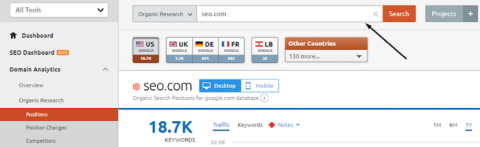
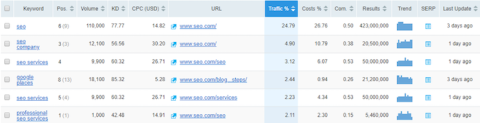
Extract the keyword results into an excel file. To get the most out of this tactic, I recommend going for at least the top 5 results. Anything less won’t give you a lot of insight, while anything more could end up eating too much of your time or simply lead to duplication.
Then, compile the complete list of keywords into a single excel sheet and remove duplicates.
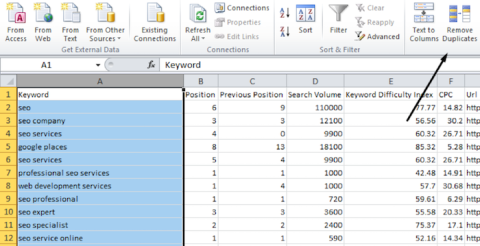
Discard any irrelevant keywords, for example, “seo work online” and “How internet marketing works”. Neither of these keywords fit my target audience.
Group your keyword results into 3 categories:
Once you sort your keywords, take some of the new sub-topical seed keywords you found and create a separate excel sheet for those.
For example, when researching ‘seo services’, I also found competitors targeting ‘link building services’. This is a broad enough topic to be targeted with its own page, so I create a new sheet dedicated to it.
You should target 4-5 different topical seed keywords and multiple sub-topical seeds, with topical keywords for each.
Now, dig into each new seed keyword and start adding sub-topical seed keywords for them.
As the next step, we take “link building services” as a new seed keyword. I find the following sub-topics:
Create a separate SEO sheet for these as well.
It’s entirely up to you how far you’d like to go with this. The more keywords you take through this process, the more conclusive your research will be.
To visualize the whole thing, this is what our research on “SEO services” would look like:
If a keyword is not relevant to your company, you can simply decide to drop the search and jump over to the next sub-keyword.
For example, “how search engines use links” might be pointless and too hard to rank for if you’re an agency. It might be perfect if you’re an SEO SaaS company, though.
Once you have your all of your keywords mapped out, use the topical ones to create supporting pages on your site to help rank for those terms.
Supporting pages increase average stay time on the website, which according to the research from WordStream, makes you more likely to rank.
There are several other benefits to using supporting pages. For example, they help make the main page more “topical” and authoritative. This means that whatever information the Googler is looking for, they’ll find it on your website.
Once you’re done with the research for all your base keywords, take new seed keywords and repeat the recursive keyword research process.
Recursive keyword research is not a method you can do in a day. If you want to cover all of your potential keyword targets, you need to devote time and resources.
The payoff, however, is well worth it. You’ll have a complete list of every possible keyword you can target even before you launch your website.
Using recursive keyword research, I can plan content and achieve results including:
Conducting exhaustive keyword research for your SEO campaigns pays off. You’ll have the exact roadmap of work needed to be done, specific guidance for content created, and no surprises popping up along the way.
And as we’ve just explained, recursive keyword research is the best way to get there.
 Benjamin J Church works with clients in competitive markets around the world to help them reach customers through Google. He is also a keen musician and can often be found playing the guitar.