
How to Measure SEO Success When Traffic Declines
Organic traffic is down, but is your SEO failing? Learn which metrics show real SEO success when AI Overviews and zero-click searches are reducing clicks.
Updated March 24, 2026

You want to invest more in SEO to grow your business, but who should you hire: a freelance SEO specialist or an SEO agency? Learn more about the pros and cons of each before choosing a partner to hire.
Deciding upon freelance vs. agency SEO services comes down to what your business needs most: agility, scale, or compliance. Both freelancers and agencies can improve rankings, boost visibility, and drive traffic, but the right partner depends on how you weigh expertise, cost, flexibility, communication, and risk.
Outsourcing makes sense if your team lacks in-house SEO skills, but not all providers deliver the same value. Freelancers offer personalized attention at lower costs, while agencies come with structured processes and deeper resources. This article breaks down when to hire each, comparing their strengths and limitations across five key criteria so you can make the smartest investment for your growth.
Looking for a SEO agency?
Compare our list of top SEO companies near you
However, companies that don’t have the resources or expertise to optimize their website on their own may need to outsource their SEO efforts to either a freelancer or an SEO agency.
Learn more about the strengths and weaknesses of each to determine which one would be the best partner for your business.
Looking to hire an SEO expert? Search for top-rated SEO companies on Clutch, then filter by location, client ratings, and cost to find the perfect partner for your business.
A freelance SEO provides services that help businesses improve search rankings, traffic, and conversions without the overhead of an agency. This includes keyword research, technical audits, on-page optimization, traffic monitoring, content development, competitive analysis, and link building.
These freelancers are flexible workers (hourly, per project, or on short-term retainers) collaborating with internal, full-time marketing teams or web developers.
An SEO agency is a larger, structured organization that delivers end-to-end services through a team of specialists. Unlike a single freelancer, agencies typically include strategists, technical SEO experts, content creators, and link-building professionals. This allows them to provide several different services and execute all aspects of an SEO strategy.
In deciding whether a freelance SEO specialist or an SEO agency is the right choice for you, there are several key criteria you want to consider:
Here’s how freelance vs. agency SEO services stack up in each of these areas and the benefits and disadvantages each brings.
Freelancers can provide a known, single point of contact with direct access through email, messaging apps, or shared project boards. This can make communication faster and more personal. Their update cadence can be ad hoc or scheduled based on the project’s pace. This setup works well for smaller teams that value quick turnaround, direct collaboration, and flexibility.
Agencies typically have established communication protocols. You might work with an account manager as your main point of contact, supported by specialists behind the scenes. Updates are delivered on a set schedule (such as weekly, biweekly, or monthly) through formal reports and review calls. While this is less flexible than freelancer communication, it ensures consistency, accountability, and visibility across multiple stakeholders.
Clear communication builds a stronger relationship where you will be able to bounce ideas off one another, provide feedback, and discuss potential ways to move forward.
Not only will communication be better when you can work closely with an SEO partner (whether it’s a freelancer or an agency), but they will have a better understanding of your business goals, audience, and strategic initiatives.
Search engine optimization is multifaceted and includes everything from writing on-site content, keyword research, and building a backlink profile to technical aspects like managing your website’s code, creating an intuitive website architecture, creating a robots.txt file, internal linking, and managing 404 errors.
As you can imagine, it can be difficult to find one person who not only has the expertise needed to execute everything in your SEO strategy but also who has the time to. Most freelancers have to manage tasks independently with widely available project management tools like Trello or Google Sheets. This allows them to adapt workflows to a client’s preferred style with flexibility for quick pivots. However, if you prefer the structure of formalized processes, a freelancer may not work this way.
Not surprisingly, freelancers have very little oversight — they have nobody reviewing their work, communicating details, and providing feedback. In order for the partnership to run smoothly, an internal team member has to manage them and provide work. This can detract from their own responsibilities and impact your team’s success.
SEO agencies, on the other hand, have many experts who can support your project, managed in enterprise-grade platforms such as Jira, Basecamp, or proprietary dashboards to coordinate all these team members across strategy, content, technical, and reporting tracks. The workflows are standardized, with defined milestones, QA steps, and approval layers, offering greater consistency and scalability for complex or multi-channel SEO initiatives.
Because of this, an SEO company is likely to require less oversight. You may only need to meet with them when they deliver status updates or reports.
If you’re a small company or working with a smaller SEO budget, hiring an SEO freelancer may be your best option because they are considerably more affordable.
Freelancers tend to charge hourly rates and are more flexible in negotiating the terms of the work partnership, ensuring you’re only paying for the services you really need and can easily manage how much you’re spending on SEO specifically.
SEO agencies are generally more expensive than freelancers because they have more resources and have built up a reputation in their field. That being said, how much they charge and the pricing model they use varies depending on the services they provide, where they’re located, how many employees have, and their experience.
Here’s a breakdown of the most common pricing models with typical cost ranges for SEO freelancers vs SEO agencies:
| Pricing Model | Freelancers | Agencies | Best For |
| Hourly | $50–$150 per hour | $100–$300 per hour | Short-term tasks, audits, or flexible workloads |
| Project-Based | $500–$5,000 per project (e.g., audit, content package, site migration) | $2,500–$30,000+ per project (depending on scope/scale) | Defined deliverables with clear start and end points |
| Retainer (Monthly) | $500–$2,500+ per month | $3,000–$15,000+ per month | Ongoing campaigns, strategy execution, and long-term growth |
Freelancers typically have a fast onboarding process since you’re dealing directly with the one person doing the work. Many freelancers can start within days of receiving access to your website and analytics tools. Their reporting cadence is usually flexible depending on your preferences and their capacity, from informal weekly updates to monthly summaries.
Agencies, on the other hand, typically require more structured onboarding. They may request discovery calls, competitive analysis, and technical audits before any optimization work can begin. Agencies tend to have standard reporting, delivered monthly or biweekly with dashboards and formal review calls.
Freelancers are best if you want speed and personalized updates without heavy formalities. Agency processes tend to be slower but ensure consistency, detailed performance tracking, and alignment with long-term strategy.
It’s important to remember that SEO may take awhile to produce results. While the impact on website traffic and conversions can make SEO well worth the investment in the long run, it can be difficult to justify the expense of working with an SEO agency when it’s difficult to measure their impact right away.
An individual freelancer will only be able to support SEO in the areas that they’re familiar with, whereas an SEO company has a full team of experts that specialize in different areas. For SEO in particular, it can be challenging to find an SEO specialist with the technical expertise to improve your site’s performance.
Many SEOs have built their experience on the SEO skills such as content development and building backlink profiles. While these skills are really beneficial, if your site needs more support resolving technical issues, some SEO freelancers may be able to diagnose the problem but won’t be able to fix it without support from your development team.
While a freelance SEO specialist can be ideal for smaller workloads or specific tasks, scaling quickly can be difficult without bringing in additional help.
Alternatively, an SEO agency will have experts in both areas, ensuring that they are able to support all of your needs. This resource depth allows agencies to handle higher volumes of work, manage multiple campaigns simultaneously, and scale efforts up or down more seamlessly.
This makes SEO agencies a great option for companies who see the value in investing in SEO but don’t have the internal resources to support all of their efforts.
Many SEO agencies can be hired on retainer or for longer contracts in which they will dedicate a set amount of time each week to managing your SEO. Whether you want a partner who spends just a few hours monitoring your website’s performance or one who can handle everything from start to finish, you’ll be able to find the partner who can support your ongoing SEO needs.
Most SEO freelancers transfer ownership of created content, reports, or strategies once payment is complete, but this isn’t always guaranteed. Be sure any account access granted comes from client-owned accounts, with the freelancer given temporary or role-based permissions. This ensures the company retains control.
SEO agencies generally follow more formalized processes, but it’s equally important to confirm that all deliverables, campaign assets, and data remain client-owned. Contracts should specify IP rights, especially for proprietary frameworks or tools the agency may use. Agencies often set up accounts on behalf of clients, so clarify whether those accounts are created under the client’s ownership or the agency’s. Again, be sure you retain account control and ownership of all assets. If you change SEO service providers, you want to protect continuity and avoid dependency issues.
Since SEO agencies can’t guarantee results in a certain time period and understand that SEO takes time to be successful, they may require longer contracts.
While this is largely to protect their business, it does make it difficult for companies who are on a tight budget to work with an SEO agency. Freelancers, on the other hand, are more flexible and can be brought on for specific projects.
When outsourcing SEO services, compliance and security need to be top priority. Whether you’re going with a freelancer or an agency, the right partner must demonstrate the ability to operate within your industry’s regulatory and security standards. Not to mention they’ll have access to sensitive assets and mishandling them can create legal, financial, or reputational risks.
Agencies often have an advantage in this area because they manage larger teams and serve multiple industries. Reputable agencies usually enforce internal security protocols, maintain audit logs, and use enterprise-grade tools for data handling. They may also have compliance officers or legal support to ensure campaigns align with industry regulations.
A freelance SEO expert can still provide strong security, but because freelancers typically operate independently, you’ll need to confirm they’re following best practices and that they have proven familiarity with any industry-specific compliance requirements. Request documented workflows and security measures (e.g., password managers, two-factor authentication, and least-privilege access) and verify whether they’ve worked in regulated environments before.
Whether you choose a freelancer or an agency, vet providers for security and compliance readiness. Look for clear policies on access control, data encryption, vendor risk assessments, and breach response.
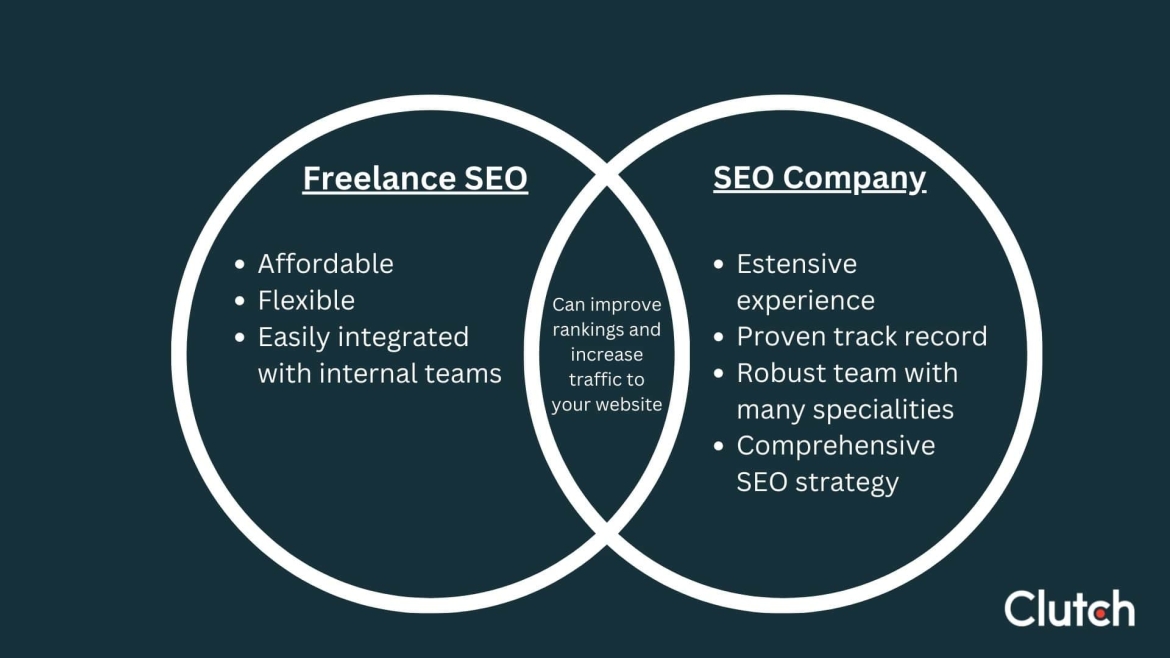
Both freelance SEO specialists and SEO agencies can help improve your website’s rankings and increase traffic to your website, but they both have their strengths and weaknesses.
While SEO freelancers are often more affordable and can easily be integrated with the rest of your team, they often have limited resources and lack oversight. At the same time, SEO agencies can be costly, but they have experienced teams that can provide ongoing support as long as you want to invest in SEO.
Carefully consider the pros and cons of each before reaching out to potential partners.
Discover Clutch’s top SEO agencies.
The key is a structured handoff. Ask your freelancer to document everything: keyword strategies, technical fixes, content calendars, backlink sources, and analytics setups. This documentation ensures the agency inherits both the strategy and execution details, rather than starting from scratch.
Next, manage the technical transition carefully. Verify that redirects, canonical tags, and tracking codes remain intact during the switch. Transfer ownership of tools like Google Search Console, Google Analytics, and CMS logins to your organization, and then grant the agency access. This avoids gaps in data and prevents lockouts that can stall campaigns.
Ask about the scope of services (technical SEO, content, link-building), service-level agreements (response times, deliverables), reporting frequency, the metrics used, and how performance will be measured.
Include questions on potential conflicts of interest, like if they work with competitors, and data handling practices, such as how they protect client analytics and access credentials. These questions help you determine if the provider can deliver measurable, secure, and accountable SEO.
Some freelancers have deep, industry-specific expertise, but this is less common and can be harder to verify compared with agencies that specialize in highly regulated sectors like healthcare, finance, or legal.
If compliance is critical, verify credentials and knowledge before hiring. Ask for case studies in your industry, request references, and confirm familiarity with the relevant regulatory frameworks, such as HIPAA, PCI DSS, or GDPR compliance. Whether going with a freelancer or an agency, it’s on you to confirm so they don’t put your business at risk.
Hourly or project-based models are typically more flexible than retainers. Hourly contracts give you control to scale work up or down quickly, but costs can become unpredictable if scope expands. Project-based contracts set clear deliverables and pricing, making them ideal for defined initiatives like audits or site migrations.
Hybrid models, with a set project fee and the option of hourly support, specify deliverables while leaving room for unforeseen needs without having to craft a new contract.
Ask direct questions about how they secure client data. A credible provider should use least-privilege access (granting only the permissions needed), maintain audit logs for account activity, and apply encryption to data in transit and at rest.
Also, ask about how they evaluate third-party vendor tools and plugins before use. If they can’t explain their policies clearly, that’s a red flag.