![How to Make a Budget for Print Design [With Template]](https://img.shgstatic.com/clutch-static-prod/image/resize/715x400/s3fs-public/article/d593c4d0f16292c1f26270424626b50f.png)
How to Make a Budget for Print Design [With Template]
Discover how to prepare an effective budget for your print design needs through this piece.
Updated March 31, 2026

AI can generate a logo in seconds, write ad copy on demand, and produce hundreds of variations before lunch, so it’s no wonder graphic designers feel like it’s nipping at their heels. The data, however, tells a more nuanced story about where human creativity is still a necessity.
The graphic design industry is currently undergoing one of its most transformative periods in decades. The recent explosion of sophisticated generative AI design tools allows for faster content production and lowers barriers to creating graphics, and designers are wondering if they’re being squeezed out of the field.
“I’d describe [the state of today’s graphic design industry] as the most exciting, yet the most chaotic, it’s been in years,” says Jack Oddy, Managing Director of Soap Media. “It’s sitting somewhere between a renaissance and the wild west.”
Looking for a Graphic Design agency?
Compare our list of top Graphic Design companies near you
It seems only natural that many designers and companies are asking the same question: Will AI replace graphic designers?
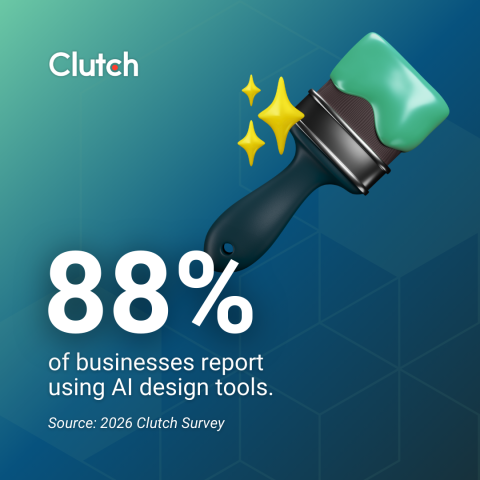
However, Clutch research shows that businesses still rely heavily on professional graphic designers. While 88% of companies use AI design tools in some capacity, only 18% of those surveyed said that AI tools have reduced their need for designers.
Let’s explore how businesses are using AI tools, whether AI usage has affected whether brands continue hiring graphic designers, and what companies want from their designers in 2026.
Nearly nine in ten (88%) of businesses told Clutch that they already use AI design tools to some degree.
The four most popular AI design tools that companies use internally are:
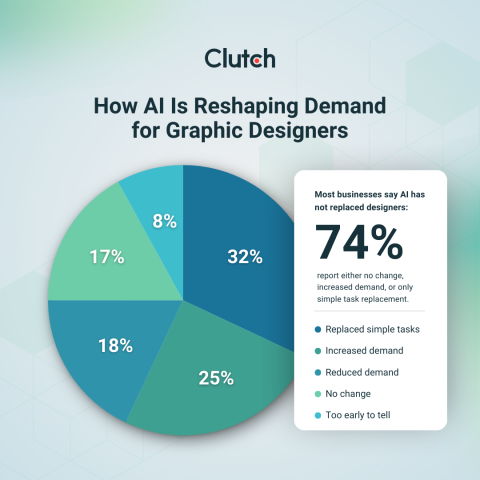
How, then, has AI impacted the demand for graphic designers? Our survey revealed that 74% of businesses report that AI has either not changed their need for graphic design professionals, increased the demand, or replaced only simple graphic design tasks. A mere 18% say that AI has reduced the demand for human designers, while 8% feel it’s too early to tell.
“AI design tools have changed the industry dramatically, but not in the ‘designers are finished’ way the headlines suggested,” says Oddy. “They’ve mainly rewritten how design work gets done.”
Ultimately, AI is functioning more as a creative production assistant than a replacement for graphic designers.
One way AI serves as a creative production assistant is by allowing graphic designers to accelerate their creative work.
Oddy says, “What used to take an hour in Photoshop can now be mocked up in minutes.”
But it’s essential to point out that faster production does not automatically mean better results. As Oddy notes, “AI design tools have put the graphic design industry ‘on steroids,’ so to speak. But you still need all the key ingredients, just as a bodybuilder would need discipline, a strict diet plan, and a focused training regime. AI has commoditized the bottom layer of production and made judgment, taste, and systems thinking more valuable than ever.”
Just like any new technology, AI is most effective when used as a tool to supplement work, not to replace human ingenuity or creativity.
Across all industries, one fact is true: AI can’t replicate humanity. It can perform a nearly indistinguishable impression, but without lived experience, technology can’t truly know what it’s like to be human. Because it lacks consciousness, emotions, judgment, strategy, and subjective personal history, it relies on data computation to approximate feeling.
This principle applies to graphic design and AI usage. AI excels at rapid iteration and generating options at scale, but it lacks the genuine empathy, intuition, and cultural understanding necessary to create original storytelling.
The distinction is important. Effective design requires more than executing individual tasks in isolation.
When making design decisions, a skilled designer synthesizes:
They consider all of those variables simultaneously and adjust their creative choices based on what they want a specific audience to feel at a certain moment.
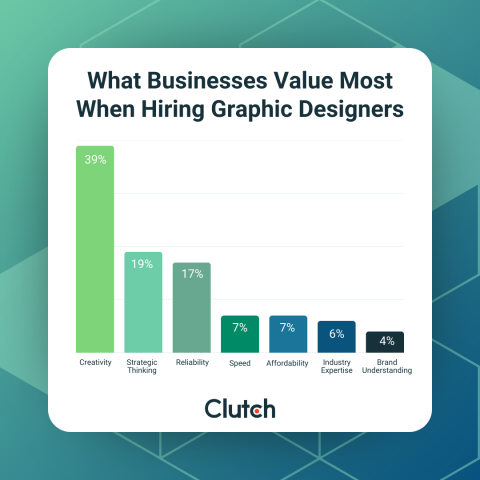
That contextual judgment is what AI can’t replicate, and businesses appear to know it. According to our survey, creativity ranks as the most valuable trait when hiring designers (39%), outpacing strategic thinking (19%), reliability (17%), speed (7%), and affordability (7%) by a significant margin.
When AI handles production, human judgment only becomes more valuable.
Consider, as Oddy illustrates, a non-designer leveraging AI tools to create social media ads. According to Oddy, the model is unlikely to appreciate the difference between an upper-funnel ad that first introduces the brand and a lower-funnel ad aimed at consumers who have visited the brand’s website three times, added items to their cart, but haven’t yet completed a purchase. Further, this non-designer likely doesn't have the skill set to notice the difference in these ad sets either, and isn't able to clarify for the AI model to optimize them for their specific use-case.
Oddy argues that AI models struggle to account for:
The resulting creative output tends to miss those nuances.
Contrary to the assumption that AI-generated work at least looks passable, our survey suggests otherwise: 30% of businesses say that AI-generated designs are lower quality overall, and only 23% consider them comparable to human work (and only for simple assets, at that).
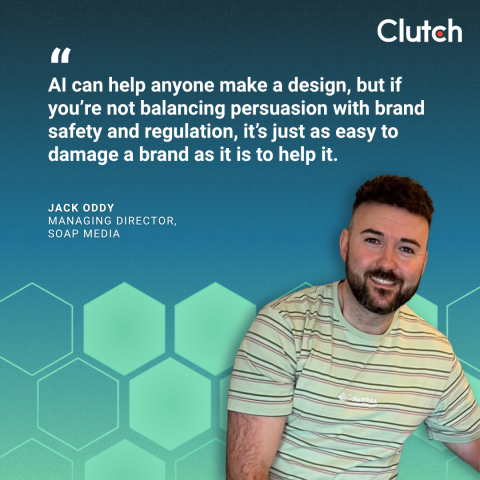
As Oddy puts it, “AI can help anyone make a design, but if you’re not balancing persuasion with brand safety and regulation, it’s just as easy to damage a brand as it is to help it.”
In other words, production was never the difficult part. According to Oddy, what resists automation is the judgment that determines what to make, why, and for whom. This is the kind of strategic thinking that the businesses we surveyed ranked as the second most valuable trait a designer can have.
Great designers are now taking on more strategic roles. Instead of just producing designs, more and more are turning their focus toward planning concepts, shaping marketing strategies, and coming up with creative direction.
Rather than creating every asset manually, designers can now use their creativity and ingenuity to guide AI outputs, define the acceptable standards AI must meet, and manage the variations of its work.
AI helps designers work much faster, allowing them to create many creative variations in far less time than it would take by hand.
“In the time we’d previously budget for one promotional asset, we can now produce three solid variations,” Oddly explains. “But those three are only good because a human set a clear concept with constraints and standards.”
The value of AI to a graphic designer isn’t in letting the machine do the work, but in moving the designer’s contribution upstream from execution to concept definition, creative direction, and quality control.
So, is AI going to take over the graphic design industry? It’s highly unlikely.
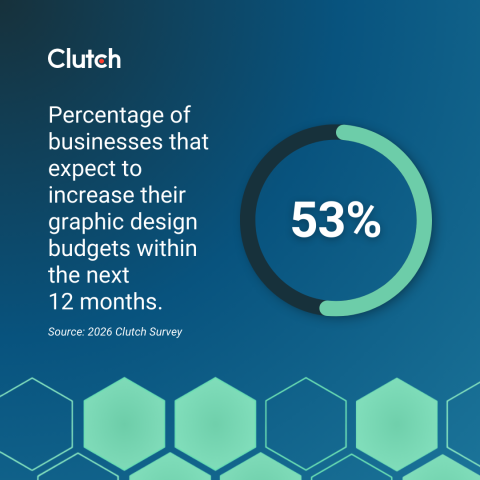
The future of graphic design industry professionals is as bright as ever. With 90% of businesses still using graphic designers in some capacity, demand for these creative professionals is high. Nearly half (47%) of the businesses we surveyed reported increasing their design budgets over the past year, and more than half (53%) expect to increase their investment in graphic design over the next 12 months.
Several trends are currently shaping the industry:
Visual content often gets better results than written content. In a HubSpot digital marketing survey, 49% of respondents said short-form video brings the highest ROI among all media types. Platforms like Instagram and TikTok now lead the social space, outperforming Facebook and X for brands.
As brands compete for attention in crowded digital spaces, visual communication has evolved from a support service into an essential business function.
Social media has become the fastest-growing driver of design work. Half of the businesses we surveyed reported increased demand for social media content over the past year. The content that performs best on these platforms tends to prioritize authenticity over sophistication. We’re also seeing this change in broader design trends as they move toward rawness, imperfection, and human-centered visual storytelling.
Hard data, such as conversions, click-through rates, and audience behavior, is increasingly influencing creative decisions. Our survey findings reflected this change. Businesses say that graphic design has the biggest measurable impact on advertising performance (31%) and social media engagement (30%).
AI is a valued production tool for designers. Our report shows that businesses are most comfortable using AI for image editing and background removal (45%), social media graphics (36%), ad creative variations (35%), and concept ideation (33%). These applications free designers to concentrate on strategy, storytelling, and making judgment calls that automation can’t replicate.
Designers whose training has revolved around software execution may find themselves competing with tools that now do “decent” work automatically. The far more valuable designers are those who bring creative thinking, marketing strategy, brand development, and communication skills to the table.
According to Oddy, “Making things and creating great designs are two completely different outputs.”
The data backs him up. In a 2025 survey of 500 senior marketing leaders, McKinsey found that human creativity and brand building have only grown in strategic importance as AI adoption accelerates.
While AI increases efficiency and speed, differentiation still depends on people. Those very human skills are irreplaceable in the graphic design industry.
The data makes it clear that AI is a powerful creative accelerator, not a replacement for graphic designers. Companies are increasing their design budgets, and demand for human designers remains strong. On top of that, the skills that matter most, like strategic thinking, brand judgment, and creative direction, are ones that no algorithm can replicate.
The graphic designers who flourish in this tech-heavy era are those who learn to wield, not resist, AI. They’ll use AI to create faster, explore more variations, and produce graphics at scale, but what gives the work its meaning and effectiveness will always be human insight.
AI can help anyone make something that looks like a creative design, but looking like a design and functioning as one are two very different things. More than just looking slick and flashy, the essence of a true design is one that moves people, conveys a story, builds your brand, and drives conversions.
Ready to work with a graphic designer who brings the strategy, judgment, and creativity that AI can't replicate? Browse top-rated graphic design agencies on Clutch to find your perfect match.