7 Tips For Designing Web Forms
Clutch surveyed 502 web users about what they actually want from form design. Here are 7 data-backed UX principles that reduce abandonment and improve...
Updated May 29, 2026

Web design is a vital investment for businesses looking to thrive in the digital age. Poorly designed websites can cause businesses to lose their business. Stay ahead of the curve and read more about these interesting web design statistics as you take on 2025.
A company’s website is no longer just its digital business card – it’s the first and most important interaction many customers will have with a company's brand.A poorly designed site can push visitors away in droves, while an engaging and user-friendly design is more likely to hold their attention and earn their trust.
By 2025, we expect to see a deeper integration of technologies like AI and augmented reality (AR) and more focus on accessibility and personalization:
Looking for a Web Design agency?
Compare our list of top Web Design companies near you
These trends highlight the importance of staying ahead in the digital space. Partnering with the right professional web design team will position your business to make a lasting impression in 2025 and beyond.
With customer expectations continuously growing and shifting, companies that invest in thoughtful web design have a definite competitive edge. View our list of the top eight stats in the web design industry to kickstart your efforts in 2025:
First impressions are powerful, and when it comes to your website, Hostinger reports that 94% of those impressions come down to its design. Visitors form opinions in seconds, rapidly judging everything from color schemes to layout. If your website’s design feels cluttered or outdated, they’ll assume the same about your business.
This goes beyond aesthetics. People tend to equate polished, professional design with trustworthiness and credibility. Even small details, like consistent branding or intuitive navigation, can reassure potential customers you’re worth their time and money. By investing in a modern, user-friendly design, you’ll send the right message from the start.
If you were visiting your site for the first time, would you feel confident navigating it as a new visitor? If not, it might be time for a redesign.
Staring at long blocks of text doesn’t exactly excite web visitors. On the other hand, visually engaging websites — that incorporate high-quality images, videos, and interactive elements — keep visitors on the page longer. This isn’t surprising, considering humans process images faster than words.
According to Sproutworth, sites with eye-catching visual components hold visitors’ attention an average of 47% longer than those that rely heavily on text. This extra engagement offers your business a valuable opportunity to connect with your audience, communicate your message, and drive conversions.
But it’s not just about slapping images onto a page. The key is relevance. A generic stock image is unlikely to captivate anyone. Instead, invest in visuals that feel authentic to your brand and speak directly to your audience. For example:
These elements guide visitors’ attention and encourage them to explore further.
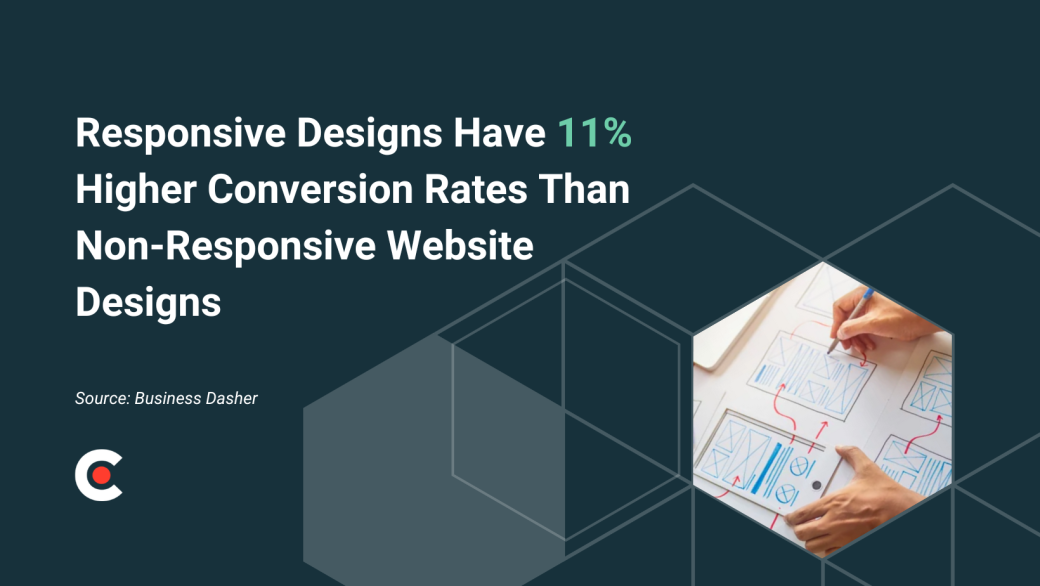
With more than 60% of web traffic coming from mobile devices, responsive design is non-negotiable. Business Dasher discovered that websites optimized for all screen sizes see an 11% higher conversion rate than those that aren’t.
If someone lands on your site from their phone only to find text overlapping or navigation that doesn’t work, they’ll likely abandon it immediately. A responsive design solves these issues by adapting your site to any device.
Beyond functionality, responsive design also improves accessibility. Text remains legible, images scale correctly, and navigation is simple. Making mobile browsing a priority gives your business credibility.
If you’re not using video on your website, you’re missing an opportunity to hold visitors’ attention. Wistia’s research shows that pages with video engage users for an average of six minutes, compared to just 4.3 minutes for those without.
Videos work because they require less effort from the viewer. A product demo, customer testimonial, or behind-the-scenes look at your company can quickly communicate what might take paragraphs of text to explain. More importantly, video appeals to emotion in a way static content can’t.
The most successful websites embed videos strategically, such as in hero banners, product pages, or FAQs. Just make sure the content is high-quality and optimized. Poor audio, pixelated visuals, or slow load times can do more harm than good.
White Peak Digital found that the average website visitor spends less than six seconds engaging with written content. Rather than reading every word, they scan for key points and quickly move on.
Your content needs to be concise and visually appealing to capture attention in this short window. Walls of text won't hold their attention. Some suggestions include:
By designing your content with scanning behavior in mind, you can capture attention and communicate your message effectively.
According to Sweor, a shocking 70% of small business websites lack a clear call to action (CTA) on their homepage. Without a CTA, visitors wander aimlessly — or worse, leave your site without taking action.
A CTA gives users an unambiguous next step, whether it’s “Schedule a Demo,” “Shop Now,” or “Subscribe to Our Newsletter.”
Placement matters, too. CTAs should be prominently displayed above the fold or at logical stopping points throughout your site.
Don’t overcomplicate it. A simple, well-timed CTA can significantly improve your conversion rates. Just make sure it’s specific and aligned with your business goals.

Wegic.AI reports that flat design, characterized by simplicity and minimalism, has become the preferred style for 88.5% of web designers. This modern aesthetic prioritizes functionality and performance. Your site will inevitably be easier to use without distractions like heavy gradients or complex graphics.
Simplified visuals load faster and improve site speed, which impacts user experience and search engine rankings. If your website feels crowded or antiquated, consider integrating flat design principles for a clean, modern look.
AI tools are revitalizing the creative process in web design. According to recent research by HubSpot, 58% of web designers use AI to generate images, animations, and other media for their projects.
But contrary to some misconceptions, AI isn't here to replace human creativity — it’s here to enhance it. Automating certain repetitive tasks empowers designers to focus more on strategy, storytelling, and creating personalized content that resonates with audiences.
This means faster turnaround times and more design flexibility. AI-driven platforms can quickly produce high-quality visuals tailored to a brand’s specific needs, often at a fraction of the cost and time compared to traditional design methods. This efficiency doesn’t mean your design team abandons creativity at the door. It allows designers to experiment with more complex ideas while their work aligns with the company’s vision and style.
The key to using AI in web design is recognizing that AI is a tool to help human designers work smarter, not a replacement for the human touch that makes content truly compelling.
Web design is entering an exciting phase of innovation. Businesses that stay on top of design trends will see higher engagement and more (and better) conversions.
Before we detail our predictions for the coming year, here’s a quick recap of the key web design stats for 2025:
Whether you choose to experiment with something new in web design or continue following your tried-and-true strategies, think about what will attract your key audience to your service.