Evaluating an Marketing Agency in the AI Search Era
AI search has completely changed how people interact with online content. When an AI summary appears at the top of search results, Google users only click a...
Updated March 6, 2026
Subject matter expert (SME) insights can transform your content marketing strategy. Learn why and how to engage your SME in content marketing.
What is a B2B content marketer to do?
AI has kicked off a tsunami of generic marketing content. Some experts say that by 2026, 90% of all the content online will be generated by AI.
Yet content marketing still matters — 87% of B2B marketers say they used content marketing to generate leads last year.
As a content marketer who sees B2B brands flooding search results and social feeds with bland, high-level, often inaccurate, or even plain wrong content assets, I say focus on expertise.
High-level, superficial content assets such as blog posts that rehash the top five results on Google never really worked on B2B audiences anyway. Brands that use AI to make “more” of this kind of content are doing it wrong.
The upside is that since AI content generation has become a thing, many others and I think generic content marketing is 100% dead.
Now that anyone can generate thousands of words daily, it has become essential to have unique content that makes your audience go, “Yeah, that’s me.” Brands that lean into real content, a topic Gartner calls “acoustic positioning,” will stand out by default.
While a high-performance content marketing team (in your organization or via a B2B content marketing agency) is one ingredient for authentic content, subject matter expertise is another.
To gain the insights that feed expert-led content marketing, you must involve your internal subject matter experts (SMEs) in content creation and planning.
It can be a serious struggle to get developers, product managers, CTOs, or other relevant stakeholders involved in content marketing.
Subject matter experts, by the nature of their jobs, tend to have a relatively narrow organizational focus inside most organizations.
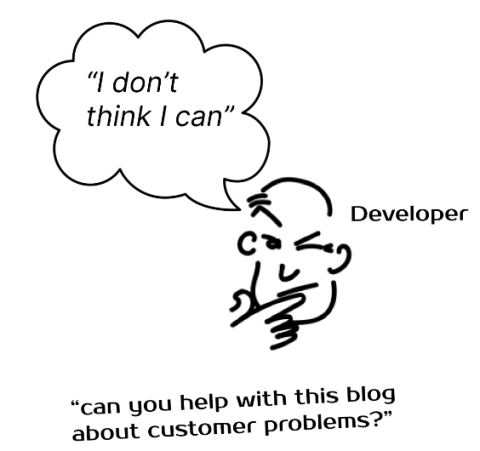
Typically, an expert on a niche topic, such as fileless malware attack vectors in cybersecurity or penetration testing, will not have a marketing background.
Early in your content planning, you need to start identifying the ideal people with expertise to contribute to content marketing.
In my experience, you want to find individuals who are: a) relatively senior and have worked in several companies and b) have a reasonable degree of flexibility in their roles that will allow them the space to provide insights regularly.
This is especially true with cybersecurity content marketing or any other technical space.
People with these traits are also typically better at explaining technical topics to non-technical audiences (which will make your job much easier as a result) and might be more likely to see the benefits of content marketing for the entire business.
The best person to get some insight from is typically someone in a senior product role with wide experience—ideally, a technical person turned product manager. Also great are experienced salespeople who, while they don’t always have the most advanced technical knowledge, can have incredible insights into the problems customers face.
If you are lucky, you might have access to a CTO or another high-level executive. But C-suite content insight can be a double-edged sword.
You need to be very clear about maximizing these individuals’ input and realistic about their long-term availability. Your CEO might be extremely keen on providing input into content on day one, but there is a strong chance their schedule will fill up, and your content chats will get postponed indefinitely.
It’s never a bad idea to have an “A” team of content contributors open to helping out regularly and some backup individuals willing to weigh in occasionally.
Just ensure everyone signs up ahead of time and is not being landed with another job responsibility they didn't expect.
Whoever you approach for insight, you need to be able to explain easily why content marketing is worthwhile.
At a high level, you need SMEs to feel that the content you want to create is a priority business asset.
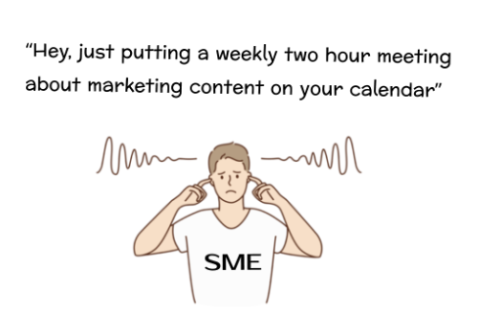
Don’t lead a proposal with some version of “marketing needs your support on this.” Instead, pitch potential contributors on the specific reasons why content is happening. For example, “Our competitor x is the online expert on this topic; we need content to show customers we know more.”
Give experts an insight into the “why” behind content marketing.
This shouldn’t be difficult - if you are seriously investing in content, you’re probably doing so for a reason. Content marketing might be happening to stop leads from dropping out of your funnel, save the sales team from having to answer the same questions over and over again, get better-qualified customers, or start appearing as an authority in your niche.
Whatever the reasons, prepare an elevator pitch to engage contributors.
You do not necessarily have to share all the nitty-gritty keyword research and competitor comparisons your content team has (hopefully) done, but it can be worth giving a high-level idea of what you’ve discovered.
It’s also a good idea to include any real audience insights you have, like a quote from an existing customer or a transcript from a sales call.
SMEs are very smart people. They want to see that their time spent on content benefits the business and, ultimately, their careers.
As a bonus, ask them if they are okay with their names being featured in content assets. It can add huge weight to a blog post if it was “created with insight from x, a technical expert.”
Being featured in content can also help boost SMEs' own profiles if that is what they want.
To get insight from SMEs — whether into a specific content asset like a whitepaper or your overall content strategy — you need to make giving that insight technically simple.
Set up a clear content workflow. Give expectations about the timeframe you need people to give their insight (or quality assurance) within, for example, by next Friday, and the realistic amount of time it will take.
Do not ask, “Can you take five minutes to review this whitepaper, whenever suits you?” if it is 2,000 words long, needs serious proofreading, and the SME has a million other things to do.
In my experience, it's best to give contributors a range of options to have their input within a clear, time-limited space.
Some experts might have the time to discuss things on a call with you; others might be more comfortable commenting on a document or responding to you via email.
I typically give three options: Call, email, or Google Doc, but I also appreciate Loom recordings or even audio notes. Just ensure the basics are right, like adding the expert as an approved contributor in a document, sending a Zoom link with the correct time and day, and so on.
Sometimes, a 30-minute video call with an SME can define an entire content strategy or inform weeks’ worth of content assets. Other times, you might need multiple calls just to get a single blog post over the line.
Don’t let expert insight go ignored.
If you are collecting information via a call, make sure to record it (with prior explicit consent) and take notes during the call itself. I like to go old school with a notebook and pen during video calls to jot down any insights that might otherwise be forgotten or overlooked.
I think it pays to treat any insights from SMEs — even negative feedback — as a precious resource.
It’s not unusual to hear something “unexpected,” particularly on more “open-ended” calls, but brilliant, that you can use to make a unique piece of content. Other times, I’ve used information collected months ago to create new assets with up-to-date insights.
I store everything for each SME I work with. I also periodically review my notes and raw transcripts to see if they can be mined for new insights. Just make sure to do this securely and watch out for potential IP leaks.
I’ve worked with dozens of brands to turn SME insights into expert-led content. One core piece of advice I would give someone thinking about developing an expert-led content campaign? Just start.