What Is Site Schema? 3 Must-Have Markups for Your Website
Site schema is structured data added to your website's HTML to help search engines understand your content. Here are 3 easy types to implement today.
Updated February 18, 2026

Whenever you search for something on Google, you must have seen some questions related to your query under the section “People Also Ask.” This section contains some of the frequently asked questions by people on the web that can be useful in your research. Each of these questions has an answer and a link to the webpage answering it.
The People Also Ask feature can be super useful for businesses to improve SEO and drive traffic to their website by targeting popular topics and queries. Targeting increases the likelihood that their content will be featured in PAAs. But the question remains: how to optimize for People Also Asked results. Let’s read ahead in this article and find out.
People Also Ask, or PAA, is an innovative Google feature that displays questions related to a user's initial search query, providing quick answers and links to the source webpages. When you click the question, it expands to reveal the short answer and the reference link below.
Looking for a SEO agency?
Compare our list of top SEO companies near you
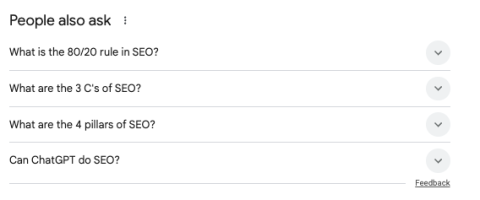
Clicking on the question also opens up new questions that help the user learn more about the subject without referring to any specific website. That also reduces the number of searches that users might have to perform to uncover the topic.
If you know about Google AI Overviews, they can also land in the PAA sometimes.
The process by which Google determines the PAA questions is a bit complex, but here is a simpler version.
When you type a query, Google’s machine-learning-driven algorithms dig into billions of prior searches to identify related questions that real users frequently ask next. It clusters queries based on intent proximity — i.e., how closely questions relate in meaning — and then surfaces them in the “People Also Ask” box.
After this, Google pulls answers from pages that clearly and authoritatively address those questions. These can also be from lower-ranked pages sometimes. As users click questions, new ones unfold dynamically. That creates a discovery spiral that refines Google’s understanding of what people really want next.
As Google is a semantic search engine, it can also offer personalized PAA queries to the users. However, it has to access your information, such as search history, location, and other contextual factors. According to statistics, PAA boxes appear in 1 out of 2 Google queries (51.85% of all searches).
When you have an online business, featuring in PAA boxes can be a plus. According to stats, websites optimized for PAA questions have seen an average 21% increase in click-through rates. Besides, there are several other reasons for including PAAs in your SEO plan:
PAA boxes appear very frequently (in almost 51.85% of all searches). That means that the opportunity for your content to be discovered in this format is huge, especially since PAA often appears near the top of the page.
When Google selects your content to answer a PAA question, it signals that your site is seen as relevant to that topic. Over time, this strengthens trust with users & helps your site become a go-to resource. If you keep adding content relevant to your website, it will further enhance your topical authority.
Even if you’re not ranking #1 organically, but you are featured in the PAA box, it can get your content above the fold. In many cases, PAA appears in position two about half the time when it’s present.
The questions in PAAs often reveal what people are really curious about. These include:
Monitoring these can uncover content ideas you may never have considered with standard keyword tools.
Pro-Tip: Add FAQs to your content piece on trending questions related to the subject to gain traction.
Many businesses still neglect optimizing for PAA. Doing it well can get you ahead. Also, PAAs help you find content gaps. For example, you can learn about the questions people ask that aren’t yet well answered.
With these insights, you can build content that fills those gaps and gives you more SEO traction. By leveraging these insights, you can also improve personalized content creation, ensuring your articles and pages directly address the specific needs and interests of your target audience.
Besides the benefits described for businesses, there are several other reasons to rank for PAA placement. Here are some of the top ones:
According to recent statistics, the average user attention span is 8.25 seconds. When attention spans are shorter, you need crisp, concise answers for your users. To satisfy this immediate intent, ranking for PAAs is necessary. Precise answers to queries can boost engagement and help build trust with users who see you as helpful.
You might rank organically, but if you also show up in PAA, that’s double real estate on the SERP. Two chances mean more clicks, more trust, and more brand recognition. It lets you dominate the page from multiple angles.
Since PAAs account for over 50% of search queries, it is understandable that there are many ranking opportunities. Even if you are not ranking for the primary, broad keyword, you can target the related long-tail keywords and follow-up queries. These queries can be answered from different angles, helping you cover more ground and attract traffic.
Creating content that effectively answers People Also Ask questions helps boost your online visibility and brings more traffic to your website. If you want to appear in Google's People Also Asked box, there are specific steps you must take.
The very first step is to dive into real SERPs, especially the “People Also Ask” boxes. Enter the keyword you want to rank for and note the kinds of questions returning for your target keywords. What phrasing do people use? Are they looking for definitions, comparisons, step-by-step instructions, or stats?
“That can help you spot patterns and learn which kinds of content Google believes satisfy that query,” said Jeff Benton, Founder of Benton Accident & Injury Lawyers. “Once you learn about the queries, you can use them in headings, the main text, or as part of an FAQ section. Queries with keywords integrated into them as H2s can boost your chances of ranking in PAAs.”
For example, you enter the “ad fatigue” query, and here is what PAA suggests:
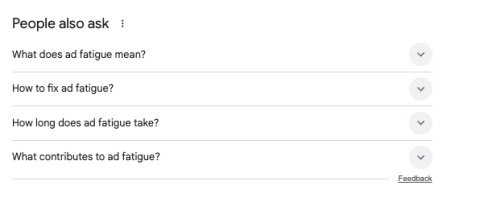
You can use “What is an example of ad fatigue?” or “Is ad fatigue real?” in the subheading to discuss all the details about ad fatigue that target customers can be interested in. Using on-page SEO and backlinks can help you rank higher in the PAA box and reach a larger audience with new content. The caveat here with link building is that the quality of those links and their contextual or niche relevance must be on point.
The key to ranking faster in PAAs is to provide direct, concise answers that help Google better understand and match your content to users' questions. While that may not be enough, it can increase the chance that your answer is featured in the PAA box.
To effectively provide answers for PPA, you can consider the following tips:
In summary, the People Also Ask section prefers lists and FAQ pages most, as they directly answer users within your content. Moreover, leveraging structured data can help search engines better understand and digest your website.
Today, it is not just about writing content; it is about genuine expert views on a topic. Google tends to favor content from sources seen as expert, reliable, and up-to-date. Therefore, it is necessary to show your credentials, including:
Make sure your content is fact-checked and well-sourced & that your site has a strong reputation. Show your expertise and experience by creating detailed, well-researched content and including author bios to support your qualifications. Use guest posting and social media to build your authority and credibility in your field.
Nothing is perfect, not even your competitor’s content. Your competitors’ content can show you hidden PAA opportunities. You just have to review their pages that are ranking in PAA or are almost doing so. Look for questions they are missing and angles they are ignoring.
“Analyzing your competitors' ranking in the PAA box is a great way to identify weak content spots, content formats, and questions, and to generate new page ideas to be featured in the SERPs,” said Brian White, Founder of Attorney Brian White Personal Injury Lawyers. “Ensure you look at competitors to understand the content gaps on your site.”
You can use tools like Ahrefs, SE Ranking, or conduct a manual search to identify questions that should have been answered but weren’t. Fill these gaps with new content or add sections to your posts.
Backlinks remain one of the strongest signals Google uses to judge trust & authority. In fact, a 2024 study by Internet Marketing Ninjas showed that 96.3% of sites ranking in the top 10 results have over 1,000 unique-domain backlinks, while only 0.3% have fewer than 100.
These numbers are clear proof of how a robust backlink profile dramatically improves your chances of being seen as a credible source, especially when Google is choosing content for “People Also Ask” boxes.
Create content that naturally attracts links. Write guest posts for websites relevant to your topic. If you are focusing on local audiences, use local link building to stay relevant to your targeted area.
There are various ways to build these backlinks, such as:
Using these tips, you can improve your chances of being featured in PAA results and driving more traffic to your website. Keep track of how your content performs and adjust your methods to stay competitive in your area.
Once you have made efforts from your end to optimize for PAA placements, keep track of your website performance and see which spots you have won. Ensure you monitor parameters such as PAA presence/appearance, click-through rate (CTR), ranking movement, traffic/impressions, and competitive comparisons.
That is necessary, as without tracking, you won’t know what’s working or what you need to change. You can use any ranking tools, like SE Ranking, that track the SERP features by filtering PPA results to notice any significant changes.
While AI is increasingly taking over organic search, PAAs remain a valid and effective way to rank at the top and drive organic traffic. It is also forecasted that some of the answers in the PAAs are generated by AI, but not all. That is where you can shine.
Implementing the mentioned strategies can not only help boost your ranking but can also establish authority. Working while using AI can help you find relevant queries faster and put you way ahead of the competition.