
How to Choose a 3PL: 5 Mistakes E-Commerce Brands Make
Learn how to choose a 3PL that fits your channel mix, avoids hidden costs, and scales with your brand. Real selection criteria, and top providers compared.
Updated March 24, 2026

Read 3 pieces of advice for businesses that don't have or don't believe in having a department dedicated to sales.
Selling without a sales team is a reality for many businesses, from start-ups that don't have the resources for a sales department to successful companies that feel like they don't need one.
In a world where only 30% of leads convert to sales opportunities, and only 2% of sales opportunities convert to deals, we have chosen to rely on other techniques to replace the standard sales team.
Looking for a BPO agency?
Compare our list of top BPO companies near you
This article offers three pieces of advice for business leaders who refuse to subscribe to conventional sales practices. If business organizations focus on the big picture, sales come naturally.
Every time an employee engages directly with a client, that employee acts as a member of the sales team. What an employee says matters just as much as the usability of your product. In fact, 26% of referrals convert into deals, higher than any other acquisition channel, including email campaigns, events, and webinars.
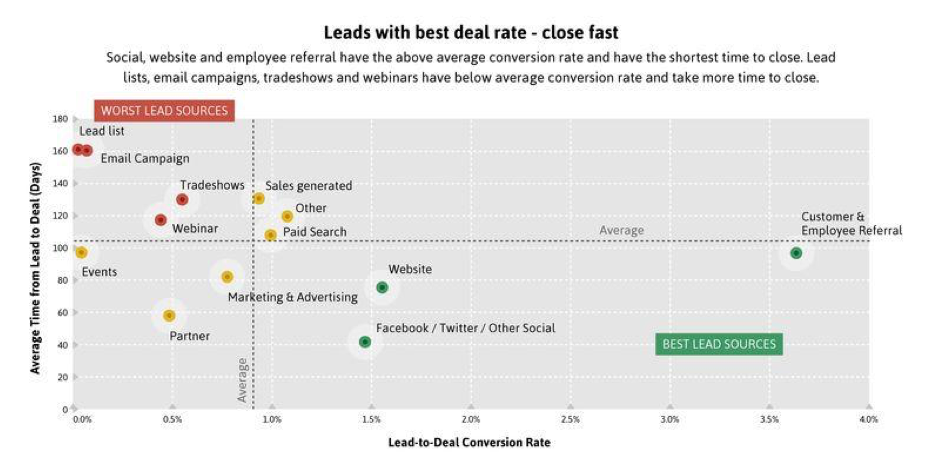
Source: Salesforce
Referrals beat sales in both average time from lead to deal and in their average lead-to-deal conversion rate. Referrals have higher lead success because strong employee interactions make customers more eager to refer other potential clients.
An employee’s network can be your connections if you provide them with the right tools to spread the word. Every employee should be a buzz agent.
A buzz agent is passionate about the company and an expert on the products or services offered.
Focusing on culture and brand education within your company can make referrals skyrocket, reducing the need for a sales team. Herb Kelleher, the former CEO of Southwest Airlines, connected his lack of a traditional sales department to the success of his whole company:
“Employees come first, and if employees are treated right, they treat the outside world right, the outside world uses the company’s product again, and that makes the shareholders happy. That really is the way that it works, and it’s not a conundrum at all.”
Southwest Airlines built its reputation on an employee-first culture. Prior to the COVID-19 pandemic, the company achieved 47 consecutive years of profitability, one of the longest streaks in the airline industry. Surveys have also shown that about 85% of Southwest employees say they are proud to work for the company, demonstrating how investing in employee satisfaction can translate into stronger customer experiences and long-term business success.
Kelleher explained how having a dedicated team that cares about the brand is the first step toward making effortless sales.
To support independent selling, companies can implement systems that allow customers to explore, evaluate, and purchase with minimal direct intervention. Automation tools can guide prospects through the buying journey by answering common questions, delivering targeted content, and prompting next steps.
Meanwhile, well-designed websites with clear product info, pricing transparency, and streamlined checkout processes reduce friction and empower customers to make decisions on their own timeline.
When these tools are thoughtfully integrated, they replicate many of the functions traditionally handled by a sales rep.
Self-service resources also play a major role in enabling sales without a dedicated team. Knowledge bases, interactive demos, onboarding tutorials, and product comparison tools help customers quickly understand how a solution fits their needs.
Forrester research shows that today’s B2B buyer will find three pieces of content about a business online for every one piece of information that sales can deliver. Given the popularity of online content, having an eye-catching website, blog, and social media presence is essential if you don't have a traditional sales team.
Your goal should be to make your website the go-to destination for consumers seeking products or services in your industry. This level of popularity can be achieved by curating unique and engaging content on the right social networks.
Think beyond standard social media campaigns: run contests, host Instagram takeovers, or start a Medium account. Building brand awareness can extend your company's reach and help customers differentiate between you and your competitors.
It can be difficult to determine exactly when someone needs your services, so focusing on marketing rather than conventional sales can be key to customer acquisition.
If you have an impactful story, it will speak for itself. In fact, a story is often more powerful than a sales team.
Paul Zak, a pioneer in neuroeconomics, reveals that stories are an extremely effective way to communicate key information and values from one person to another. Hearing a full narrative engages different parts of the brain, making a story 22 times more memorable than a fact.
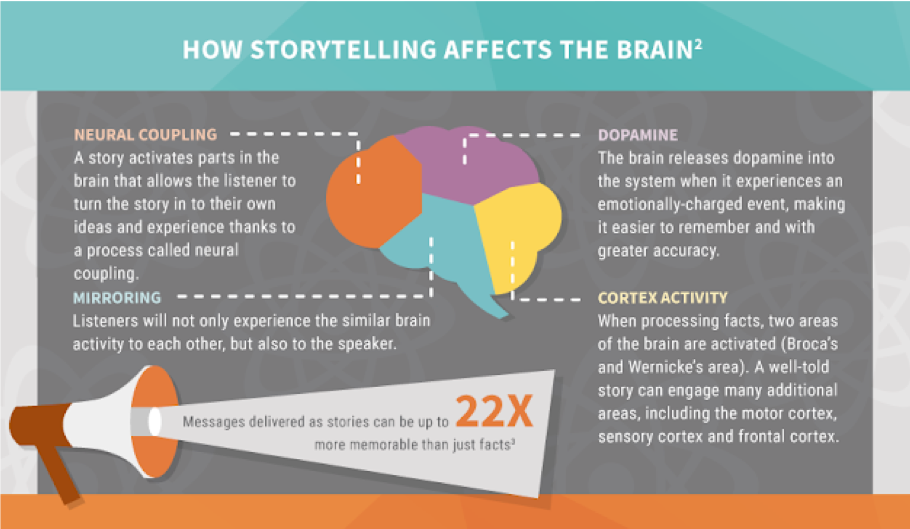
Source: Onespot
Zak’s article, “How Stories Change the Brain,” illustrates how when stories are personal and emotionally charged, they engage more of the brain:
“By knowing someone’s story — where they came from, what they do, and who you might know in common — relationships with strangers are formed.”
Emotional stimulation explains why a compelling story can be the key to a successful sales pitch.
According to a study by Entrepreneur, a story adds significance to a product or service that would otherwise be impersonal. Stories can make people relate their own experience to the one you are telling, which makes them connect to you as a person rather than as a salesman.
There are many ways to sell with a story. An example of a useful method is the Point, Story, Metaphor Formula. With this approach, you share your ideas by stating a message, then tell a narrative about real-life applications to support it. If you’re successful, your story can have a big impact on your listener.
Companies can generate and convert leads without a dedicated sales team by investing in strong marketing and inbound strategies. Content marketing, social media engagement, and targeted email campaigns help attract potential customers while educating them about a company’s products or services. When combined with effective lead magnets, like downloadable guides, webinars, or newsletters, these strategies help nurture prospects and guide them naturally toward a purchasing decision.
Technology also plays a central role in replacing many traditional sales functions. Those customer management tools ensure that leads are captured, nurtured, and converted efficiently without requiring constant human oversight.
As demand grows, businesses can scale their sales efforts through automation and efficient workflows rather than expanding a sales department. Outsourcing certain marketing tasks, implementing automated lead scoring, and standardizing processes for onboarding or customer support can help manage increasing sales volume. By combining strategic marketing, the right technology platforms, and streamlined operations, organizations can build a sustainable system that supports growth without relying on a traditional sales team.
There are some issues that could arise without a sales team, but there are solutions to those as well.
It’s important to realize that all aspects of your business should function as one cohesive unit. Seize every opportunity to make a sale, and train your employees to be advocates for your business at all times.
You can create powerful brand awareness by perfecting the art of storytelling. Your skilled employees and impressive stories will increase your chances of making deals and improving your business. You might just find that a lack of a sales team can be an advantage.