![How to Create a Corporate Training Budget [With Template]](https://img.shgstatic.com/clutch-static-prod/image/resize/715x400/s3fs-public/article/f8cb0a8fb8e36a14ff257e02ce8b9475.jpg)
How to Create a Corporate Training Budget [With Template]
Create a budget for corporate training services using our free template.
Updated January 3, 2025

Traditional hiring procedures are falling by the wayside as new technology progresses, so it’s time for businesses to evolve, advance, and thrive in a digital era.
The world of modern recruitment is hectic. With both employers and employees jostling for an advantage in a fiercely competitive marketplace, it’s difficult to make your hiring strategy work.
There’s also never been such a wide and varied pool of talent available or such advanced technology to help out hiring managers.
Looking for a BPO agency?
Compare our list of top BPO companies near you
Whether your business is large or small, changes to recruitment and selection aren’t cause for concern. It’s a chance to flourish through innovation and to acquire new talent in an exciting era.
This article will explain why recruitment is important as well as some modern recruitment and selection strategies.
Let’s start with the basics of recruitment.
The first thing to do is get your job description out there.
Here are some of the ways you might get the word out:
Social media is another way to inform potential candidates about your job. Although social media has courted negativity lately, it can be highly effective for recruitment.
In the Chartered Institute of Personnel and Development’s (CIPD) 2014 report, "Putting social media to work," energy service supplier Cape turned to social media to promote its recruitment procedures.
Cape currently has more than 21,000 likes on its dedicated Facebook recruitment page. It is proof that businesses can successfully use social media to recruit.
Use Cape's success as an example: Figure out the best ways to promote your own openings on social media.
You don’t have to interview every applicant. Use modern technology to screen for the best candidates.
An introductory phone call is a great first step. Save yourself, and your candidates, a vast amount of time with an introductory screening call.
This is instead of the traditional focus on dragging a series of candidates down to your office for an hour-long interview.
Use Skype, or just give candidates a phone call. In a span of 10 to 30 minutes, you’ll get a sense of the candidate’s personality and skill set.
By using these screener calls, you can quickly narrow down your list of potential candidates, and you won't waste time with in-person interviews that lead to nowhere.
To help us understand the marked shift away from traditional recruitment, networking giant LinkedIn produced a white paper with essential insights.
The white paper highlights four emerging trends: diversity, new interviewing tools, data, and artificial intelligence.
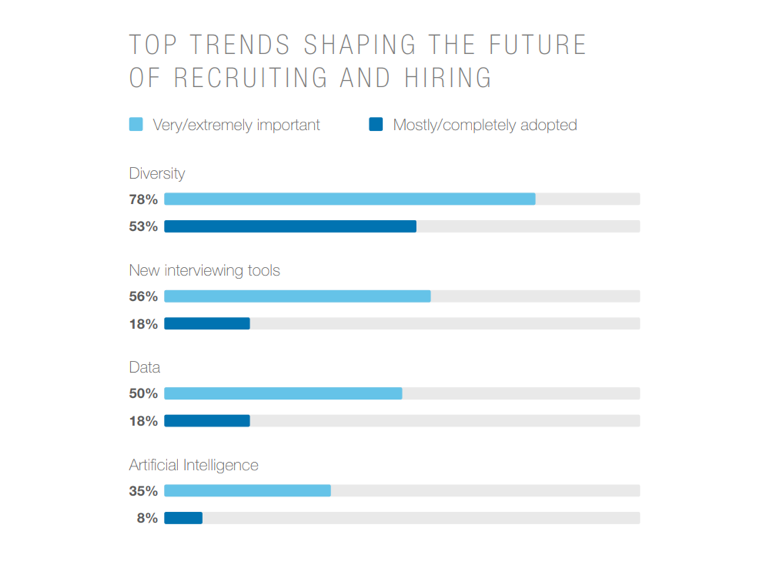
Let’s take a look at how to implement these trends.
Your business is in a multicultural, interconnected world. The stronger your culture, the better the support for your diverse workforce.
Your staff benefit from feeling included and encouraged. If they’re happy, the chances are your business will grow.
An overhaul of your hiring strategy can help streamline this. So, shake up your recruitment policies to try to avoid confirmation bias.
Confirmation bias leads to subconscious, pre-defined favoritism that places some candidates before others, even if those candidates aren’t as good.
Try getting your HR department to provide CVs/résumés stripped of information that would allow the hiring team to guess at gender, race, age, and educational background. Focus solely on what candidates are good at.
Enabling diversity in the interview stage avoids your business looking like it’s stuck in the past.
The traditional interview, in which a nervous candidate answers long established questions (“Where do you see yourself in five years?” etc.), has been an industry standard for decades.
With good reason—it’s still effective!
LinkedIn’s stats show that structured and behavioral interviews (i.e., where candidates have their work history assessed to indicate how they’ll act in the new role) are still the most popular, with 74% and 73% respectively using them frequently or always.
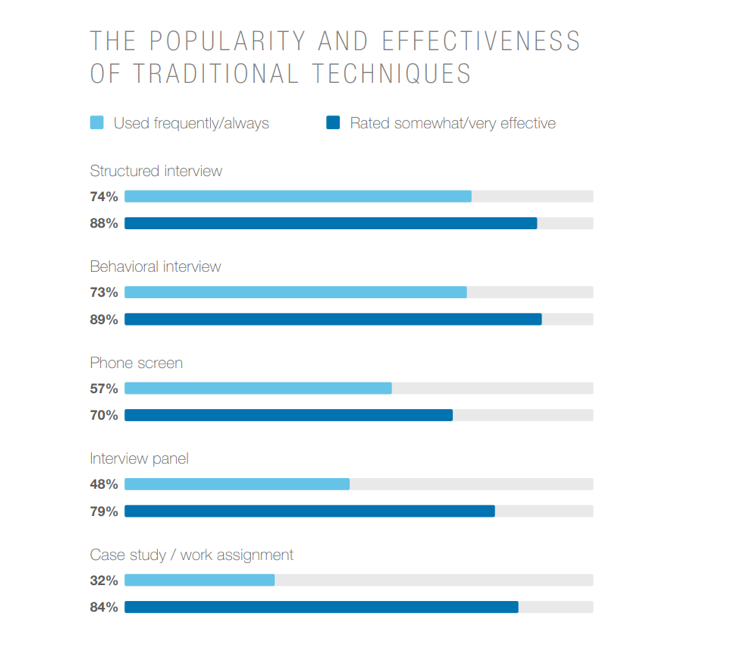
Despite these stats, there’s been a marked shift in new directions. Many businesses now rely on psychometric tests, which assess personality, for an initial candidate overview.
While some wonder if psychometric test results are accurate, our research from a BrightHR guide to hiring found that 84% of companies thought using the tests would make for more reliable hiring.
Soft skills assessments, which test communication, critical thinking, leadership potential, and positive thinking, are also increasingly popular.
Virtual reality has been effective because you can create a simulated work environment for your candidates.
Car manufacturer Jaguar uses a bespoke video game to hire new talent.

The company even teamed up with music group the Gorillaz to create the video game.
Elsewhere, CEO Walt Bettinger of Charles Schwab invites candidates to a meal. He then asks the restaurant to screw up their order; the candidate’s reaction informs him how they will handle an unexpected situation.
When you remove candidates from a room answering familiar questions, you’ll get candid results.
Artificial intelligence (AI) helps businesses source, screen, and develop talent.
Bots can crawl the internet and find potential candidates, even filtering them based on the likelihood they’ll want to change jobs.
As LinkedIn indicates, it’s particularly useful in sourcing candidates — 58% of businesses found it the most effective use for AI.
Chatbots are a popular way to use AI in communications. Larry Kim, founder of WordStream and MobileMonkey, has developed the technology to “build chatbots that qualify leads.”
It’s effective for recruitment, too. Chatbots can respond to queries you receive about your job specs.
AI will become a genuine time saver in recruitment. It pre-screens candidates, diverts those who are unsuitable, and fast-tracks the people who match your criteria.
Businesses can now use data to make hiring faster and more effective.
If you have data analytics and an Application Tracking System (ATS), then you have a massive resource at your disposal.
This new HR technology involves tools that analyze social media activity and big data. LinkedIn refers to the process as “the analysis and interpretation of talent pool data to find the best people for your organization faster.”
Take advantage of HR analytics and your workforce strategy to find answers to your recruitment needs.
After you interview a group of candidates, you have to choose one for the job. It can be hard to know which one to pick.
If you have a couple of top candidates, job auditions offer a closer look at their skills and personality.
Auditions aren’t an easy or perfect idea, though. First-day nerves, plus a new environment, have a habit of hindering outright performance. Candidates also have to take a day off work to come in and audition.
To alleviate those concerns, provide an incentive, such as paying them for the full day. Throw in free tea and coffee, plus a complimentary lunch, and that can offset the trouble.
From my experience at BrightHR, what businesses want is a worker who is enthusiastic and committed. Don’t underestimate enthusiasm, even if a candidate’s skill set isn’t quite there yet.
If a candidate is eager for the role, they’ll put in the effort to learn and achieve.
Some key signs of enthusiasm include:
There are many new recruitment tactics you can take advantage of. By experimenting with some, you might even invent a new technique yourself.
If you experience a setback – say a candidate doesn’t accept an offer – then don’t treat that as a failure. Learn from your experience, and refine your strategy.
Remember that your recruitment process represents your company as a whole. Show candidates the best version of your business, and they’ll show you the best versions of themselves.
Alistair Brown is the chief technical officer at BrightHR in Manchester, England. BrightHR is an industry leader in HR and employment law. Alistair oversees expansion plans and unique strategies to help their clients grow.
See full profile