
How to Use Claude Code if You're Not a Developer
Learn how to use Claude Code to build your own AI agents without a coding background, including setup, first steps, and safety tips backed by Clutch data.
Updated April 13, 2026

Many businesses struggle with AI because integrating it into well-functioning systems without disrupting them is more complicated than expected. We provide a practical guide that covers the key to successfully adding AI to an existing business.
Approximately 78% of enterprises struggle to integrate AI into their existing systems. Even though the majority of companies already understand the potential of artificial intelligence, they face a challenge in connecting AI to their current infrastructure without breaking what already works.
This is the exact concern we hear from businesses every day. No matter whether it’s a mid-sized e-commerce company or a fintech startup scaling operations, they still ask our development agency the same question: How do we add AI without starting from scratch?
Looking for a Artificial Intelligence agency?
Compare our list of top Artificial Intelligence companies near you
The good news is that you don’t need to rebuild everything. What’s more, the most successful AI implementations are not radical overhauls but smart integration into the existing processes. In this article, we’ll describe how to launch AI into your business in a practical and low-risk way.
Even though adding AI might seem like a straightforward upgrade with just a few steps, it is a much more complex process that requires considering various threats. The reason is that most businesses operate on a complex web of tools, databases, APIs, and evolving workflows.
As a result, businesses face four major barriers:
You probably use data from different systems, such as CRMs, ERPs, analytics tools, and internal dashboards. On the contrary, AI models need clean, structured, and accessible data. Many companies don’t have that ready when they decide to launch AI into their operational processes.
Often, older systems lack the power to run AI. Your infrastructure may lack APIs, have rigid architectures, or simply can’t handle real-time processing requirements. So, make sure that you revise your technical capabilities before you invest in AI implementation.
Even if the AI integration is technically possible, businesses usually fear interfering with systems that already work. They don’t want downtime, bugs, or data inconsistencies to negatively influence their revenue. As a result, many AI initiatives stall at the experimentation phase.
Many companies don’t dare to invest in artificial intelligence because they lack in-house specialists who understand both AI technologies and business processes. Lack of skills to support adoption is the #1 obstacle to artificial intelligence launch. It’s not enough just to hire a developer or data scientist. A successful AI integration requires a combination of skills, namely data engineering, machine learning, system architecture, and product thinking.
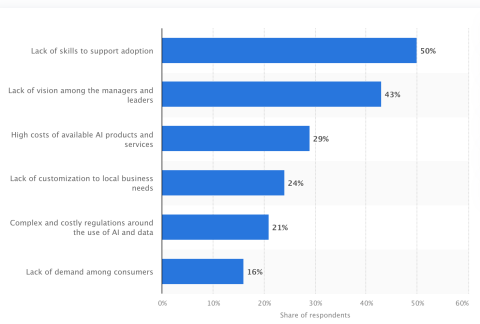
Main obstacles to artificial intelligence (AI) adoption in global business in 2025. Source: Statista
AI integration may feel difficult for businesses. However, the reason is not always a lack of technology accessibility. Companies often suffer from gaps in data, infrastructure, and internal capabilities. Businesses must prepare their systems, reduce risk, and involve the right expertise to launch AI successfully into their existing business.
Many businesses may start by choosing the AI tool. However, it’s a mistake. The first step is choosing the right problem that can be solved with AI.
AI delivers the most value when businesses apply it to processes that are repetitive or time-consuming, include heavy data, or are prone to human error. We’ve gathered the list of spheres where integrating AI can be beneficial.
Customer support automation: You may use AI chatbots or assistants to handle repetitive queries. In this way, you’ll reduce response times and free up human agents for more complex tasks.
Data analysis and reporting: Given that AI can process large volumes of data and generate insights, working with data and reporting can become much easier and faster.
Personalization: 71% of customers expect a personalized approach at every touch point with the brand. You may apply AI to improve user experience without changing your core platform.
Internal process automation: In 2026, businesses try to optimize their expenses and operations. AI can handle document processing, lead qualification, and fraud detection in different workflows of your business.
Take a practical look at your current setup before you even start adding AI to your business processes.
Focus on a few basics:
From our experience in AI development, in most cases the issue isn’t missing data. It’s that the data is scattered or hard to access. A simple audit will help you determine whether AI can use this data without breaking anything.
Before you move to solving the problem of how to integrate AI, it’s worth deciding who will actually help you do it.
Approximately 80% of AI projects fail. And one reason is poor implementation. You need the development team that understands both the AI development aspects as well as the business operations. Without that, it’s easy to end up with something that looks good in a demo but never makes it into real workflows.
A strong partner should be able to:
Following these requirements is especially important if your in-house team doesn’t have AI experience. You may choose to hire a full AI team or bring in external specialists to strengthen your in-house experts.
For example, for the VitalAI and BigSister.AI projects, the primary goal was not to just build a model; it was to make sure those models worked effectively inside real products, with real users and real data.
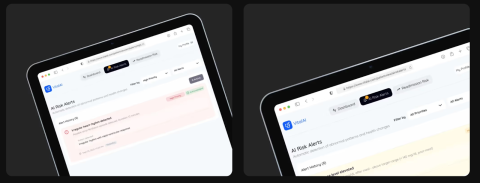
Example of the VitalAI product launched
So, choose a team that has both technical AI expertise and a deep understanding of business processes. In such a way, you’ll reduce risks and accelerate time to value.
There’s definitely no universal way to integrate AI. The right approach depends on your infrastructure, goals, and resources. Let’s view some options that may be suitable for your business.
APIs are considered the fastest and most flexible way to integrate AI. You may add AI services and connect them to your existing systems via APIs. It will allow you to add functionality without changing your core architecture.
Businesses usually use it for chatbots, recommendation engines, or text/image processing.
Using the Middleware Layer approach, you’ll place AI between your systems. As a result, it will act as an intelligent processing layer. The artificial intelligence will receive data, process it, and send results back to your tools.
It’s suitable for workflow automation, data enrichment, and cross-system operations.
Embedding AI features in your product offering is the most expensive and risky approach. However, when done right, it can bring the most value. It basically becomes part of the user experience.
Use this approach for SaaS products, adding customer-facing features, or when you need competitive differentiation.
The majority of our clients make the same mistake. They want to launch AI only when its perfectly built. On the contrary, we recommend that AI integration should be iterative.
It's better to focus on the following aspects, instead of aiming for full automation:
For example, an AI-powered assistant doesn’t need to resolve 100% of queries from the very beginning. On the contrary, addressing at least 30–40% of repetitive requests can significantly reduce the team's workload.
AI has no sense if it does not perform well for your business. That’s why it’s critical to track the performance improvements resulting from the AI launch.
View the following KPIs; they may fit your business:
Tracking results helps ensure your AI initiatives align with business goals.
Make sure that you avoid pitfalls that can slow down your AI adoption.
Running a business in 2026, you cannot ignore AI capabilities. They provide many opportunities and growth points for your business. However, your goal needs to be making AI work smoothly and bring value to your business.
That’s why follow the recommendations that determine your future success with AI: a clear, practical use case, the simplest possible integration approach, and a partner who knows how to connect all of it to your existing systems.