![How to Make a Budget for Print Design [With Template]](https://img.shgstatic.com/clutch-static-prod/image/resize/715x400/s3fs-public/article/d593c4d0f16292c1f26270424626b50f.png)
How to Make a Budget for Print Design [With Template]
Discover how to prepare an effective budget for your print design needs through this piece.
Updated March 26, 2026

AI tools have made “good enough” design nearly effortless. However, companies looking for more than that should hire graphic designers.
AI creative tools produce social graphics and ad variations in seconds, and they’ve become more accessible than ever. However, companies aren’t abandoning graphic designers because of these capabilities. In fact, they’re doubling down.
According to Clutch data, 88% of businesses use AI design tools, but only 18% say AI has reduced their need for designers. Moreover, nearly half of the companies surveyed increased their design budgets in the last year, and more than half plan to increase investments over the next 12 months.
Looking for a Graphic Design agency?
Compare our list of top Graphic Design companies near you
The key takeaway? AI is changing how design work happens, not eliminating the need for designers. Discover why, and explore the core competencies today’s designers need to stay relevant in a shifting market.
The main reason that nearly 90% of companies use graphic designers is that differentiation still matters. AI tools are good at quickly creating simple designs. However, they struggle to build concepts that stand out among a sea of digital creators using similar tools.
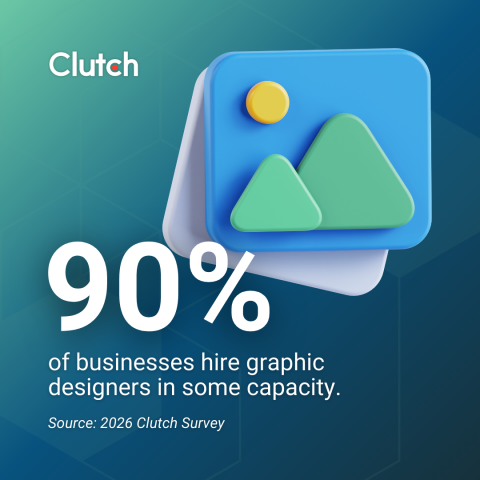
The numbers from Clutch's survey tell a clear story:
Looking ahead, 53% of businesses expect to increase their investment in graphic design over the next 12 months, while only 10% anticipate a decline.
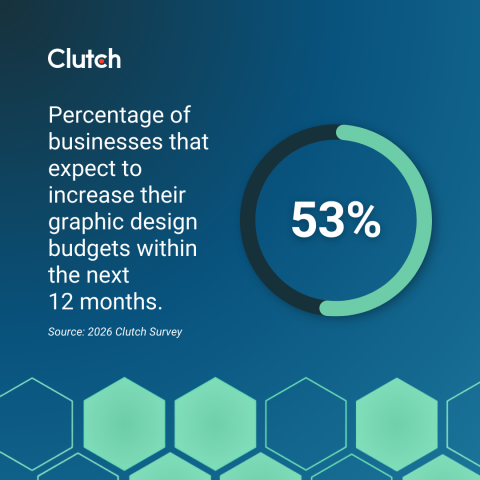
Those that plan on spending more typically do so to stand out during key moments of growth and change, including:
Companies invest in graphic design at these times because it’s when they most need content that distinguishes them. Designs informed by a positioning strategy help to convey what makes the product or service different from what’s on the market today. Humans are much better than AI tools at designing with this context in mind.
Human designers remain important, but AI tools are seeing rapid adoption across industries. They’re primarily a low-cost option for simple design work that doesn’t require much strategic context or brand differentiation.
The data shows that companies are using AI for high-volume, repetitive, execution-focused tasks. In Clutch’s survey, 88% of businesses use AI design tools, with 61% using them regularly or occasionally.
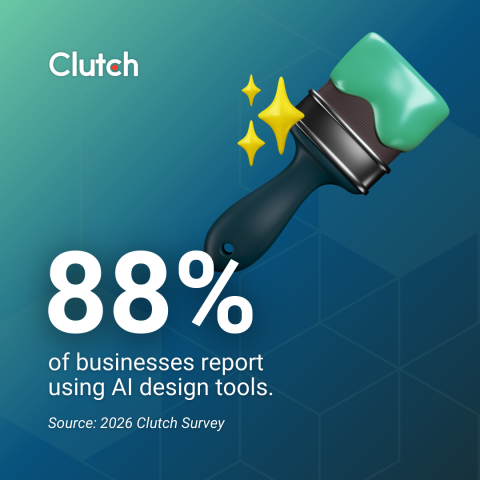
Among those companies, these are the major design use cases for AI:
With this context in mind, AI has a definite impact on design hiring:
These tools definitely have a place. However, they can’t replicate the value of human designers with their years of experience and ability to blend business strategy with design choices.
Clutch found that companies rank creativity as the most important trait when hiring a graphic designer, above strategic thinking, reliability, speed, and even affordability. Why is this skill so vital?
One of the big reasons is that AI can’t replicate it. Automated design tools essentially remix existing ideas, so they struggle to produce assets that feel truly unique. This means any company that relies on them for that purpose is at a disadvantage.
Will Scott, CEO and Co-Founder of Search Influence, explains:
“Decent-looking design is nearly free now with Canva templates, AI-generated social graphics, and automated ad variations. Small businesses can produce passable work without a designer. But brand systems, complex layouts, work that requires understanding the business context? That still needs a person.”
This is the key dividing line in the age of AI design. Automated tools can handle basic execution, but human creativity is an important element for anything beyond the actual production of a graphic. Creativity is essential for capturing a brand’s unique voice and resonating with highly targeted audiences.
For designers, this reflects the importance of building and maintaining the creative skills that AI can’t replicate, including:
The future belongs to designers who can go beyond executing templates to also bring genuine creative thinking to every brief.
There’s a meaningful distinction to be made between design execution and strategy: Execution is simply producing the asset, while strategy means understanding why the design exists, who it’s for, and how it fits into the larger brand story. AI can generate images, but it can't bring the larger context to the graphics it creates.
Proactive designers go beyond producing a deliverable by:
As Scott puts it: "Anything where the designer needs to understand the business, not just the deliverable… AI can generate a social graphic. It can't build a brand system that works across packaging, digital, print, and signage while staying coherent."
That’s why in Clutch's survey, the projects that businesses hire designers for most frequently are more about strategic investments than pure visual production:
All of these elements require a strong understanding of how a design fits into the larger brand ecosystem. For designers, it's a reminder that the real value you bring to a brand is in helping it translate business goals into visuals that best advance those goals.
AI generates individual assets quickly, but speed is not what brands need most. What's more important than a pile of graphics is cohesive visual systems, where every individual asset feels part of a larger whole — the brand’s identity.
That’s why systems thinking is a third critical skill for graphic designers in the AI era. Designers who develop and maintain visual systems help protect brand equity over time by building recognizability. Today’s AI tools just aren’t equipped to do this.
For designers, this means knowing how to create:
The cross-channel piece of this is especially important. Today’s consumers might first find a brand on Instagram before visiting its website a few days later or seeing one of its products in a retail store months down the line. It’s important for the brand to look the same across every touchpoint. Otherwise, the consumer in a store may fail to recognize the brand they’ve come to enjoy on Instagram, which can hurt sales.
The role of the graphic designer is evolving as AI tools become increasingly effective at basic execution tasks. The professionals who thrive in this landscape will be those who understand the true value they have to offer.
The key step is moving away from being an executor of design tasks toward becoming a creative and strategic partner to the brands you support. That could involve changing how you position yourself, communicating with potential clients, and approaching projects day-to-day.
Here’s what that looks like in practice:
AI may have replaced many of the execution tasks that graphic designers once performed, but professional designers are still highly valuable. The key is transforming your business into more of a strategic advisory service, helping companies understand what their creative assets should look like to achieve their positioning goals.
AI is reshaping the production side of graphic design, but that’s not necessarily bad news for designers. It can eliminate many of the repetitive, low-value tasks that previously ate up your time to create new space for the truly valuable work that still requires human judgment.
The data reinforces this. Companies are investing more in designers than ever — they’re just using them for different things. Design is still one of the most powerful tools a company has to differentiate itself in competitive markets.
The designers who lead in this new era will be those who combine strategic thinking with creativity and systems expertise. As a graphic design agency, showcase the special skills you possess that stand out from AI by making a verified profile on Clutch.