Lead Quality vs. Lead Quantity: Why B2B Teams Are Rethinking Their Funnel in 2026
Bigger buying committees and tighter budgets are forcing B2B teams to rethink lead quality vs. quantity. Here's how top teams rebalance the tradeoff in 2026.
Updated May 25, 2026

Empathy in marketing can drive loyalty and increase sales. Here’s how to use it effectively to achieve your goals.
Few things are as valuable to a business as a loyal customer. But earning loyalty is difficult. To do it, you’ll need to build emotional connections with your target audience, a task often easier said than done.
It’s also one worth pursuing. Harvard Business Review says that "emotionally connected" customers are 52% more valuable, on average, than those who are merely "highly satisfied." Connecting with your customers could result in a major increase in profits to fuel your next stage of growth.
Looking for a Digital Marketing agency?
Compare our list of top Digital Marketing companies near you
One underrated (but highly effective) strategy that can help you get there is empathetic marketing. Brands that use it tend to outperform in terms of trust and customer retention, but it’s not always easy to leverage. So, how can you use empathy in marketing to build emotional connections and drive loyalty?
Keep reading to find best practices, tips from experts, and more guidance to get you started.
First, it’s important to define what empathy means within the context of marketing. In general, it refers to understanding and acting on customers’ feelings, perspectives, and needs. But why does that matter? Here are three key reasons:
Another reason to use empathetic marketing is the impact it can have on reach. When your ads feature a message that aligns with your audience’s core values, they’ll be more likely to share it with others.
This type of content also tends to be emotionally charged, which can spark online conversations and put your company at the center of them. This can increase brand awareness and help you form the kinds of emotional bonds that lead to loyalty.
Empathy can be a powerful tool for growing your business, but it can also be hard to get right. Your message must walk a fine line between connecting with your audience and achieving your conversion goals. Embracing the following tips can help you make it happen.
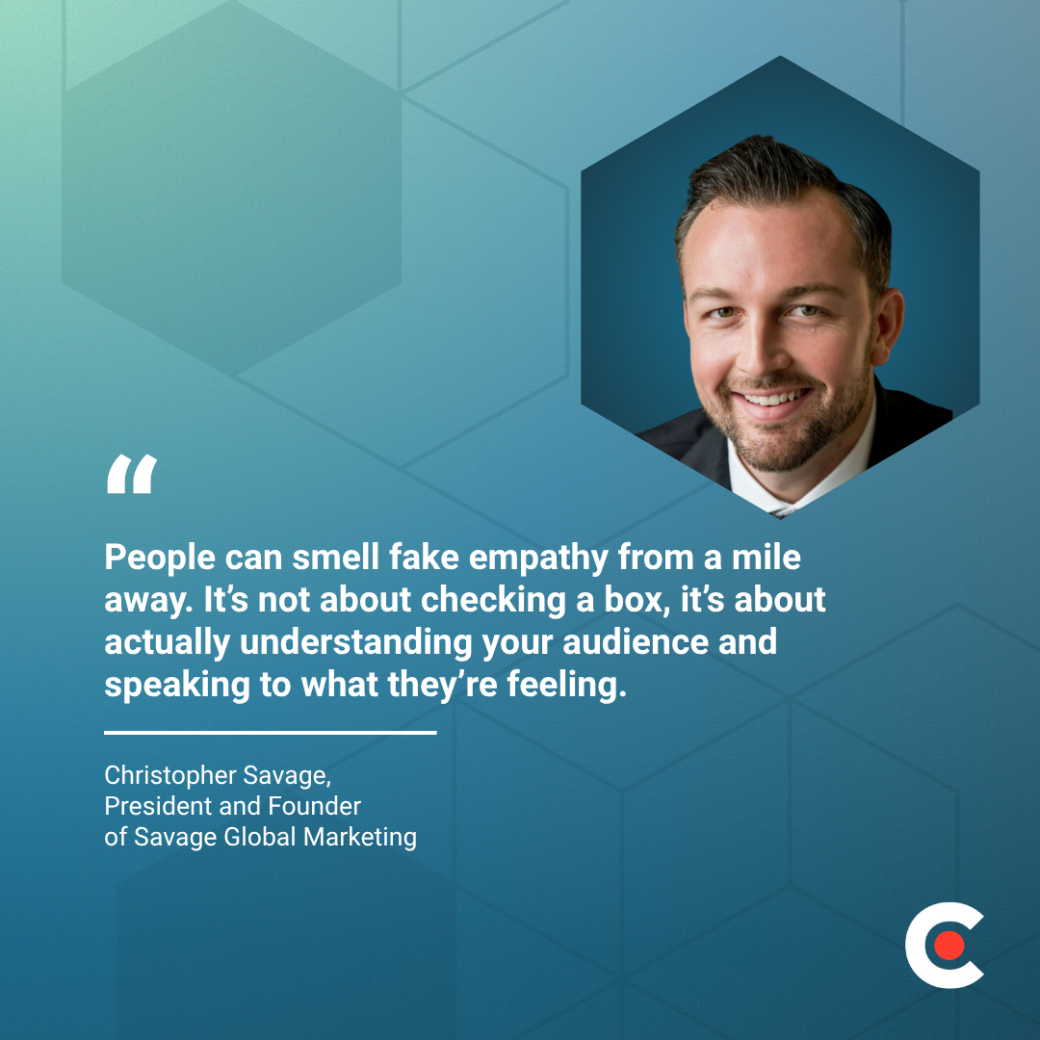
First, your message should be centered around customers’ values. Christopher Savage, president and founder of Savage Global Marketing, explains: “People can smell fake empathy from a mile away. It’s not about checking a box, it’s about actually understanding your audience and speaking to what they’re feeling.”
A key step is to use language that reflects your customers’ experiences and emotions around the issue you’re speaking to. For example, a company that wants to share a message of sustainability would want to use language that mirrors how its target audience talks about the issue.
This idea leverages the similarity-attraction effect from psychology, a widely observed phenomenon where people are more likely to form positive relationships with those who share common traits or characteristics. So, your goal is to position your brand to be on the “same side” of an issue as its target audience.
The next step is to figure out how your audience is speaking about the issue you want to address. This will help you draft a customer-centric message that mirrors their language and encourages emotional connection. You can use several strategies, one of which is social listening.
You can monitor social media to see how customers are speaking about your brand, its industry, and other companies in it. This can help you understand target audience pain points, how they talk about them, and the kinds of solutions they imagine.
Platforms like X, Instagram, Facebook, and LinkedIn can all be beneficial for social monitoring. Try to track the sites that your audience uses most frequently. This will help you keep your pulse on the conversation, so you can evolve your message as needed over time.
You can also use feedback loops to refine your approach. For example, you might come up with an idea based on social listening, develop an ad to target it, and then test a few versions of that ad on a small segment of your audience. You could track KPIs like engagement rates and overall reach to see what messaging performs best and adopt it moving forward.
Once you have a general approach you’d like to use, try to express it in personalized content. For example, if you want to connect with your audience on sustainability, you could tell a story centered on an individual who’s representative of your target audience.
This speaks to the individual customer instead of the demographic. A target audience member might see themselves in the story and relate to your brand through it. That’s why Savage says it’s important to “Use real stories, real voices, and don’t wrap it all in a sales pitch.”
It could also make sense to tell several versions of a similar story to connect with different segments of your audience. For instance, a company focused on sustainability might tell a story about a young person concerned about their future and another story about a senior worrying about their grandchildren.
This approach can help you connect with distinct groups who care about the issue you’re addressing.
It’s also important to represent diverse perspectives honestly when designing your empathetic marketing campaign. People can feel more than one way about an issue, and you want your company to appeal to as many perspectives as possible.
You can create more inclusive marketing materials by:
By prioritizing inclusivity at every stage, you ensure your marketing resonates authentically with a wider, more diverse audience.
Finally, consider building your empathy-focused campaigns around causes that your customers care about. This will encourage social sharing, spark conversation, and help your brand cut through the noise.
The key will be talking about the issue you target authentically. For example, you can’t go on and on about sustainability if your company doesn’t use sustainable business practices. Customers see through that, and it’ll hurt your brand instead of helping it.
Backing your message up with actions is one of the best ways to look more authentic when talking about an important issue. For instance, a company focused on clean practices might pledge to plant a certain number of trees annually as part of a campaign to spread climate change awareness.
You can even tie your mission-driven actions to sales goals. For example, you could donate a percentage of every purchase to a charity that supports a mission your customers care about. This can increase revenue today while helping your business form emotional connections to create tomorrow’s loyal customers.
It can be hard to measure the direct impact of adopting a more empathetic marketing approach. But there are some KPIs worth tracking, including:
Remember, the goal of empathetic marketing is to spark emotional connections that create customer loyalty. So, any metrics you currently use to track loyalty should be helpful in determining whether your message is working. When these KPIs improve, you’ll know that you’re on the right track.
Let’s wrap up by reviewing some common mistakes to avoid when using empathetic marketing. Here are some tips:
It’s also worth considering the fact that consumer values can change over time. They don’t always, but you don’t want your company to be caught on the wrong side of an issue that later evolves. This can create future problems for the brand.
That’s why it’s important to think very carefully before addressing any especially controversial subjects. It may still be worth approaching if the issue really aligns with your brand’s values. But it’s a risk that you should only take if you’re doing so with your eyes wide open to the potential downsides.
Practicing more empathy in your marketing could be exactly what your brand needs to connect with its target audience. The right strategy can create emotional connections that drive loyalty through value alignment. Just make sure to really research your audience’s perspective before starting and focus on inclusive personalization to expand your impact.
Whether your company is just starting out or looking to shake things up, empathetic marketing can be a powerful tool for driving sustained revenue. If you need help developing a strategy, it may be worth partnering with an agency that can refine your message.