
Task Automation: How to Cut Repetitive Work
Task automation saves time, gets work done faster, and reduces errors. Learn how to automate repetitive tasks step-by-step and how to decide what to automate.
Updated June 15, 2026

Most enterprises still run legacy systems, which power the core of the business. However, the reality is that the pressure to adopt AI without creating operational chaos has never been higher. AI Automation is reshaping competition across every industry. Building AI infrastructure for reliable AI output is a great option, but you can also start the digital transformation by adding AI-powered features to your legacy system.
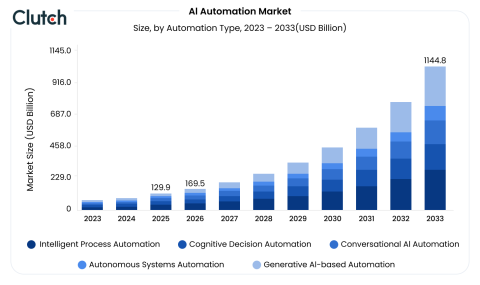
The global AI automation market was valued at around $129.92 billion in 2025. By 2033, it is projected to hit nearly $1.15 trillion. That is a 31.4% CAGR from 2026 onward.
Looking for a Artificial Intelligence agency?
Compare our list of top Artificial Intelligence companies near you
So yes, you need to modernize, and smart B2B leaders see this as an opportunity. This guide gives you practical strategies for adding a ‘reliable’ AI-first approach to your existing business without rebuilding everything. That starts with a readiness audit, then zero in on high-impact areas like customer support or sales. Layer in AI gradually using APIs and no-code platforms. Avoid the usual traps like data silos, skill shortages, and compliance risks. And always track ROI with clear, measurable metrics.
Ready to dive in? In this article, you will learn how to embed AI-powered custom software development intelligently, protect your legacy investments, and push your enterprise ahead.
Do not dive into AI blindly; here, a quick audit shows what is ready now. No big overhauls. Just smart checks.
Look at servers, cloud setup, and apps. Can they connect to AI tools? Most enterprises find gaps here fast. Fix the small issue; upgrade bandwidth or APIs. And you are set.
Dirty data kills AI. Is yours clean? Organized? Labeled?
Score it: 1-10 on accuracy.
Spot issues: Duplicates, missing fields.
Quick win: Clean one dataset for pilots.
List daily workflows. Where is the pain? Support tickets piling up? Inventory guesswork?
This audit takes days, not months. Reveals 80% of wins without even rebuilds.
Hit the spots where AI pays off fast. No need to touch every corner. Target these enterprise objectives, and then quick setups, big returns.
Tickets overwhelm teams, and AI chatbots handle a high percentage of routine queries very easily. Then humans step in only for the tough ones. Response times drop in half. However, the good news is that customer satisfaction scores climb.
Predictive analytics spots delays before they hit. For this, you can expect inventory to stay just right. It means the maintenance cost goes down. Downtime shrinks. Ops runs smoother, costs fall.
Resume screening? Artificial Intelligence sifts through thousands in minutes. Matches skills perfectly, and hiring speed increases. Besides that, the onboarding process gets personalized nudges.
In finance and banking, partnering with an enterprise custom software development agency is a must. For example, AI-powered anomaly detection detects fraud in real time. Budget forecasts tighten up. CFOs see ROI from week one.
No time for AI experiments that disrupt operations? Indeed, you need to fix a budget for the initial stage & then maintenance. This process keeps things smooth. Here is a step-by-step process for starting small and scaling smart.
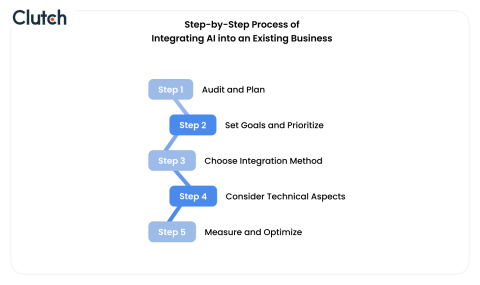
First, look at what you have. Data, systems, teams. A quick audit uncovers easy wins. Talk to department heads. Map pain points. Customer service swamped? Supply chain unpredictable? Here you need to spend a week.
Use simple checklists, score data quality, and test infrastructure bandwidth. In many cases, enterprises skip this and regret it later; this is one of the reasons a percentage of AI projects fail or fail to deliver the intended business value.
After that, you need to set one or two high-impact business areas, such as customer support (for faster response) and sales (for lead scoring). Here are the two crucial aspects that you need to consider:
You can set measurable targets like cutting ticket resolution by 40%, boosting close rates by 20%, or reducing inventory waste by 25%; something like these for clear success tracking.
You test one function and measure it with the current baselines. It proves quick ROI before broader commitment.
You evaluate team bandwidth and budget to realistically match the pilot scale.
This targeted strategy delivers rapid, measurable results. You can proceed to scale with confidence upon pilot validation.
Now, you need to find the integration methods, which means no full rebuilds. Here, go for low-disruption options that fit legacy setups. Here, APIs make it simple: connect AI services directly to your CRM or ERP.
Here are some crucial technical aspects that you should consider:
Link AI services to your CRM or ERP using secure, scalable endpoints from cloud platforms. Quick setup allows chatbots or analytics without core changes.
Tools like workflow automators route data and trigger AI actions. No developers required, just drag-and-drop layers AI onto legacy systems.
Create a safe mirror of production environments. Run full tests risk-free in a sandbox, catch issues before they hit live operations.
Launch in one department first. Monitor performance for two weeks, gather data, then expand confidently across the organization.
Essential compliance standards, such as GDPR and SOC 2, must be embedded from day one. In this way, you can protect data flows and build trust.
Train your organization and gradually roll it out; initially direct 20% of workloads to AI. Use real-time dashboards to track key metrics, such as efficiency gains. You can also conduct weekly feedback huddles to refine models. Besides that, you can run a 5% Shadow Mode launch; this means your AI features run in the background for 1-2 weeks to compare their outputs with human results before any customer or live data is affected.
Enterprises target 20-30% improvements in pilot phases. To match this target, you need to review data biweekly. Identify underperformers, like low-accuracy predictions, and iterate through model retraining/workflow tweaks. Moreover, you can also go one step further by conducting quarterly audits.
Indeed, this targeted focus delivers measurable ROI fast. Now, let's map the practical steps to make it a reality.
Adding AI to your enterprise transformation journey often sounds simple, but most businesses face obstacles. The following challenges are not just warnings; these are recurring realities faced by countless B2B organizations.
Your legacy systems likely store data that has accumulated over decades; messy, fragmented in silos across finance, operations, or other customer-facing departments. Generally, enterprises discover these too late. It means it turns what should be a quick integration into a prolonged data remediation marathon.
Attempting to layer AI onto legacy ERP or CRM systems from the early 2000s is tough because most of those systems are incompatible. Rigid architectures, proprietary protocols, and the absence of modern APIs create a patchwork of workarounds that strain IT bandwidth. Moreover, you can expect risks of operational disruptions during testing phases.
Initial projections rarely account for the creeping expenses of iterative model training, third-party API subscriptions, or consulting needs. It results in CFO scrutiny when promised returns fail to materialize within quarterly cycles.
Your legacy perimeter was built for firewalls, not LLMs. The greatest risk is Shadow AI, where sensitive legacy data is fed into unapproved public models. Such workflows may also mismatch with regulations such as GDPR or other industry-specific mandates. Interestingly, the legacy security perimeters offer no protection against model biases, which could trigger audits or fines.
Enterprises need hard evidence to justify scaling. Focus on these key aspects, tied to real business outcomes:
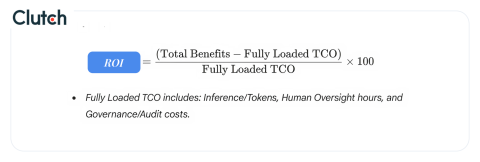
Integrating AI into your existing enterprise does not require a rebuild; you need to partner with a leading AI development company to take strategic steps. Unlock transformative value & minimize disruption. The above step-by-step approach delivers measurable ROI. You can customize the process that matches your legacy system. It is true that enterprise leaders who prioritize governance, data fluidity, and human-in-the-loop oversight position their organizations for sustained advantage. Start with a 60-90 day pilot. Measure and scale confidently.