
Task Automation: How to Cut Repetitive Work
Task automation saves time, gets work done faster, and reduces errors. Learn how to automate repetitive tasks step-by-step and how to decide what to automate.
Updated June 15, 2026

Most enterprise owners know they need AI. They have sat through the presentations, approved the pilot budgets, and nodded through the strategy decks. And yet, nothing meaningful has changed.
That is the real problem in 2026. The Execution Gap.
The global AI market is on track from $390.91 billion today to $3.497 trillion by 2033.
Looking for a Artificial Intelligence agency?
Compare our list of top Artificial Intelligence companies near you
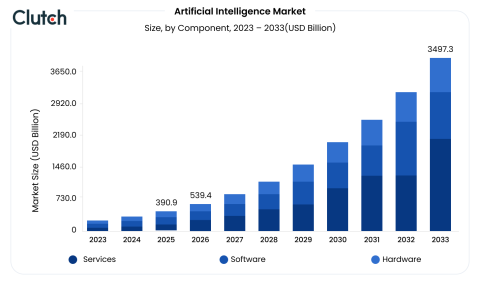
That growth is not going to the organizations stuck in "Pilot Purgatory" or endless committee reviews. It is going to the "Early Scale" leaders who have moved, for example, beyond simple chatbots to Agentic Workflows.
If you are ready to stop planning and start building, this article shows you exactly how traditional industries are winning with AI.
The numbers don't lie. According to McKinsey's State of AI 2025 Survey, 88% of organizations now report regular AI use in at least one business function, up from 78% just a year ago. And yet, only 7% are actually capturing meaningful enterprise value from it. That's the gap. That's the problem.
Traditional industries: manufacturing, healthcare, logistics, finance, and agriculture are sitting on decades of operational data. The uncomfortable truth? Waiting is no longer a neutral decision. It's a losing one.
Most enterprise owners understand AI matters. What they do not always have is a clear picture of why their internal teams struggle to move beyond experimentation.
The Deloitte 2026 State of AI report found that the AI skills gap is the single biggest barrier to integration across organizations globally. And it is not small.
Here's what that expertise gap actually looks like on the ground:
The outcome of all this? Companies invest in AI tools, run a few demos, and then shelve the whole thing because it didn't "work." In most cases, it wasn't the technology that failed. It was the implementation.
That's where specialist AI development companies come in. They don't just build software. They bring the strategy, architecture, training pipelines, and governance frameworks that make reliable AI.
AI is not a universal solution; however, for the following industries, it is quickly becoming a survival strategy.
Manufacturing has the most to gain, and the most urgency. AI-driven value for manufacturing will see the highest annual GVA growth rates of 4.4 percent by 2035. Predictive maintenance, quality control, and demand forecasting are changing plant economics in real time.
No sector is moving faster. Healthcare AI is growing at a 43.9% compound annual growth rate. AI is handling work that used to consume physician hours (Diagnostics, imaging analysis, clinical documentation).
Banks and investment firms crossed the experimentation line years ago.95% of hedge fund managers report using generative AI in their work, up from 86% in 2023, according to AIMA's 2025 research.
Most enterprise owners expect a vendor pitch. A few case studies, a live demo. What a serious AI development company does is quite different, and a lot less glamorous in the early stages.
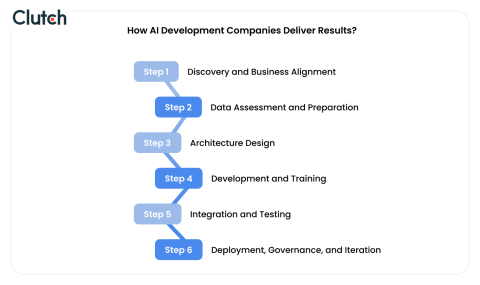
The process is structured. However, it must be structured around your business, not a template.
Nothing gets built yet. This phase is entirely about understanding where your business actually bleeds, and where AI can stop it.
The conversations here are not technical. They are operational. Which decisions are your managers still making on instinct when the data should be making them? A good team asks uncomfortable questions in this phase. That's the point. The ‘output’ is a transformation roadmap tied to real business outcomes.
Here is where most internal AI projects quietly die. Teams assume their data is ready. It rarely is.
The development team goes through what you actually have — where it sits, how it is structured, how consistent it is across systems. Legacy infrastructure is the problem. Data stored in formats untouched since 2009 does not just connect to a modern AI pipeline. This phase surfaces those problems early.
Now the technical decisions start. Hybrid, Edge, or Sovereign Cloud? Which model type fits the use case? How does the AI layer plug into the software your teams already use every day?
Getting the architecture wrong means rebuilding it later; a strong AI development team designs for your environment specifically: your data privacy requirements, your compliance obligations, your existing software stack. Not a general blueprint with your logo on it.
Generic AI solves generic problems. Your business is not generic. Custom models get trained on your data (your terminology, your product categories, your customer patterns, your operational edge cases). The result is a system that understands your business the way a 10-year employee does.
A model that works in a lab means nothing if it falls apart in the real world. This is where the solution gets wired into your actual workflows — messy data flows, legacy systems, and all.
Performance gets benchmarked. Bias gets tested. However, the most important test? Sitting your warehouse supervisors or finance team down and watching them use it. If they do not trust the output, the project is dead. No accuracy score fixes that.
Going live isn't the finish line. It's the starting line for a different kind of work.
Monitoring gets set up. Human oversight protocols are defined — because AI governance isn't just an IT concern; Deloitte's research shows that enterprises where senior leadership actively shapes governance achieve far greater business value than those that leave it to the technical team.
The best AI deployments six months after launch are meaningfully better than they were on day one. That only happens when iteration is built into the process from the start.
When you start planning your AI transformation, the service landscape can feel overwhelming. Lots of vendors. Lots of buzzwords. What matters is understanding which services actually solve the problems your business is facing right now.
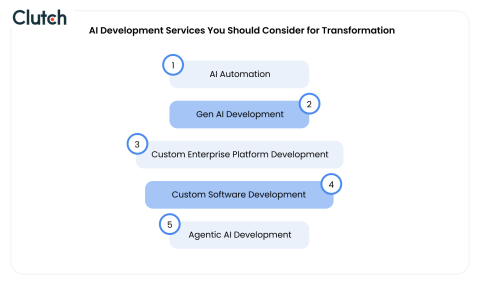
It is usually the right place to start. Process automation powered by AI handles repetitive, rule-based tasks (such as invoice processing, compliance checks, customer query routing, and data entry).
Currently, most enterprises report process automation as their leading AI use case, and organizations are seeing operational efficiency gains within 18 months of implementation.
Custom GenAI applications can draft complex contracts, generate technical documentation, produce code, analyze large volumes of unstructured data, support decision-making at a speed that would take human analysts weeks.
Generative AI is now the technology with the highest adoption rate across organizations, used by an average of 71% of companies across industries, according to research data from early 2026. Companies are getting a 3.7x ROI for every dollar invested in GenAI on average; however, the returns are highest when the applications are purpose-built for specific workflows.
Your operations are specific. Your data relationships (ISO 42001/SOC 2) are specific. Generic ERP or CRM platforms were never built for your specific challenges.
This is a longer engagement, but the competitive advantage it creates is durable. A platform built for your business is one your competitors cannot easily copy.
These systems can plan, make decisions, and execute multi-step tasks without waiting for a human prompt at every turn. Gartner predicts 40% of enterprise apps will feature task-specific AI agents before the end of 2026.
Sometimes the exact tool you need doesn't exist on the market. A custom build, developed specifically for your workflows, your team, and your compliance requirements, gives you software that fits your business rather than software your business has to fit around. Custom software development is especially necessary in regulated industries.
Adoption challenges are real; however, here is what's actually blocking AI progress:
No company has clean data. None. A good AI team builds pipelines designed for messy, inconsistent, real-world data. Start with what you have, not what you wish you had.
When employees do not understand why their role is changing, they push back. The fix is simple: involve them early. Deloitte found education was the top talent strategy adjustment companies made in response to AI in 2025.
Vague mandates produce vague results. Define success in numbers before anything gets built. What does the process cost today? What would a 20% improvement be worth? Answer those first.
Compliance and data governance belong in the architecture phase, not bolted on after deployment. Build it right from the start.
The companies that will lead their industries by 2030 are making decisions right now. Not in two years. Not after the next budget cycle. Right now. The data is consistent: AI adoption is accelerating, and budgets are increasing. The advantage of working with a specialized AI development company is that you do not have to figure out governance from scratch or burn months on a pilot that goes nowhere. You get a partner that has done this before, in your industry, with data like yours. The transformation is a business decision. And the best time to make it is now.