
How to Choose a 3PL: 5 Mistakes E-Commerce Brands Make
Learn how to choose a 3PL that fits your channel mix, avoids hidden costs, and scales with your brand. Real selection criteria, and top providers compared.
Updated April 24, 2026

Creative leadership drives productivity and fosters success in a company. This article breaks down the importance of creativity in the workplace and in leadership styles.
Creativity is one of the most important qualities of a modern business leader.
Creativity itself is the abandonment of rigid structures, a very desirable trait for individuals in leadership positions to have in a corporate setting, which goes outside of typical business models.
Looking for a BPO agency?
Compare our list of top BPO companies near you
This article discusses the business benefits associated with creative leadership and how it can improve an organization. It also suggests strategies for leaders to improve and grow as creative leaders and help foster those leadership qualities and creative thinking in others.
Creative leadership is the ability to inspire innovation and original thinking while guiding a team toward a shared vision.
Unlike traditional leadership styles, which often emphasize hierarchy, control, and established procedures, creative leadership prioritizes collaboration, adaptability, and experimentation. It encourages risk-taking and diverse perspectives.
Creative, innovative leaders can look at things in new ways and solve problems by seeing what others don’t.
Further, they build an environment that allows others to showcase their creativity and get outside of their comfort zone. By fostering a culture of innovation and ambition, teams are better equipped to solve problems with innovative ideas, build a competitive advantage, and remain dedicated to their mission.
Creative leadership, as a concept on its own, can be somewhat vague. But there are plenty of other qualities that define creative leadership.
Managers, business owners, and employees should be able to identify these qualities in themselves and others to foster a culture of collaborative builders with myriad skill sets.
Important leadership qualities for fostering a creative environment include:
All of these are characteristics of successful creative leaders who are changing our world today.
The role of creativity in leadership is vital to any organization's survival in today's ever-changing business and cultural climate.
Creative leadership matters because it enables organizations to adapt, evolve, and thrive in rapidly changing environments. By encouraging experimentation and diverse perspectives, it fuels innovation, strengthens problem-solving, and increases team engagement through a shared sense of purpose and ownership.
Ultimately, creativity gives leaders a competitive advantage by helping their organizations anticipate change and develop original solutions that set them apart.
Through survey-based research, that creativity is deemed the most important leadership quality among leaders themselves.
They found that creativity ranked as the most important leadership quality for business success, ahead of integrity and global thinking.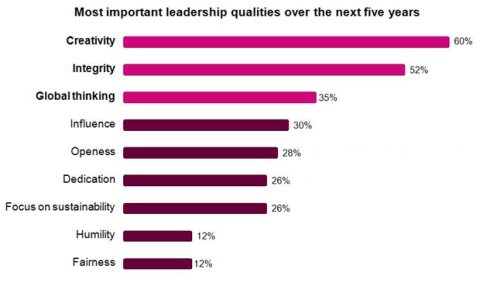
Source: Fast Company
There are many advantages to creative leadership within companies, including
Each of the advantages of creative leadership and its applications to business is listed below.
Creative leadership helps companies by opening up new opportunities for problem-solving and growth that more conventional methods would not allow for.
New perspectives on problems, approached creatively, can lead to solutions that are new and perhaps previously unheard of.
Companies looking to build upon their creative leadership qualities should take the following problem-solving steps:
Searching for opportunities to exhibit each of these solutions within your company can help build up creative leadership qualities internally.
When leaders approach goals creatively, they can achieve them more easily.
A creative leader sees unique paths to reach these goals. Whether it is how to increase profits or expand product offerings, the creative leader can map a path to new levels of success that other leaders within the company can’t see.
By giving teams the opportunity to achieve their goals, businesses create space for creative people to realize their full potential.
As companies grow and processes change over time, lower-level staff can often feel ostracized or forgotten.
Creative leadership offers opportunities to remedy this mindset by implementing non-traditional techniques and ideas that involve people and teams in the company’s success.
A creative leader might suggest that employees brainstorm ideas from their own perspectives rather than taking ideas from the top.
Employees don’t always have the same information as management, so seeing problems or generating ideas from within could lead to new or deeper insights that help form solutions.
New businesses change over time, but change shouldn’t be bad. Give your employees room to adapt while fostering a positive culture in the workplace.
To thrive, a company must grow, adapt, and forge its own path to success. Creative leaders embrace unlikely and unpopular viewpoints. Unlikely perspectives reveal new avenues, which can be used to implement changes that help the company thrive and grow.
Creativity creates many enticing opportunities for both the leader and in the workplace.
As a company expands, leaders spend more time on managing the business and can miss out on chances to be creative leaders and contributors to their team.
Use the following advice in your efforts to become a more creative leader in a busy, thriving workplace:
These 6 creative leadership approaches will ensure that you continue developing important leadership qualities in the workplace.
Continued learning is one of the most effective steps to take toward becoming a creative leader.
Educational resources range from single articles to full-blown courses for individuals in leadership positions that teach strategies for creative leadership in the workplace.
Leaders should also look to experienced individuals when learning about leadership and management to help them reach higher levels. Employees and other individuals in similar positions are fantastic resources for learning to be a better, more creative leader.
Events and seminars are a staple of corporate training and are used by many companies to advance team-building, leadership development, and management training.
The same holds true for creative management training. Finding a seminar and attending it allows an individual a visceral, in-person resource for becoming a more creative leader.
A team can be an extension of its creative leader by providing their ideas and insights into day-to-day decision-making and problem-solving.
Providing autonomy and some decision-making power to a team allows their creative leadership skills to thrive. Further, your employees will appreciate the creative freedom and trust you’re giving them in the process. After all, 96% of engaged employees trust their management team.
By relying on a team, a creative leader has more time and energy to focus on the bigger-picture goals and ideas, which gives them the room to develop new products or prototypes and new approaches.
Giving your team room to grow on their own will benefit both them and you, the creative leader.
Building a reputation as an expert goes a long way toward building trust as a creative leader.
According to the Harvard Business Review’s book Creative Confidence, communicating innovative ideas and documenting and sharing their evolution in search of new insights can communicate your thought processes to others.
You naturally set yourself apart as an innovative thought leader in your field by providing creative leadership expertise.
Just a few recommended strategies for developing thought leadership in your industry include:
Each of these options gives you the chance to share knowledge and inspire others as a creative leader.
Every creative leader needs time to clear their mind, reflect, and be creative. Creative leaders need to focus on big-picture ideas and reflect on what put them there in the first place: their creative vision.
Most employees feel they don’t have much time for creativity amid their busy schedules. Companies like Google are known for creativity, and note that some of their success in this arena comes from empowering their employees and encouraging expression at every opportunity.
Quiet time spent exercising, being outdoors, meditating, and engaging in activities that quiet the mind can wipe the slate clean. In turn, this allows for time and clarity outside the busy day of running a company.
Having fun with your company team and industry peers creates an open, unstructured atmosphere that can spark creativity. Relaxing and enjoying activities with like-minded individuals leads to energized conversations and open-forum brainstorming.
Communicating in an unstructured environment outside the workplace can get your mind off the daily grind and lead to higher productivity among employees and peers. The creative vibe and energy that shines from a creative leader inspires the people around him or her.
Creativity is one of the most important characteristics of an effective leader and fosters a successful and healthy workplace environment.
Creativity opens up opportunities for problem-solving, goal achievement, and inspiring teams to be creative and explore unlikely perspectives.
Employing creative leadership-building strategies, such as continuing education, relying on trusted teammates, developing thought leadership, reflection, taking scheduled time out to develop creative skills, leaning on mentors, and just having fun with peers, are essential in the journey to becoming a successful creative leader in a thriving company.
Companies looking to grow creative leadership on their teams may benefit from working with a top-ranked consulting team to get started.