
How to Choose a 3PL: 5 Mistakes E-Commerce Brands Make
Learn how to choose a 3PL that fits your channel mix, avoids hidden costs, and scales with your brand. Real selection criteria, and top providers compared.
Updated May 28, 2026

Having a relevant, current, and positive online reputation directly impacts sales. But buying positive online reviews is not the strategy that will help you in the long run. Instead, implement these six simple tactics.
Online reviews have become a modern form of word-of-mouth. In fact, 96% of customers regularly check reviews before purchasing a product or service they’ve never bought before. A strong review profile builds trust, strengthens credibility, and influences whether buyers choose you over competitors.
Because reviews carry so much weight, some businesses look for shortcuts — including buying positive online reviews. However, today’s consumers are more skeptical than ever, and review platforms are increasingly effective at detecting suspicious activity. If potential customers suspect your reviews aren’t genuine, trust erodes quickly.
Looking for a BPO agency?
Compare our list of top BPO companies near you
The good news? You don’t need to buy positive online reviews to build a strong reputation.
With the right approach, you can consistently generate meaningful feedback that drives conversions and reinforces brand trust. Below are six proven tactics to help you improve online reviews ethically, and turn satisfied customers into your most powerful marketing asset.
Checking reviews have become an essential first step in the purchasing journey, and every review is critical for building trust, credibility, and reputation. According to a Clutch survey:
When you work effectively to gain positive reviews, your business will grow. Don’t wait for someone to point out a negative review. Work actively and diligently to develop and maintain a positive online reputation – and keep happy customers.
By doing so, you will maximize the impact of positive press, build trust and customer confidence, enhance your public image as a local business, improve customer retention, and attract top talent while increasing sales revenue.
While it may be tempting to take the easy route and hire an agency to post 5-star reviews (likely alongside generic AI-generated copy) for your business, that strategy will likely backfire.
Online shoppers are more skeptical about review legitimacy than ever before, and nearly half (48%) believe they encounter AI-generated or manipulated reviews often when shopping online. In fact, 72% of consumers say that simply suspecting reviews are AI-generated decreases their trust in a product or service.
So, if potential customers suspect your reviews are fake, they will move on to another company’s product or service without a second thought.
Luckily, getting positive online reviews is not difficult. In fact, the strategies are quite simple. Businesses just need to be consistently committed to it. Here are six highly successful strategies:
While this tip may seem obvious, few businesses do it. Most consumers make a dozen or more buying decisions on a typical day. How many of those businesses have asked you for a review?
When you know your customers are happy with your product or service, ask them to submit a review. Make it easy for them. Ask: “How was your experience buying X product or receiving Y service?”
When they reply positively, ask if they’d mind posting that on your website or a review site you use. Most will agree to do it. It’s up to you to help them complete the task.
If appropriate for your type of business, ask them to review your business while you’re speaking with them. If asking then is inappropriate, send them a follow-up email or thank you note and mention their intention to post a review. You might even include a link to the review site.
Statistics show that asking customers through email, in-person, and invoices/receipts are the best strategies to increase review collection.
Request positive reviews for use on your website, business profile, or social media posts only after receiving affirmative comments or feedback.
Asking soon after the buyer is satisfied lets you leverage your goodwill with minimal effort, since the experience is fresh in their minds.
You can gain more good reviews than your competition simply by the way you ask for them. For example, the word “invite” is softer than “ask,” and the word “feedback” is more neutral than “review.” Vocabulary plays an important role in asking for reviews.
Send review requests when it makes the most sense for your business. Perhaps when work is completed or after you have sent client thank-you emails or letters. This will build your review volume and improve your search rankings.
If appropriate for your business, offer a small token of appreciation, such as a voucher, coupon, or discount, for submitting a review. Clearly communicate that you will reward satisfied buyers for the time they invest to provide feedback about their experience by offering incentives.
A word of caution here: Ideally, you want to earn reviews without offering rewards. Websites like Yelp filter out reviews that were provided in exchange for incentives. Google also uses analytics to monitor review traffic. It is also bad practice to offer an incentive only if people leave a positive review. Be sure to check platform guidelines to make sure you’re not breaking any rules.
Educate your employees and team leaders on the importance of providing an excellent customer experience and teach them how to ask for reviews effectively. Be willing to reward your employees for every review that gets posted for your business that mentions them by name.
Let people know whenever you have received a positive review. A few ideas for showcasing positive reviews include:
Position positive client reviews so that your audience learns from satisfied clients across platforms.

Pyatt Broadmark Management shares reviews on its website, which is an effective digital marketing and reputation management strategy.
Highlighting your impressive reviews can convince potential customers that your business has high-quality products or services.
Keep your social media presence active on the platforms where your ideal clients gravitate. These may include the most popular ones, such as Instagram, TikTok, LinkedIn, Facebook, and YouTube.
Include reviews between your other informative posts as social proof that your business can be trusted. You never know when a point made by a happy client will be the trigger for someone else to become a new client. An engaging social media feed will keep you top of mind with customers and amplify positive brand equity.
One negative review can cause a 22% drop in your potential customers' search results.
Follow up with each negative reviewer. If the customer had a bad experience, thank them for their feedback, apologize with sincerity, and then work on a satisfactory solution.
While negative reviews aren’t ideal, they are a great opportunity to listen to customer feedback and learn where your business can improve.
When you’re able to turn that negative review into a positive one, ask permission to post the fact that the issue was resolved. The key is to act immediately to convert the negative review into a positive one.
After receiving a negative review, take the time to respond tactfully. Below is an example of a company responding respectfully to a poor review:
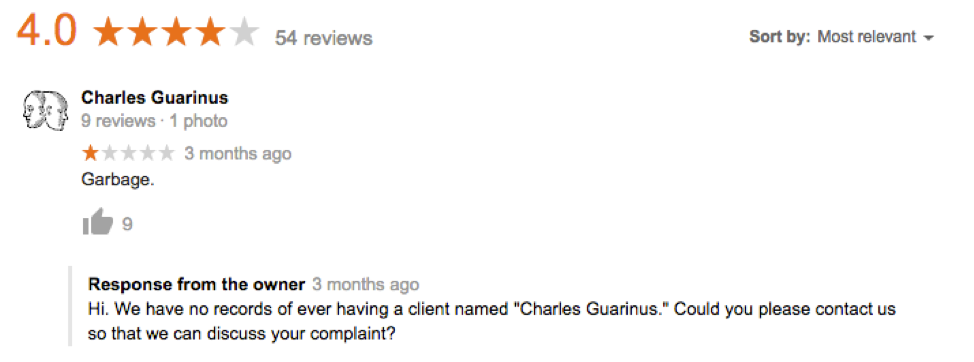
Replying earnestly and professionally to an unfavorable review will show readers that you care. It may also transform a negative digital asset into a positive one.
There are multiple sources of online reviews. These online reviews are key pillars for building a loyal customer base that will support your company’s marketing organically.
While it is rather simple to post favorable client reviews on your own site, it’s not likely that your site will be the first or only place potential clients look for information.
A quick Google search for “how many review websites are there,” revealed an astonishing 2,280,000,000 results! Among the top results are “18 Online Review Statistics Every Marketer Should Know,” “32 Customer Review Sites for Collecting Business & Product Reviews,” and “14 Alternative Business Review Websites.”
Included in these lists are sites such as Clutch, Amazon Customer Reviews, Angie’s List, Choice, Trustpilot, TestFreaks, Which?, ConsumerReports, TripAdvisor, Yelp, and Google My Business – places where customers can leave positive testimonials and bad reviews that could impact businesses of all sizes.
Whatever your type of product, websites like these may play a crucial role in determining the success of your business when it comes to attracting new customers.
Depending on how curious your buyers are and how much time they want to devote to research, they may seek out information about your product and the competition before making a purchase decision. Further, most buyers want to see what your clients have to say about a specific product and the level of service provided.
Given this interest, it is important that you conduct similar research on yourself periodically. Know what your potential clients are seeing and what pre-conceived notions they may have about your product before speaking with them.
No matter your type of business, the reality is that online reviews directly impact bottom lines. To maintain your reputation, it is imperative that you control what potential clients find online about you, your company, and your products.
If you need help curating reviews, hire an experienced BPO company to support your vision. Do everything within your ethical power to increase your positive online presence.
 Sameer Somal is the co-founder & CFO at Blue Ocean Global Technology. A subject matter expert witness and frequent speaker, Sameer helps clients build, monitor and repair their digital presence.
Sameer Somal is the co-founder & CFO at Blue Ocean Global Technology. A subject matter expert witness and frequent speaker, Sameer helps clients build, monitor and repair their digital presence.
See full profile