
How App Companies Can Build Trust with Customers
Learn how app companies can build customer trust through better privacy practices, transparent communication, and stronger security to improve retention and...
Updated January 3, 2025

Constant automatic functionality guarantees uninterrupted availability and quality, which makes chatbot development an intuitive next step for your business.
Did you find this blog using Apple’s Siri? Did Amazon’s Alexa help you get here? If so, take a moment to appreciate the underdog technology that took decades to surface and realize its true potential. Voice assistants have found their worthy place among the deluge of new advancements in the technology space
This trend began when Facebook first started employing about 30,000 chatbots in 2016. Within a single year, that number increased to 100,000. Website- and messenger-specific chatbots have found further ways to assist us.
As currently used, chatbots are still relatively unexplored. The fast-paced nature of AI development will boost chatbot technology to its full potential.
Looking for a Mobile App Development agency?
Compare our list of top Mobile App Development companies near you
Research and Markets offer the following insight and predictions: “The Chatbots Market was worth USD 946.55 million in 2017 and is projected to reach USD 5638.64 million by 2023 registering a CAGR of 34.64% over the period 2018 - 2023.”
According to a survey by Business Insider Intelligence, the United States has surprisingly been the least responsive to chatbots. As a country, it is below the rate of acceptance and uses administered in European countries such as France. Eventually, chatbots will prove to be one of the most important new tools of technological development.
Chatbots have the potential to become a critical part of our personal and professional lives in the near future.
There are two different types of chatbots:
Simple bots have pre-programmed responses that work based on the keywords mentioned. Usually, the sole purpose is automating of basic jobs like booking a flight or placing an order.
Cleverbots, on the other hand, learns from every conversation a user facilitates and offer better-structured responses that become increasingly advanced. Cleverbotslearncontinuously as they interact with people.
Most companies create chatbots with specific requirements and functionalities. The standard enterprise-centric bot includes:
Whatsapp and Facebook have a combined user bandwidth of a billion users. Chatbots are an excellent way for these companies to communicate with the customers on the go. Amazon, Google, and Microsoft are competing to produce the best type of this technology, which likely indicates it will be an important part of most industries fairly soon.
Countless aspirations come from NLP integration in chatbots, which enable them to assist customers better without any additional website or app design. Bots provide the same ease of use as a mobile app and solve problems immediately without the typical hassles.
Chatbots serve as an around-the-clock customer service employee to assure them about any doubts or queries. If a bot can’t find an answer, it will lead consumers to a human counterpart who can.
Computer technology corporation Oracle claimed that by the year 2020, 80% of enterprises will adopt chatbots technology. This raises the important question of whether chatbots should be expected to undergo the most human regime of communication. Much doubt still exists about their ability to communicate freely or fully understand what a user wants to express.
Approximately 83% of shoppers need assistance while shopping. In the movies, we often see depictions of screens installed in malls that let shoppers select clothes and a robot who tells them if they look good in them.
Chatbots use a variety of methods to comprehensively support customers:
Enki, developed by ASOS, answers customers’ questions using advanced features such as style match technology, enhanced personalization, and controlled tasks. The most common types of questions are regarding budget, fitting, and costs.
When “speaking” with Enki, it’s easy to imagine that a salesperson is right there helping you. It recreates the same sensory experience.
Chatbots offer companies unlimited availability. Unlike human employees that might make a consumer wait for assistance on the phone, bots are always available regardless of the time of day or volume of user traffic.
Customers usually return to the company that treats them best. Chatbots are specifically built to always be polite and of the utmost service to the customers. Advanced programming can make chatbots more technologically sound, so they can serve customers with perfect manners. Using chatbots gives firms the upper hand; customers never have to deal with an employee who is having a bad day.
Another function chatbots can handle is social media. These tools assure the regularity and propriety of every post that goes live and monitors responses more closely than a human could, which decreases the demand on employees.
Chatbots can be brilliant guides for users who are trying to navigate an app or website. Based on an assessment of a specific user’s search history, they can suggest purchases they’re likely to enjoy.
For example, eBay’s Shopbot helps users discover deals and find products. It uses text, voice, and photos to make suggestions that further assist the customers.
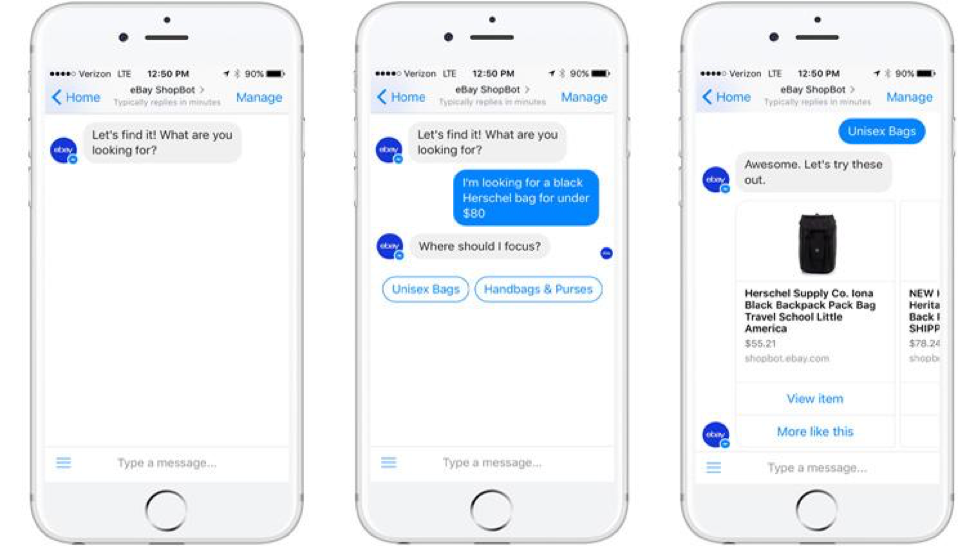
The example above shows a conversation between eBay's shopbot and a customer shopping for a bag. The chatbot responds to the query with several options matching the user's search.
Customers require 24/7 availability to answer their questions. They expect both a personal approach and effective assistance. Chatbots save enterprises the need for a huge amount of personnel, which cuts down on costs and reduces the potential for human error.
The many chatbot integrations available can reduce staff demands by performing the same jobs at the same level of speed and quality, without faltering. Research from Business Insider Intelligence shows that chatbots can cut down about 30% of the costs associated with customer communication.
Considering how many enterprises have contact numbers that are not toll-free, these savings can be enormous. Chatbots are a profitable tool overall because they’re less expensive than building a fully functioning cross-platform app or hiring employees for every task they can perform.
Enterprises can track how chatbots are helping their customers by taking feedback from users. Using this insight, a company can find new ways to provide better service and differentiate their products in the market.
Monitoring user data gives firms a snapshot of how they’re viewed in the consumer's eye. Tailor the information you receive by crafting different types of questions about specific products. In essence, chatbots can help you build a secret feedback bank that you can use to improve your company.
When apps first arrived on the market, they were an incredibly novel concept. Now we’ve grown accustomed to the most common apps, downloading new ones with a different design and UI to get used to every time can feel tiring. You might be noticing that your phone’s available space is running low in this app-driven world.
We all have the basic apps we use every day, but about 65% of people don't download any new apps in an entire month. Most already have the ones they want, and the existence of chatbots fulfills the rest of their needs successfully.
Chatbots simplify processes by showing people how something looks and works through a chat. Many users find it easier to talk to new chatbots than to learn everything they want to know on their own time.
Last year has been a very successful chatbot experience with mega-corporations like Google launching the concept of Duplex, leaving behind Microsoft and Amazon. Now, even small business owners are beginning to leverage AI to increase income and improve.
A firm’s reputation is the most significant factor that makes it popular or trustworthy. Chatbots increase brand recognition and offer the chance to improve at every step based on live information.
The image below shows how Google Duplex is making supported tasks easier for users who interact with Google Assistant. In this example, the user requests an appointment through Google Assistant via their phone or smart home device. Via Google Duplex, a business can receive the inquiry and make the call in the background.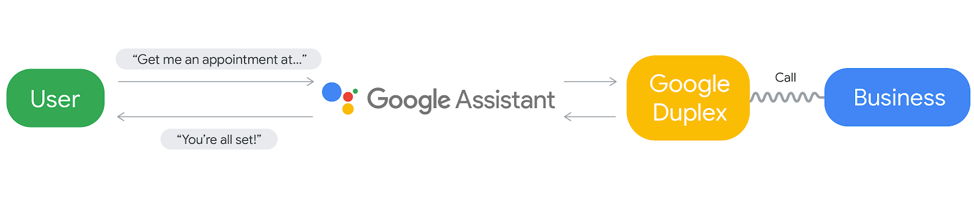
From the user perspective, they simply have to say "Get me an appointment at..." and hear the voice assistant respond "You're all set!" All of the legwork for booking happens behind the scenes.
Chatbots’ ability to personally attend to every consumer helps build specific portraits of user personas. This insight can include details such as:
AI and machine learning are creating a comfort zone for consumers. Attending to their needs personally t helps firms maintain a great reputation and ensure no one feels left out.
Outside of customer service, Chatbots are extremely helpful for recruiting. Aspects they support include:
Chatbots offer a masterful level of variety for companies. By 2020, 85% of customer interactions will occur without any human beings being involved from the company’s side.
Consumer types change rapidly intergenerationally, but chatbots are a safe choice to keep your businesses progressive. Within each new generation, expectations tend to rise. Enterprises need to meet increasingly higher standards, and chatbots are a proven tool to do so.
Yash Patel is a co-founder and CTO of Sunflower Lab. A dynamic entrepreneur well versed with the full spectrum of proven business practices and leading-edge technologies, he likes to spend quality time with his family and have fun with friends and colleagues – When he’s free!
Unique problem-solving capabilities, he has extensive knowledge and sound experience across multiple business domains and project management disciplines such as resource management, strategy and planning, solution design, product design and go to market strategies. Yash Patel is a seasoned solution architect and specializes in cloud, IOT and digital product designing and development.
At Sunflower Lab, apart from leading the solution architect team he focuses on IT strategy and execution, team building and client relationship.
See full profile