7 Tips For Designing Web Forms
Clutch surveyed 502 web users about what they actually want from form design. Here are 7 data-backed UX principles that reduce abandonment and improve...
Updated April 11, 2025

Customer feedback benefits online businesses because it helps effectively manage customer satisfaction. This article describes 3 ways to ask questions and gather valuable customer feedback.
The more information a business collects from its target audience, the better it learns how to appeal to customers.
When you match customer feedback to data you receive in your analytics, you can get a clear picture of reasons why your customers behave in a certain way and answer many other critical questions.
Looking for a Web Design agency?
Compare our list of top Web Design companies near you
However, people don’t want to spend a lot of time completing customer surveys, and often, they ignore most companies’ attempts to collect insights from them.
In this article, I provide 3 proven ways of collecting customer feedback online. They are:
Customer surveys provide the information a company needs to improve.
For example, surveys can help a business determine whether its customer experience is good enough for its target audience or whether customers are willing to pay more for premium features.
A survey is a valuable tool, but you should follow certain rules to increase the chance of a high response rate:
One of the best ways of collecting customer feedback using surveys is to place them on your site. This way, you ensure the person who sees the survey has at least some interest in your business, product, or service and has an experience with your business.
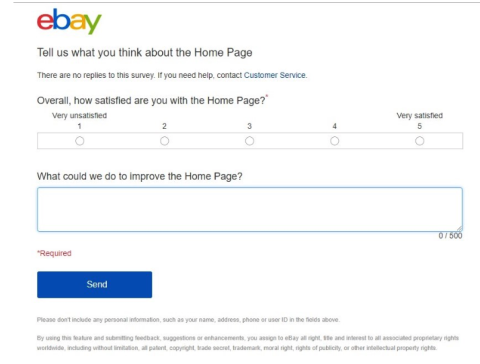
For example, eBay offers a survey with one open-ended and one multiple-choice, closed-ended question.
Advantages:
To sum up, surveys are critical for businesses because they produce results that can be used for the improvement of products, services, customer service, and so on. Your website is the first place to start surveying your customers to get their feedback, but following these best practices is required to get maximum information.
A feedback box is a small box that contains questions related to the customer experience on a website or specific webpage.
Many businesses use these boxes to collect information about customers’ perception of new designs or possible issues the business should know about, such as website bugs and broken links.
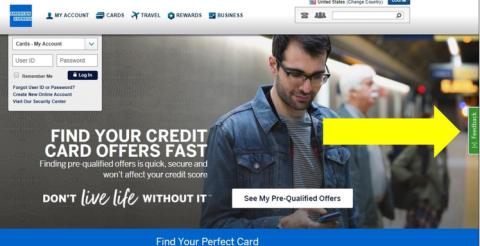
For example, if you visit American Express’s website, you’ll see a little green button on the right side. That’s a feedback box!
Click on the feedback box, and a small window pops up requesting you to answer questions about your experience on the website.
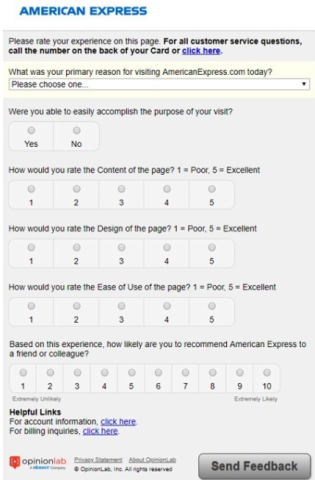
The list of questions may seem a bit intimidating, but all of them are closed-ended questions that require just one or two clicks.
Another example is TNT. Its website uses the same feedback box as American Express, but when you click on it, it gives you three options for feedback:
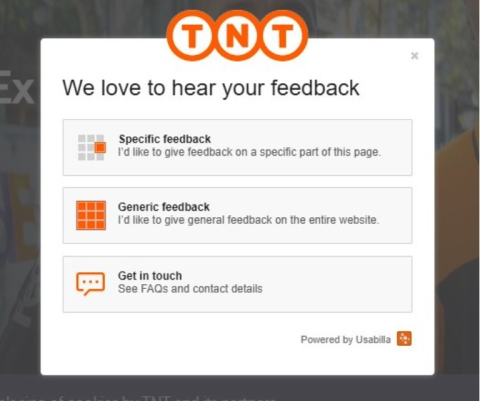
TNT’s feedback box allows customers to give their feedback in multiple ways.
Whatever design you choose, make sure that the box doesn’t interfere with the user experience on the website.
Feedback boxes are another effective way to collect customer feedback without being too pushy. By using them, you can ask both open-ended and closed-ended questions and get rich information on the things that interest you. Just don’t ask too many questions, and remember not to interfere with the user experience.
If your feedback collection effort doesn’t produce appreciable results, you can always ask your customers directly.
For example, you can design a feedback email form, dig into your customer base, locate their emails, and send them the form.
Here are tips for getting the most out of feedback emails:
Here’s an example of an email that follows these tips:
Hi John,
Thank you for registering on our site! We’re currently in the process of adding new features to our product, and we’re reaching out to our customers to know what they think about them. This allows us to understand what’s important to them.
Could you help us, too? The survey takes less than 5 minutes, but it means the world to us!
Give Feedback [CTA button]
Thank you again for your business!
In addition, one version of the feedback email may perform better than the other, so instead of sending one version to everyone in the email list, create two versions and send them to equal shares of customers. That way, you can create the most effective email possible.
Trying to reach your customers directly for feedback is a good way to collect some helpful information. Just like with the tools described above, following proven practices is a must to get maximum results, so pay attention to the design of the email you’re sending as well as its content.
One thing is clear: Customer feedback is critically important for growing your business.
When you’re creating a customer survey to get some feedback, especially for the first time, it’s certainly helpful to know how to do it properly.
Feedback is essential, whether you receive it from surveys, feedback forms, or emails.
Lucy Benton is a marketing specialist and business consultant and helps people to turn their dreams into the profitable business and currently works at A-writer. Now, she is writing for marketing and business resources. Lucy also has her own blog, ProWriting, where you can check her latest publications.
See full profile