
Updated September 21, 2026
Hiring content marketers is on the top agenda for many businesses today in the B2B space. Learn about the benefits and the right questions to ask when hiring.
Content marketing is an excellent strategy for making potential customers aware of your brand. Since most customers often do some research before purchasing a brand’s products or services, they may likely find your content online before making a decision. When content marketing is done correctly, it increases website traffic, brand visibility, leads, and social media engagement.
The problem is that not all content marketers and strategies are equally effective.
As a business owner, you need to know what solutions your potential customers are looking for, which content platforms they are using, what makes content convert, and how to work with algorithms to get content in front of them.
Browse Related Marketing Services
What is Content Marketing?
Content Marketing: an inbound marketing technique that attracts users to your brand through publishing written and visual material online.
Content marketing helps brands build authority, increase sales, and maintain audience relationships by creating engaging content. Some of the materials used in content marketing services include website copy, blog articles, infographics, emails, newsletters, social media posts, podcasts, press releases, and print publications.
Content marketing is valuable to businesses since, when properly implemented, it gives them a competitive advantage. Brands can use content marketing services to stand out from the crowd by creating content using a unique brand voice that resonates with the target audience.
Depending on the size and stage of your business, your content marketing goals will be different. But generally, some of the tasks involved in content marketing include:
- Auditing your existing content
- Finding your audience
- Analyzing your competition
- Auditing research and buyer personas
- Performing keyword research
- Developing a content marketing plan
- Building and managing a content calendar
- Creating compelling and engaging content
- Editing and adhering to a style guide
- Distributing and promoting content
- Repurposing content
- Measuring, analyzing, and reporting content marketing performance
When properly executed, content marketing can snowball, as brands can build a vast audience over time and see higher returns for every published piece of content.
Content Marketing Services by Country
-
 United States
Content Marketing Services
9,941 Providers
-
 Canada
Content Marketing Services
1,157 Providers
-
 Australia
Content Marketing Services
777 Providers
-
 United Kingdom
Content Marketing Services
3,471 Providers
-
 India
India
Content Marketing Services
3,061 Providers
-
 Pakistan
Content Marketing Services
424 Providers
-
 Germany
Content Marketing Services
525 Providers
-
 Philippines
Content Marketing Services
129 Providers
Content Marketing Services by City
-
 New York City
Content Marketing Services
938 Providers
-
 Los Angeles
Content Marketing Services
714 Providers
-
 Houston
Content Marketing Services
245 Providers
-
 Chicago
Content Marketing Services
425 Providers
-
 Ontario
Content Marketing Services
641 Providers
-
 London
Content Marketing Services
1,640 Providers
-
 Sydney
Content Marketing Services
299 Providers
-
 Dubai
Dubai
Content Marketing Services
465 Providers
5 Benefits of Content Marketing
The right content marketing strategy can position your brand as an industry leader that customers turn to when they need products, services, help, or have questions. Some of the ways effective content marketing services can help your brand include:
- Increased brand visibility: When your brand consistently posts informative and engaging content online, such as blog posts, more people are likely to find your content, interact with it, and even share it. Quality content should address the needs, challenges, and interests of your target audience.
- Boosts website traffic: Quality content ranks well on search engines when people search for related keywords. Email marketing and social media marketing can also drive traffic to your website.
- Generates leads: Content marketing can offer educational content to users seeking solutions, lead magnets such as ebooks and webinars to build email lists, and calls to action to prompt certain actions, such as email newsletter signups or demos. It is a powerful tool for nurturing leads and moving them further down the sales funnel.
- Supports sales: Content marketing services can help convince potential customers that your products or services are the right fit for them. Quality content can shorten the sales cycle by showcasing product features and benefits and addressing common pain points. This lets customers make informed decisions without contacting the support or sales team.
- Increases social media engagement: Posting valuable and engaging content online allows users to like, comment, and share it with their networks and followers. This can increase your brand’s social media engagement and help you build an online community around your brand on social media platforms.
What Services Do Content Marketing Agencies Provide?
Content marketing services provide end-to-end solutions for businesses to plan, create, distribute, share, and publish content.
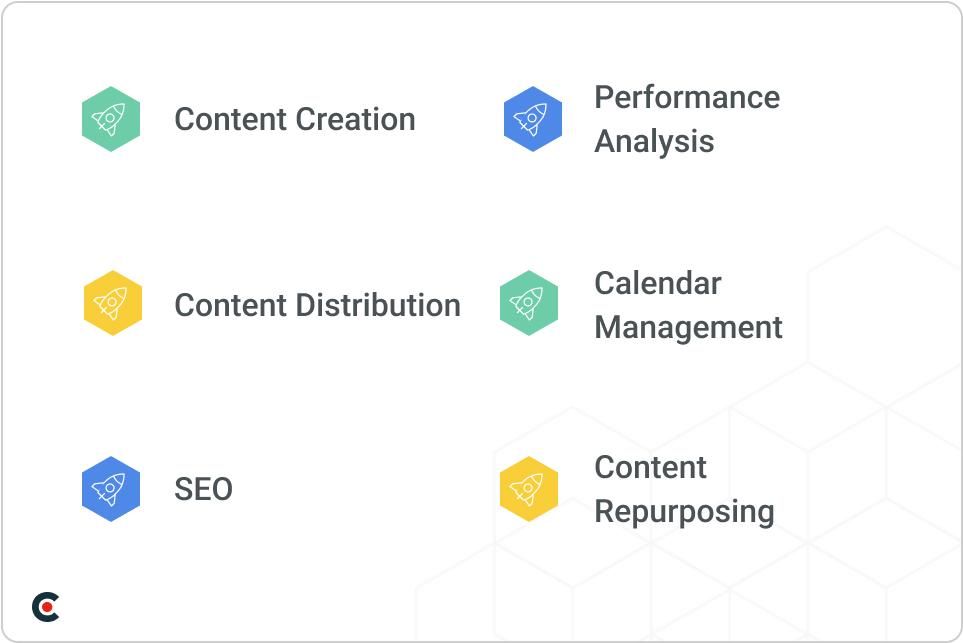
Some of the services a content marketing agency can offer include:
- Content creation
- Content distribution
- SEO
- Content performance analysis
- Content calendar management
- Content repurposing
Content Creation
Content creation comes in many forms, from articles to guides and social media posts tailored to your brand and target audience. This process involves research, writing, editing, and design to produce quality, engaging, and informative content. Quality content creation for your business can increase organic traffic to your website, provide value to your audience, build trust and credibility, generate leads, and establish expertise within your industry. Optimizing content may require the collaboration of SEO professionals.
Content Distribution
Your website could have the best content in the world, but it’s useless if no one reads it. Distribution — an often overlooked aspect — is a critical component of content marketing that can help improve your brand’s reach and engagement. Content distribution strategies may include sending emails, sharing on social media platforms, and guest posting.
SEO
Search engine optimization (SEO) involves optimizing content for search engines to boost website traffic and conversions. Content marketing services can help improve search engine rankings through keyword research, on-page SEO, off-page SEO, and technical SEO. Using relevant keywords in copies and crafting compelling headings and meta descriptions can make content more discoverable by potential customers searching for related topics.
Off-page SEO involves building backlinks to reputable websites for site authority, while technical SEO entails optimizing your website’s technical aspects, such as page speed, site architecture, and mobile friendliness, for a better user experience.
Content Performance Analysis
Once your brand’s content is online, measure and evaluate its effectiveness. Is your audience interacting with published content? Are they performing the desired actions, such as signing up for webinars?
Performance analysis is possible through analytics tools that evaluate traffic growth, engagement rates, and conversions. You can assess your return on investment by comparing performance to prior months’ benchmarks.
Content Calendar Management
Content marketing isn’t a one-time thing. It is a consistent process that involves planning and organizing content creation and distribution through a content calendar over a period of time. This process outlines the type of content to be published, when, and where it will be published.
Content calendar management requires all team members, including writers and SEO specialists, to be on the same page and aware of their responsibilities and deadlines. An effectively executed calendar guarantees a steady flow of brand content, such as blog posts, social media posts, and newsletters, keeping your audience engaged.
Content Repurposing
Repurposing content occurs when a piece is slightly adapted into several additional pieces, typically in different formats. This maximizes the value of existing brand content by reaching different audience segments.
Take, for example, this guide. If you write a blog, you may want to distribute it by sharing it on your business's LinkedIn or X pages and sending it directly to some contacts.
Since you’ve spent time writing the blog, you don’t need to write social media posts for your brand from scratch. You can turn your post into an infographic, a video, or social media snippets, making content repurposing quicker and more efficient.
How to Assess Content Marketing Services
As a business, you want to know if you create influential and effective content for clients and if your audience reads and engages with it. To measure your content marketing efforts, you must first know the metrics you need to track, depending on the channel, the format, and your goals.
Analyzing content marketing metrics can help you evaluate how your existing content is performing online, identify the type of content that resonates with your audience, and gauge whether your strategies contribute to your business goals. This information is useful when optimizing your content marketing strategy.
Here are some of the key metrics to assess content marketing services:
- SEO Metrics: Google’s first page is where your company should be. Better rankings on search engine result pages will drive more people to your website and likely convert them into loyal customers. Two crucial aspects of improving your SEO are domain authority and backlinks. Authority addresses how relevant your site is on a subject and how well your page ranks. Backlinks signal to search engines your site's content trustworthiness, credibility, and relevance.
- Subscriber Growth: A high subscriber growth rate in your newsletter opt-ins and social media accounts indicates that your content effectively reaches and impacts a broader audience. It also indicates the demand for more content from your audience.
- Lead Generation: Content can generate leads. It’s important to measure the number of potential customers generated. However, this only indicates interest and potential sales. Conversion depends on the continuity of good content delivery in the final stages of the sales funnel.
- Website Traffic: Traffic measures your content’s effectiveness in attracting clicks. This metric drives the target audience to your site or social media accounts, and the best way to measure traffic is through growth. Total visitors, traffic sources, changes in organic traffic, user engagement, and session duration are key indicators when measuring website traffic.
- Social Media Engagement: Track your brand’s social media engagements, such as likes, comments, and shares, to see how many people interact with your content. When assessing this metric, find out the platform most effective to reach your audience, the time of day with the most engagements, such as afternoons or evenings, and the type of content driving engagements, such as stories, videos, or infographics.
What Is a Content Marketing Team?
Regarding content marketing hiring, you'll want to fill several unique roles within the team.

A fully fleshed-out content marketing team can immerse themselves in your long-term content marketing strategy. Some of the team players that can help you realize this goal include:
- Project Manager: This team member oversees the entire content creation process, scheduling projects and assigning tasks to different team members. A project manager acts as a go-between between clients and content marketers. They also manage budgets and project deadlines.
- Content Strategist: This team member develops a content marketing strategy that aligns with business goals and the target audience while ensuring content aligns with brand voice.
- Content Writer & Editor: They’re responsible for creating easily digestible content in various formats and then proofreading and editing it. They do research on topics for factual accuracy while ensuring SEO best practices are integrated into content.
- SEO Specialist: They’re responsible for SEO strategies, including keyword research and backlinking. They also fix technical issues related to optimization and analyzes content performance using SEO tools.
- Designers: They assemble images, typography, and other visual elements to make content appealing and memorable while maintaining brand consistency.
- Analytics Specialist: This team member tracks and analyzes content performance to identify areas for improvement and provides insights into what resonates with the target audience.
What to Look For When Hiring a Content Marketing Company
When selecting a content marketing company for your brand, consider aspects such as industry expertise, team size, and track record. Hiring the right team can significantly improve your content marketing efforts and increase traffic, which could translate to conversions. Content marketing services can also position you as an industry leader and the go-to source of valuable information.
Criteria for Hiring a Content Marketing Agency
When evaluating content marketers, consider the following:
- Industry expertise and experience
- Quality of past work
- Budget & pricing
- Services offered
- SEO knowledge
- Analytics & reporting
- Scalability as your business grows
In the content marketing hiring process, it’s good to take a step back and ask yourself what you want for your business. Since you expect a return on your investment, choosing a content marketing enterprise shouldn’t be rushed. With Clutch, you can check out their profiles and ratings, find out their services, and see how much they typically charge to find your best fit.
10 Questions to Ask When Hiring a Content Marketing Agency
Wondering how to hire content marketing services? Here are the key questions to ask:
- What services do you provide, and what do they entail?
- What is the size of your business?
- What’s your experience in content marketing?
- What do you think of our content?
- How do you plan what content to produce?
- How do you measure success? And how often?
- What are your tools of work, processes, and deliverables?
- How soon after the start of the campaign can we expect results?
- What makes you good at content marketing?
- How do you communicate with your clients? And how frequently?
Make Content Marketing Services Fit Your Business Needs
Hiring content marketers can be extremely rewarding, but it’s crucial to hire the right corporation for your business that can develop an effective content marketing strategy. Since content marketing enterprises deeply understand online marketing channels and SEO, they can help you reach your audience more effectively.
When hiring for content marketing services, vet potential candidates thoroughly and discuss your goals. Ask questions and communicate your project constraints to determine whether potential candidates are up to the task. Clutch can help you with this by ensuring that the outfit you choose to work with is the best possible fit for your content marketing needs and business.