Updated October 13, 2025
Transcription services convert audio and video content into accessible text. Partnering with a provider can help you save time and boost content usability.
Digital tools allow businesses to capture and generate audio and video content effortlessly. A sales team might record client consultations, while marketers create promotional videos. Health care providers, lawyers, and other professionals also regularly produce audio and video recordings. But often these organizations need to translate their recordings into written text. Depending on your industry and the purpose of your content, a transcription can improve accessibility, allow readers to review it later, and is often necessary to comply with industry best practices.
Transcription services allow you to outsource this time-consuming task to skilled professionals. These providers create accurate transcripts that capture every detail of conversations and videos.
Transcription services can help you use content more effectively and improve business operations. They also improve accessibility and usability for customers and employees.
This guide covers everything you need to know about transcription services and how to find the ideal provider for your project.
Browse Related Services
What Are Transcription Services?
Transcription Services: These services convert spoken or recorded content into accessible and searchable text. Businesses often hire transcriptionists to document court proceedings, meetings, presentations, videos, and other content.
Organizations frequently capture and preserve conversations and other verbal interactions. These communications take many forms, from casual brainstorming sessions to high-stakes legal depositions. Recording these exchanges allows businesses to document key information and improve transparency.
While some businesses still rely on analog recording devices, most use digital tools to create audio and video recordings of important interactions. Still, the raw content that is captured isn't always in a usable format. Users might need to listen to the entire recording to find one or two specific details. Written content makes it easy to reference again, allowing people to quickly review it and makes it more accessible.
While some tools like Zoom use generative AI to automatically generate written transcriptions of video recordings, this text is often riddled with errors. These inefficiencies waste time and can cause dangerous miscommunication, such as misheard instructions or medication names.
Transcription services prevent these issues by converting live speech or recordings into written documents. These providers perform many tasks, including:
- Manually convert audio recordings into text files
- Transcribe live speech into text
- Insert timestamps
- Verify the speakers’ identities and label their speech
- Understand highly specialized jargon
- Translate text from one language to another
- Create metadata to improve searchability
- Format transcriptions according to client specifications
- Proofread text and review it for accuracy
Transcription services allow businesses to get the most out of their content. Organizations can transcribe lengthy audio recordings and videos into written documents that are easy to analyze, share, and repurpose. Additionally, businesses can use transcription services to improve communication and increase customer satisfaction.
Transcription Services by Country
-
 United States
Transcription Services
515 Providers
-
 Canada
Transcription Services
75 Providers
-
 Australia
Transcription Services
25 Providers
-
 United Kingdom
Transcription Services
164 Providers
-
 India
India
Transcription Services
113 Providers
-
 Pakistan
Transcription Services
7 Providers
-
 Germany
Transcription Services
21 Providers
-
 Philippines
Transcription Services
27 Providers
Transcription Services by City
-
 New York City
Transcription Services
56 Providers
-
 Los Angeles
Transcription Services
37 Providers
-
 Houston
Transcription Services
13 Providers
-
 Chicago
Transcription Services
18 Providers
-
 Ontario
Transcription Services
39 Providers
-
 London
Transcription Services
87 Providers
-
 Sydney
Transcription Services
11 Providers
-
 Dubai
Dubai
Transcription Services
37 Providers
5 Benefits of Transcription Services
People often assume that only lawyers and medical professionals need transcription services, but that’s not true. Businesses in all industries can benefit from precise and efficient transcription of meetings, webinars, training sessions, and other content.
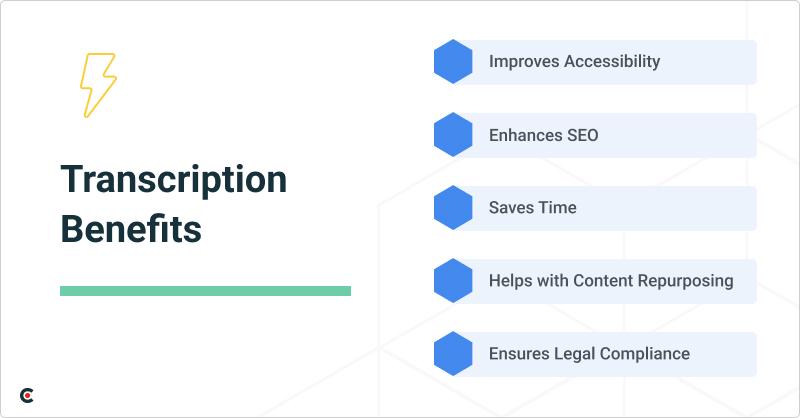
Here are five reasons why organizations invest in transcription services:
- Improves Accessibility: Organizations can promote accessibility and inclusivity by providing content in multiple formats. For instance, people with hearing impairments can read closed captions instead of struggling to decipher a video. Transcriptions can also improve comprehension for non-native speakers and people in noisy environments.
- Enhances SEO: Search engine algorithms use written content to index and rank web pages effectively. Transcribing documents allows businesses to create searchable content with relevant keywords, which can improve visibility in search engine rankings. By contrast, search engines can’t fully interpret an audio file or video, reducing its discoverability.
- Saves Time: Transcription can be incredibly time-consuming, especially for content with multiple speakers or complex terminology. Non-experts may spend hours replaying and slowing down content to accurately capture every word and fix mistakes. Outsourcing these services to trained professionals can save substantial time and allow you to receive polished transcriptions much faster.
- Helps with Content Repurposing: Transcription makes it easier to repurpose content and reach new audiences. For example, you could transform an extensive webinar into a series of written blogs and infographics. These easily digestible formats can engage customers who don’t want to spend hours listening to a recording, expanding your reach.
- Ensures Legal Compliance: Transcription services can help businesses adhere to legal requirements. For instance, doctors must maintain accurate electronic health records to comply with the Health Insurance Portability and Accountability Act (HIPAA). Additionally, organizations can use transcriptions in employment disputes, depositions, and other legal proceedings.
What Services Do Transcription Firms Provide?
Transcription providers can tailor their services to meet a client’s business goals and needs. Do you want to create closed captions for 30 training videos? Need top-secret market research transcribed confidentially? No matter your project, there’s a transcription provider with the skills and equipment to deliver results.
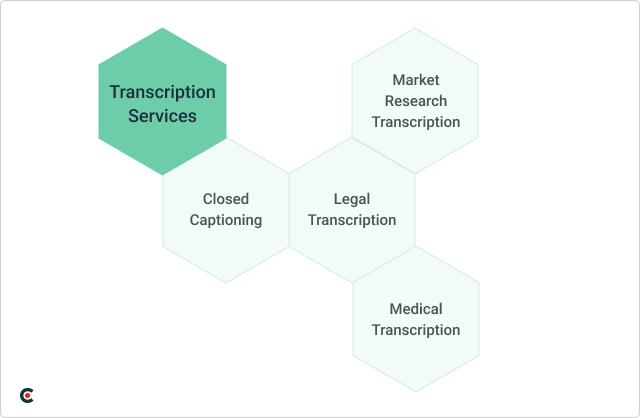
Here are some of the services you can expect from transcription providers:
- Closed Captioning Services
- Legal Transcription
- Market Research Transcription
- Medical Transcription
Closed Captioning Services
Closed captions refer to text that represents audio content in a media file. These transcriptions often appear at the bottom of videos and update dynamically, giving viewers a play-by-play translation. Closed captions can show spoken dialogue, music, sound effects, and other types of audio.
People often use closed captions and subtitles interchangeably, but they’re not the same. Closed captions are designed for people with hearing, speech, and vision disabilities. They often include extra context beyond the dialogue to help viewers fully understand the content. By contrast, subtitles translate spoken content into different languages.
Closed captioning involves several steps, including:
- Creating a written transcript of recorded or live content, including dialogue and audio clues
- Synchronizing the text with the audio
- Adding speaker labels for clarity
- Reviewing closed captions for accuracy
- Embedding captions into video files
The Americans with Disabilities Act requires businesses and nonprofit organizations to use auxiliary aids and services to share information with people with communication disabilities. Investing in closed captioning services will help you comply with this legal requirement and improve accessibility.
Closed captions also boost engagement by enabling customers to consume content in different environments. For instance, a client may use closed captions to watch social media posts on a plane or in a noisy restaurant. These transcriptions allow the viewer to follow along without relying on audio.
Legal Transcription
Many transcription providers specialize in converting legal audio and video recordings into written documents. They transcribe content from court hearings, witness interviews, arbitration sessions, and other legal proceedings.
Legal transcriptionists have in-depth knowledge of legal procedures, jargon, and industry standards. They use this expertise to accurately transcribe complex legal content and format it into professional documents.
Additionally, legal transcriptionists maintain strict confidentiality and only capture on-the-record content. They also use cybersecurity measures to protect data, giving legal professionals peace of mind.
Legal transcription allows organizations to outsource time-consuming and tedious administrative tasks. That way, lawyers, paralegals, and other professionals can focus on case preparation, research, and other essential duties. Hiring experienced legal transcriptionists also improves accuracy and reduces the risk of costly mistakes, such as incorrect quotes from witnesses or omitted evidence.
Market Research Transcription
Many businesses conduct focus groups and interview customers to gain market insights. Marketers typically record these sessions for later analysis. In some cases, organizations may end up with dozens or hundreds of hours of recorded audio or video content.
Market research transcription involves converting this content into searchable written documents. Transcriptionists also include relevant data, such as customer demographics and behavioral insights. Marketers can use data analytics tools to detect trends and extract insights from this text.
This transcription service enables organizations to conduct more comprehensive and sophisticated market research. The insights they gain can deepen their understanding of consumer behavior and market trends, improving decision-making. Transcription services also accelerate data analysis and reporting, giving businesses a competitive edge.
Medical Transcription
Healthcare professionals often dictate their medical notes and treatment plans to save time. They may also record patient consultations, surgeries, and other interactions. Transcription services convert these medical recordings into electronic health records and other written documents.
Medical transcriptionists understand medical terminology, abbreviations, and clinical procedures. Some providers specialize in one or two disciplines, while others have broad expertise across medical fields. They also understand conventions for different medical documents, such as discharge summaries and patient charts.
Healthcare organizations rely on medical transcriptionists to produce accurate and comprehensive records. This documentation helps healthcare providers deliver effective patient care and comply with legal requirements. Transcription services also protect patient safety by reducing the risk of medical errors caused by improper documentation.
How To Assess Transcription Services
As a business leader, you expect your outsourced partners to deliver results. Monitoring key performance indicators (KPIs) will enable you to measure the success of transcription services. These metrics can also help you identify areas of improvement and adjust your project as needed.
Here are a few metrics to consider when hiring a transcription services provider:
- Volume of Transcriptions: The number of transcriptions that a provider produces in a given period. A high volume can indicate efficiency and scalability.
- Accuracy Rate: The percentage of correctly transcribed information out of the total content. For instance, a transcriptionist with a 90% accuracy rating makes an average of 10 errors per 100 words. Experienced transcriptionists typically have an accuracy rate of 95% or above.
- Turnaround Time: How long it takes a provider to produce a completed transcript after receiving content. Simple transcriptions may take two or three days, while more complex content may have a longer turnaround time.
- Error Correction Rate: The percentage of errors the transcriptionist identifies and corrects. A provider may have a high error correction rate if they’re working with complex or unfamiliar source material.
- Cost Per Minute: The amount charged for each minute of transcribed content. Many factors influence cost per minute, including the transcriber’s experience level and the turnaround time.
Who Makes Up a Transcription Services Team?
Transcription services teams often have several specialists with different roles and skills. These experts work together to meet their clients’ needs and produce high-quality, timely transcripts.
Here are some of the most common roles:
- Transcriptionists: These experts handle the nitty-gritty processes of converting audio and video recordings. They can identify different speakers, understand accents, and capture specialized terminology.
- QA Specialists: They assess the accuracy and quality of transcriptions before sending them to clients. They check documents for errors, formatting mistakes, and inconsistencies.
- Project Manager: This professional coordinates transcription projects and keeps them on schedule. They also facilitate communication between clients and the rest of the transcription team.
- Subject Matter Experts: These specialists have in-depth knowledge of law, medicine, and other disciplines. They verify the accuracy of industry-specific content and terminology.
- Training & Development Specialists: They train new transcriptionists and support their team’s ongoing development. Their duties include learning new transcription technologies and conducting workshops.
- IT Support Staff: These experts maintain transcription software and troubleshoot technical issues.
What To Look for When Hiring a Transcription Firm
Are you ready to outsource your transcription projects? Learning how to hire transcription services will help you find the right partner.
Start by identifying your goals and look for providers with relevant services. Say, for instance, you want to transcribe client consultations and meeting notes. Choose a provider with relevant experience in your industry.
Scalability is another factor to consider during the transcription hiring process. As your business grows, your transcription needs may increase rapidly. Look for a partner who can accommodate large volumes without sacrificing volume or turnaround time.
Criteria for Hiring a Transcription Firm
- Accuracy
- Available services
- Certifications
- Cybersecurity measures
- Industry experience
- Pricing
- Turnaround time
Clutch’s extensive directory features over 1,000 transcription services. Use our filters to find providers who meet your project requirements. You can also read detailed customer testimonials to assess each potential partner’s quality and performance.
10 Questions To Ask When Hiring a Transcription Firm
- Can you share examples of successful projects you’ve completed?
- What file types do you support?
- Does your transcription team have certifications?
- What methods do you use to catch errors and guarantee accuracy?
- How does your team handle challenging scenarios like unclear audio and specialized terminology?
- Do you offer additional services, such as timestamps and speaker identification?
- What is your revision policy?
- How do you protect sensitive client data?
- Do you use automation or artificial intelligence to transcribe content?
- How do you keep up with industry best practices and new technologies?
Plan a practical budget for your transcription project
Download Clutch's Transcription Services Budget TemplateTransform Your Content With Transcription Services
Modern businesses generate vast amounts of spoken content. Your organization might record internal meetings, marketing videos, workshops, and countless other materials.
Transcription services can help you efficiently adapt this content into written documents. These services improve accessibility and allow you to engage new audiences, expanding your reach and promoting long-term growth.
Explore Clutch’s directory to discover the right transcription partner for your team. Our handy filters let you narrow your options in seconds so you spend less time researching and more time unlocking your content’s potential.