
How to Measure SEO Success When Traffic Declines
Organic traffic is down, but is your SEO failing? Learn which metrics show real SEO success when AI Overviews and zero-click searches are reducing clicks.
Updated March 27, 2026

People are using voice search more often, which has important ramifications for your SEO strategy. Learn how to update your website to stay competitive as search trends change.
Experts say more than one in four people online today use voice search—a growing trend that may still be in its early innings. Voice assistant sales are on the rise, and over half of Gen Z use them monthly.
Stats like these show how the way people search online is evolving. Your company’s search engine optimization strategies should evolve, too. Voice search marketing focuses on optimizing SEO content to appear in voice-activated searches.
Looking for a SEO agency?
Compare our list of top SEO companies near you
Robyn Lee, Head of Client Success at Signa Marketing, explains, “Businesses need to adapt by making their content more natural, mobile-friendly, and structured for quick delivery, especially in local and on-the-go searches.”
Embracing this growing trend can help your company generate more traffic, increase conversions, and boost brand awareness. This guide to voice search optimization will get you started with a review of best practices, expert tips, and more strategies for success.
The way that a person makes a search request impacts how results are processed.. This is the core idea behind voice search marketing.
The goal is to target the unique keywords and search intents of voice users to appear in more of their results. But to get there, you'll first need to understand how voice and text searches differ.
One major difference between voice and text search is the keywords users input to find information. Typed keywords are typically shortened fragments of longer questions, while voice keywords tend to be longer. This reflects how people generally use more natural language when they talk than when they type.
For example, someone might type "best pizza Portland" but say "What are the best pizza places in Portland?" when making the same search request by voice.
This makes long-tail keywords more important when optimizing for voice search. You may want to design more of your website’s SEO content around these to increase traffic from voice search sources.
In the past, SEO sometimes called for stuffing odd-sounding keywords into an article to help it rank higher. That’s the opposite of what you should do with content designed to capture voice searches. Keywords with natural language phrasing will better match user searches, because that’s how people talk.
Read this: ‘Robyn Hartley on Preserving the Authentic Human Voice in an AI-Driven Marketing World’
Also, consider search intent differences as you develop your voice search strategy. In other words, the reason why a person makes a search request may vary based on whether they type it into Google or speak it.
Someone speaking a request is more likely to be on the go, looking for local solutions, and ready to make a purchase immediately. This increases the importance of creating localized landing pages and addressing geographic-specific long-tail keywords in your content.
It also means you should focus on giving ready, brief answers to your customers' queries. The goal should be providing immediate solutions to someone who wants to make a purchase now, rather than trying to push a lead deeper into your funnel for a purchase at a later date.
David Ebner, president of the Content Workshop, hammers the point home: “Simplifying the message and content is not a new idea… However, many brands have yet to adopt the conciseness needed to compete in the voice search world. This is a huge misstep for most B2B brands.”

You may need to update your content strategy as part of a push for conciseness. For example, instead of writing lengthy blogs, brief, FAQ-style posts may be more aligned with the needs of your voice search audience.
Now that you know how voice and text searches differ, let’s explore best practices for targeting voice results. These five tips can help you generate more traffic.
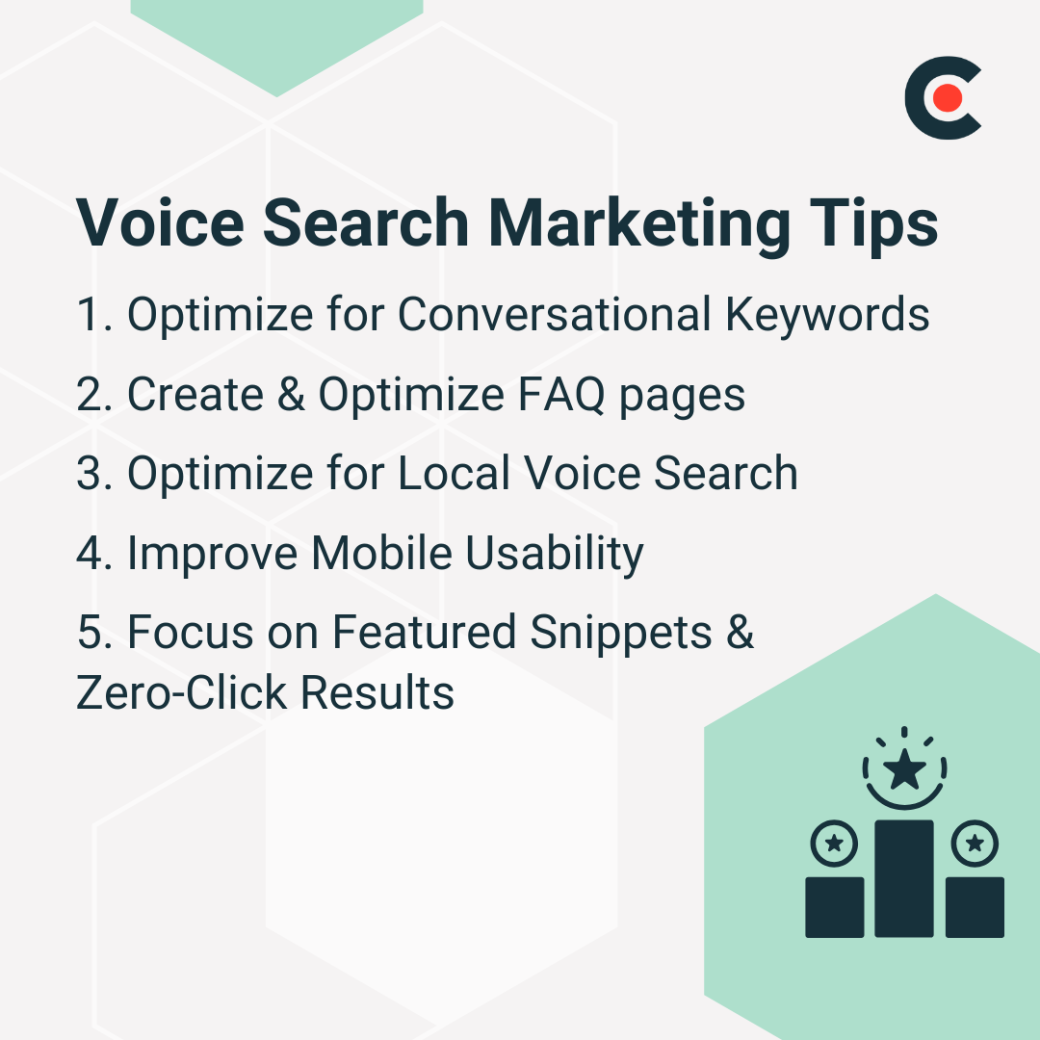
First, focus on adding conversational keywords to your SEO content. Khalil Kanbar, founder and CEO of Kanbar Digital LLC, says, “Web visitors are approaching searches with a more conversational tone, and companies need to adapt by using natural language and long-tail keywords.” But how do you do that in practice?
One strategy is leveraging keyword research tools like AnswerThePublic or Google’s People Also Ask. These can help you see which conversational keywords get the most traffic for your topic cluster, so you can target them.
You can also review internal data to see which questions people ask your support team most often and how they phrase them in natural language. Chat logs, customer service messages, and voice recordings of calls can all be helpful for this.
Whichever keywords you target, try to share content with a natural tone. This aligns with a voice-search user’s preference for on-the-go, direct answers over formal business writing. Straightforward replies to what customers are looking for will help to keep your bounce rates low, which can further improve SEO results.
Voice search results often come from frequently asked questions pages, as they provide concise answers to common voice search queries. Adding FAQs to your site can help you capture more traffic. Or, if you already have an FAQ page, it may be time to optimize it for voice search.
Focus on answering your customers’ most common questions on a single page, as directly as possible. Keeping your answers under 50 words increases their odds of being featured in voice results. You can also add an FAQ schema markup to the page to help search engines find and feature the content.
As always, using natural language is important. Chad de Lisle, VP of Marketing at Disruptive Advertising, explains: “Brands that optimize for how people talk (not just how they type) are better positioned to capture attention in a voice-first world.” You can get there by focusing on keywords that mirror how people would ask about a topic in real life. For example, a shoe brand might target, "Where can I find comfortable shoes in Chicago?" instead of just "comfortable shoes Chicago."

Another important strategy for capturing voice search traffic is appealing to a more localized audience:
Creating localized landing pages:
Optimizing for local voice search in this way increases your company’s odds of appearing in map results, featured snippets, and voice answers. For the best results, create localized pages for different cities, neighborhoods, or regions, based on your location.
For example, a clothing shop in NYC may want local pages for Manhattan, SoHo, Chelsea, and Williamsburg. But a farm supply company in Des Moines, Iowa, may need to cover a broader geography with its local pages. In general, the smaller your local community, the more territory you may need to target to reach your desired amount of voice traffic.
Next, focus on improving your site’s mobile usability. Rachel Cunningham, content marketing director at Bop Design, explains why this is important: “As voice search is primarily used on mobile devices, it’s critical for brands to prioritize the mobile functionality of their website.”
In other words, most voice searches come from smartphones, so the pages you share need to be easily accessible on these devices. Otherwise, users may find your content but leave your site before taking the desired action. This increases your bounce rate, which hurts SEO performance.
You can get your site to where it needs to be by:
Mobile users are more likely to be on the go, looking for immediate solutions than traditional laptop and PC users. This makes them a valuable group worth targeting when optimizing for voice search.
Finally, your SEO efforts should focus more on snippets and zero-click results when optimizing for voice search. The two main reasons for this:
For example, Google’s answer blocks are often direct answers to questions, from reputable sources, featuring simple steps and clear language. Many also include lists and tables, which help users understand complicated details more intuitively. Adding these to your content can improve your odds of being featured. Keep your readability at around an 8th-grade level for the best results, as platforms tend to favor clear, direct answers over highly detailed ones.
Additional Reading: ‘Solving for Zero Click Searches: Your Zero Click Marketing Strategy’
Voice search will likely become increasingly common as voice assistants and AI tools improve. That has implications for your SEO strategy. To compete in this new environment, try to optimize for more conversational keywords, create more localized landing pages, and design content to achieve new goals, such as appearing in featured snippets.
You can start the process today by auditing your current site’s voice readiness. This will help you understand where you should focus your optimization efforts first.